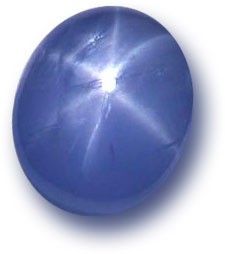
Asterism (in mineralogy) is the optical effect in the crystals of certain minerals processed to form a spherical or other convex curved surface ( cabochons ), which manifests itself in the observation of a star-shaped figure when illuminating a crystal.
Asterism is manifested in corundums , spinels , some quartz , beryl , diopside (six-pointed star), garnets ( almandine , demantoid ), some micas . The main reason that causes asterism is the presence of needle-like inclusions in the crystal, oriented parallel to the main crystallographic axes. The thickness of such inclusions is close to the wavelength of visible light, and they form several systems, in each of which the inclusions are oriented in parallel, and the angles between the inclusions of different systems correspond to the angles between the crystallographic axes .
As a result of light diffraction on the gratings of such microinclusions, when a crystal is illuminated, a group of luminous bands intersecting at one point — a “star”; the number of rays of a star depends on the symmetry of the crystal. For crystals of cubic syngony ( spinel ), two mutually perpendicular inclusion systems form two bands, i.e. a four-ray star, for crystals of hexagonal syngony (beryl) or trigonal pseudo-hexagonal ( corundum ), three inclusion systems form three bands, i.e. six-ray star.
In corundums (ruby, sapphire), needle microcrystals of rutile most often act as such microinclusions (in rubies these are usually systems of thin hollow tubules) forming three systems, in each of which microcrystals are not only parallel, but also oriented parallel to the basal plane . In some cases, twelve-ray asterism also occurs in corundums: in this case, there are two supersystems of microinclusions in the corundum crystal: inside each of them microinclusions form three normal systems, as in corundums with six-beam asterism, and these supersystems are rotated at an angle of 30 ° relative to each other, all inclusions of both supersystems are parallel to the same basal plane. As a result, these two supersystems form two six-pointed stars with a common center.
In 1949, the first stellate corundums were synthesized from a mixture with the addition of titanium dioxide , followed by heat treatment, which caused recrystallization of rutile in the crystal.
See also
- Irisation
Literature
- G. Smith. Gems. - M .: Mir, 1980 .-- S. 76.