The principle of possible displacements is one of the variational principles in theoretical mechanics , establishing the general condition for the equilibrium of a mechanical system . According to this principle, for the equilibrium of a mechanical system with perfect connections, it is necessary and sufficient that the sum of virtual work only the active forces at any possible movement of the system was equal to zero (if the system was brought into this position with zero speeds).

The number of linearly independent equilibrium equations that can be compiled for a mechanical system based on the principle of possible displacements is equal to the number of degrees of freedom of this mechanical system.
Possible displacements of a non-free mechanical system are called imaginary infinitesimal displacements currently allowed by constraints imposed on the system (in this case, the time included explicitly in the equations of non-stationary constraints is considered fixed). The projections of possible movements on the Cartesian coordinate axes are called variations of the Cartesian coordinates.
Virtual displacements are called the infinitesimal displacements allowed by connections, with "frozen time". Those. they differ from possible displacements only when the connections are rheonomic (clearly time-dependent).
If, for example, the system is superimposed holonomic rheonomic bonds:


Then possible displacements are those that satisfy


A virtual :

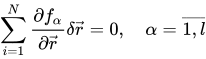
Virtual displacements, generally speaking, are not related to the process of movement of the system - they are introduced only in order to reveal the correlation of forces existing in the system and to obtain equilibrium conditions. A small amount of displacement is needed in order to be able to consider the reactions of ideal bonds unchanged.
Literature
- Buchholz N. N. The basic course of theoretical mechanics. Part 1. 10th ed. - St. Petersburg: Doe, 2009 .-- 480 p. - ISBN 978-5-8114-0926-6 .
- Targ S. M. A Short Course in Theoretical Mechanics: A Textbook for High Schools. 18th ed. - M .: Higher School, 2010 .-- 416 p. - ISBN 978-5-06-006193-2 .
- Markeev A.P. Theoretical mechanics: a textbook for universities. - Izhevsk: Research Center "Regular and chaotic dynamics", 2001. - 592 p. - ISBN 5-93972-088-9 .