Soleros ( Latin Salicornia ) is a genus of annual herbaceous plants of the Amaranthaceae family ( Amaranthaceae ). Succulents grow on highly saline soils on the sea coasts, shores of salt lakes, in gullies and ravines . Distributed in Eurasia, Africa and North America. All types of saltwater are very similar to each other and in the field are sometimes indistinguishable even to the eye of a specialist. In some cases, plants stand out in color and overall size. In Europe and North America are eaten. In Antiquity and the Middle Ages, soda was extracted from plant ash , which was used to make glass , soap , textiles and paper .
| Soleros | |||||||||||||||||||||||
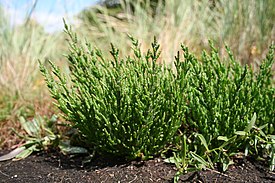 Soleros is European . Type species of the genus. General view of plants. | |||||||||||||||||||||||
| Scientific classification | |||||||||||||||||||||||
|---|---|---|---|---|---|---|---|---|---|---|---|---|---|---|---|---|---|---|---|---|---|---|---|
| |||||||||||||||||||||||
| International scientific name | |||||||||||||||||||||||
Salicornia L. | |||||||||||||||||||||||
| Type view | |||||||||||||||||||||||
Salicornia europaea L. - Soleros European | |||||||||||||||||||||||
Content
- 1 Distribution
- 2 Botanical Description
- 3 Application
- 4 Systematics
- 5 notes
- 6 Literature
- 7 References
Distribution
Plants of the genus are mainly represented in the northern hemisphere - in Europe , Western and Central Asia, North Africa and North America . The area of distribution south of the equator is limited to the coast of South and Southeast Africa. The genus is absent in South America and Australia , and almost never occurs in tropical latitudes. A number of sources indicate cosmopolitanism of the genus [3] [4] [5] , however, many of the described species, when examined in detail, do not find confirmation or belong to other groups of plants (see the Classification section) [6] .
Three or four species are common in the European part of Russia: S. perennans , S. europaea , S. pojarkovae, and S. heterantha SS Beer & Demina. The last of these taxa was described in 2005 and has not yet received universal recognition [7] [6] .
Soleros grows on moist soils with a high salt content - often in the tide zone ( drainage , marches , mangroves ), sometimes along the shores of inland water bodies with salt water [8] .
Botanical Description
Morphologically, all plants of the genus are very similar to each other, in some cases, determination is possible only at the genetic level. The main differences are manifested in the general color, the ratio of the shape and length of the central and lateral flowers in the inflorescence, the size of the entire inflorescence and the structure of the stem [9] . In most cases, these are annual plants with jointed, juicy stems and undeveloped, opposite leaves , up to 60 cm high. The stem is smooth, can be upright or creeping, single or with many branches. The stem of a young shoot, as it were, consists of individual segments, but over time it becomes more even and rustic. At first glance, soleros is devoid of leaves, but this is not so. The leaves of the plant are similar to fleshy scales, with their base literally adhered to the stem in the opposite order (the clear boundary where the stem ends and the leaf begins is not visible). Petiole is absent; leaf blade whole, narrow, finely membranous [10] .
The inflorescence is spike-shaped , consisting of fruiting segments of the stem with clearly defined boundaries. On both sides of each segment there are grooves (sinuses) in which flowers develop directly from the stem tissue, which together form an umbrella. Most often there are three flowers - one central and two lateral (but maybe fewer [11] ), separated by interstitial tissue. As a rule, the central flower rises above the side. The flowers are radially symmetrical, mostly bisexual and with a whole, inseparable, opening, only at the top, a narrow perianth slit with 1-2 stamens and a vertical pestle with two columns . Seeds are oblong, with a yellowish-brown shell, covered with hook-bent hairs at the apex. The embryo is horseshoe-shaped. Perisperm is absent [10] [12] .
Application
European Soleros is cultivated and eaten, in consistency and taste it resembles young shoots of asparagus or spinach . Sometimes it is added to salads in raw form, but more often it is preliminarily subjected to heat treatment (for example, it is boiled or cooked in a microwave oven ), after which it is seasoned with butter or olive oil . The plant contains enough salt - for this reason, as a rule, it is not salted. The finished dish is traditionally served with fish or seafood as a side dish. In the 20th century, Bigelov’s salt moss was similarly grown; as a food product, it gained the most popularity in Mexico and China [13] .
It is well known that saltros, hodgepodge , blackberry and some other halophytes accumulate a significant amount of alkalis in their tissues, primarily sodium bicarbonate (soda). This organic matter is salt, which was extracted mainly from plant ash in Antique and Middle Ages and is widely used for the manufacture of glass , soap , fabrics and paper . Scientists have not yet been able to find out which of the above plants for soda production in ancient Egypt , the Roman Empire and the State of Sassanids , known for their glassmaking, however, it is believed that at least in the 14th century for this purpose saltmoss was actively grown in the Languedoc region in southern France - in in particular in the cities of Montpellier and Nimes [14] . The English name for saltwater - glasswort (literally "glass wort") - indicates that the plant was once an important link in the manufacture of glass [15] .
The LeBlanc process in the 18th century basically supplanted the process of producing soda from plant ash. However, according to the dictionary of Brockhaus and Efron , compiled in 1890-1907, at that time this method could still be used in Spain, Southern France, the Canary Islands, Egypt and Syria [16] .
Soleros Bigelova can be grown in desert areas with salt water irrigation , its seeds contain a large amount of unsaturated fats (30%, mainly linoleic acid ) and protein (35%). Oil is squeezed from the seeds of the plant, which in composition of fatty acids is similar to safflower oil and has a pleasant nutty taste. The plant can also be used for the production of animal feed and as biofuel on coastal salt marshes, where traditional crops do not take root [17] . The experiments on the cultivation of Bigelov salinos were carried out in Saudi Arabia , Kuwait , the United Arab Emirates , Egypt , Eritrea and Mexico [17] [18] [19] [20] .
Systematics
Perennial shrub plants from the genus Sarcocornia are considered the closest related group of soleros; the discrepancy between their common ancestor began in the Middle Miocene 9.4-14.2 million years ago. Modern types of saltwater were formed relatively recently - in the Early Pleistocene 1.4-1.8 million years ago. In addition to the difference in the life cycle between these two groups (all types of soleros are annuals), the morphology of the inflorescence is considered to be the defining feature of the genus: in Sarcocornia, all 3 flowers are lined up in one line, while in soleros one flower rises above the other two [8] . In many works, some perennials, for example, S. virginica , are traditionally referred to as soleros; however, after 1978, when the genus Sarcocornia was described, an increasing number of taxonomists consider them in this plant group [21] .
The genus was described by the founder of biological systematics by the Swedish physician and naturalist Karl Linnaeus in 1753 in the two-volume Species plantarum [22] . For a long time, the taxon was considered as part of the Marevaya family (in particular, in the Kronquist system ), and many specialists still traditionally adhere to this nomenclature. At the same time, with the publication of more modern classifications APG (1998), APG II (2003) and APG III (2009), all subordinate taxa of the Chenopodiaceae family moved to the Amaranthaceae family, including Soleros [23] [24 ] ] [25] . The scientific name Salicornia is a combination of two Latin words: sal ( salt ) and cornu ( horn , horn ). Thus, the author indicated the characteristic habitats of the plant and the shape of its stem [26] .
The interspecific taxonomy of soleros is considered extremely confusing, and therefore experts even call it a “taxonomic nightmare”. The following reasons for this situation are mentioned [8] :
- A small number of morphological characteristics. In connection with the habitat, many botanical organs in Soleros are absent or poorly developed.
- Lack of biological material. In a dried plant in a herbarium, the sizes and proportions between the sizes of various organs change, which are extremely important due to the small number of characteristics themselves.
- Phenotypic flexibility. Similar external living conditions contribute to the appearance of the same morphological characters in genetically different species. Genetically identical individuals, on the other hand, produce different traits under different conditions.
- Crossbreeding system and hybridization . A closely related crossing ( incuct ) is characteristic of soleros.
- The lack of a global systematic analysis of the genus with an abundance of regional studies, often conflicting.
According to the project The Plant List (version 1.1, 2013), there are 26 species of salt marshes in the world. About 150 more of the subordinate taxa indicated in this list are either synonyms or require additional confirmation [6] . Below is a complete list of confirmed species in alphabetical order. Distribution data is taken from the article “A taxonomic nightmare comes true: phylogeny and biogeography of glassworts ( Salicornia L., Chenopodiaceae )” in the journal Taxon [8] .
| Title | Spread |
|---|---|
| Salicornia arabica L. | Gulf Coast , Arabian Peninsula |
| Salicornia bigelovii Torr. - Soleros Bigelova | Gulf of Mexico , US East (Atlantic) Coast North to Maine , Southern California |
| Salicornia depressa Standl. | The west (pacific) coast of North America from Alaska to California , the east coast of North America from Canada to South Carolina |
| Salicornia deserticola A. Chev. | Algeria (Northern Sahara ) |
| Salicornia dolichostachya moss | Northern Europe (excluding the Baltic coast) |
| Salicornia emerici duval -jouve | Western and Southern Europe |
| Salicornia europaea L. - Soleros European | Northwest Europe |
| Salicornia freitagii Yaprak & Yurdak | northeastern Turkey |
| Salicornia maritima SL Wolff & Jefferies | southeast Canada, northeast USA (including southern Alaska) |
| Salicornia meyeriana moss | South African coast |
| Salicornia nitens PWBall & Tutin | Western Europe |
| Salicornia obscura PWBall & Tutin | Western Europe |
| Salicornia pacifica Standl. | California [27] |
| Salicornia patula duval-jouve | Mediterranean coast ( France , Italy , Turkey ) |
| Salicornia perennans Willd. - Soleros saline | Southeastern and Eastern Europe, possibly Siberia |
| Salicornia perrieri A. Chev. | East African coast between Mozambique and South Africa, possibly Tanzania and Zanzibar |
| Salicornia pojarkovae N. Semenova - Soleros Poyarkova | Northern Norway |
| Salicornia praecox A. Chev. | West Senegal |
| Salicornia procumbens Sm. | Coast of the North and Baltic Seas |
| Salicornia pusilla J.Woods | Northern and Northwest France , Southern Great Britain , Southern Ireland |
| Salicornia ramosissima J.Woods | Western Europe, Western Mediterranean |
| Salicornia rubra A. Nelson | Inland USA and Canada, Subarctic Canada |
| Salicornia senegalensis A. Chev. | West Senegal |
| Salicornia subterminalis parish | California [28] |
| Salicornia uniflora toelken | southwest of Namibia , northwest of South Africa |
| Salicornia virginica L. According to other sources, it is a synonym for Salicornia depressa [8] or Salicornia ambigua [21] | The west (pacific) coast of North America from Alaska to California , the east coast of North America from Canada to South Carolina |
Notes
- ↑ For the conventionality of indicating the class of dicotyledons as a superior taxon for the plant group described in this article, see the APG Systems section of the Dicotyledonous article .
- ↑ In many classifications, Marevye are considered as an independent family. APG classification systems based on molecular analysis of DNA include it in the Amaranth family.
- ↑ Packham & Willis, 1997 , p. 105.
- ↑ Kubitzki et al., 2010 , p. 258.
- ↑ Akhani, 2008 .
- ↑ 1 2 3 Salicornia - Search Results . The Plant List . Royal Botanic Gardens, Kew and Missouri Botanical Garden. Date of treatment January 3, 2015. Archived January 3, 2015.
- ↑ Beer et al., 2010 .
- ↑ 1 2 3 4 5 Kadereit et al., 2007 .
- ↑ Lahondère, 2004 .
- ↑ 1 2 Ball, 2004 .
- ↑ Kadereit et al., 2012 .
- ↑ Komarov, 1936 , p. 172.
- ↑ Small, 2013 , p. 283.
- ↑ Henderson, 2013 , p. 24.
- ↑ Small, 2013 , p. 283.
- ↑ Soleros // Brockhaus and Efron Encyclopedic Dictionary : in 86 volumes (82 volumes and 4 additional). - SPb. , 1890-1907.
- ↑ 1 2 Glenn et al., 1998 .
- ↑ Bassam, 2010 , p. 313.
- ↑ Clark, Arthur. Samphire: From Sea to Shining Seed (inaccessible link) . Saudi Aramco World . Saudi Aramco (1994). Date of treatment January 6, 2015. Archived July 26, 2011.
- ↑ Weiss, Howard. Creating and commercializing Ecosystems . University of Florida / IFAS Office of Conferences and Institutes (December 6, 2010). Date of treatment January 6, 2015.
- ↑ 1 2 Haines, 2011 , p. 327.
- ↑ Linnaeus, 1753 , pp. 3-4.
- ↑ APG, 1998 .
- ↑ APG, 2003 .
- ↑ APG, 2009 .
- ↑ Small, 2013 , p. 281.
- ↑ Salicornia pacifica . Jepson Herbarium: Jepson Flora Project: Jepson eFlora . University of California, Berkeley. Date of treatment January 3, 2015. Archived January 3, 2015.
- ↑ Chenopodiaceae Salicornia subterminalis Parish . International Plant Names Index. Date of treatment January 3, 2015. Archived January 3, 2015.
Literature
- Genus 420. Soleros - Salicornia L. // Flora of the USSR : in 30 tons / hl. ed. V.L. Komarov . - M .; L .: Publishing House of the Academy of Sciences of the USSR , 1936. - T. 6 / ed. volumes B.K. Shishkin . - S. 172-173. - 956, XXXVI p. - 5200 copies.
- Akhani, Hossein. Taxonomic revision of the genus Salicornia L. (Chenopodiaceae) in central and southern Iran // Pakistan J. Bot .. - 2008.- T. 40 . - S. 1635-1655 .
- Angiosperm Phylogeny Group. An ordinal classification for the families of flowering plants // Annals of the Missouri Botanical Garden. - 1998. - T. 85 , No. 4 . - S. 531–553 .
- Angiosperm Phylogeny Group. An update of the Angiosperm Phylogeny Group classification for the orders and families of flowering plants: APG II // Botanical Journal of the Linnean Society. - 2003 .-- T. 141 . - S. 399-436 .
- Angiosperm Phylogeny Group. An update of the Angiosperm Phylogeny Group classification for the orders and families of flowering plants: APG III // Botanical Journal of the Linnean Society. - 2009 .-- T. 161 . - S. 105-121 . - DOI : 10.1111 / j.1095-8339.2009.00996.x .
- Ball, Peter W. Salicornia L. // Flora of North America: North of Mexico. - Oxford University Press, 2004. - T. 4: Magnoliophyta: Caryophyllidae, part 1. - 584 p. - ISBN 978-0195173895 .
- Bassam, N. El. Handbook of Bioenergy Crops: A Complete Reference to Species, Development and Applications. - Routledge, 2010 .-- 544 p. - ISBN 978-1844078547 .
- Beer, Svetlana S .; Beer, Anton S .; Sokoloff, Dmitry D. Flower and inflorescence development in Salicornia (Chenopodiaceae) // Feddes Repertorium. - 2010. - T. 121 , No. 7-8 . - S. 229-247 .
- Glenn, Edward P .; Brown, J. Jed; O'Leary, James W. Irrigating Crops with Seawater // Scientific American . - 1998. - No. 8 . - S. 76-81 .
- Haines, Arthur; New England Wild Flower Society. New England Wild Flower Society's Flora Novae Angliae: A Manual for the Identification of Native and Naturalized Higher Vascular Plants of New England. - Yale University Press, 2011 .-- 1008 p. - ISBN 978-0300171549 .
- Henderson, Julian. Ancient Glass: An Interdisciplinary Exploration. - Cambridge University Press, 2013 .-- 450 p. - ISBN 978-1107006737 .
- Kadereit, Gudrun; Ball, Peter; Beer, Svetlana; Mucina, Ladislav; Sokoloff, Dmitry; Teege, Patrick; Yaprak, Ahmet E .; Freitag, Helmut. A taxonomic nightmare comes true: phylogeny and biogeography of glassworts (Salicornia L., Chenopodiaceae) // Taxon. - 2007. - T. 56 , No. 4 . - S. 1143-1170 .
- Kadereit, Gudrun; Piirainen, Mikko; Lambinon, Jacques; Vanderpoorten, Alain. Cryptic taxa should have names: Reflections in the glasswort genus Salicornia (Amaranthaceae) // Taxon. - 2012. - T. 61 , No. 6 . - S. 1227-1239 .
- Kubitzki, Klaus (Editor); Rohwer, Jens G. (Editor); Bittrich, Volker (Editor). Flowering Plants - Dicotyledons: Magnoliid, Hamamelid and Caryophyllid Families. - Springer, 2010 .-- 653 p. - ISBN 978-3642081415 .
- Lahondère, C. Les salicornes sl (Salicornia L., Sarcocornia AJ Scott et Arthrocnemum Moq.) Sur les côtes françaises // Bull. Soc. Bot. Center-Ouest. - 2004 .-- T. 24 . - S. 1-122 .
- Linnaeus, Carl. Species Plantarum. - Holmiae: Impensis Laurentii Salvii, 1753 .-- T. 1.
- Packham, JR; Willis, AJ Ecology of Dunes, Salt Marsh and Shingle. - Springer, 1997 .-- 335 p. - ISBN 978-0412579806 .
- Small, Ernest. North American Cornucopia: Top 100 Indigenous Food Plants. - CRC Press, 2013 .-- 793 p. - ISBN 978-1466585928 .
Links
- Soleros - article from the Great Soviet Encyclopedia .
- Soleros // Brockhaus and Efron Encyclopedic Dictionary : in 86 volumes (82 volumes and 4 additional). - SPb. , 1890-1907. (Retrieved May 2, 2010)