Intensity is a scalar physical quantity that quantitatively characterizes the power carried by a wave in the direction of propagation. Numerically, the intensity is equal to the radiation power averaged over a period of wave oscillations passing through a unit area located perpendicular to the direction of energy propagation. In mathematical form, this can be expressed as follows:
| Intensity | |
|---|---|
| Dimension | MT −3 |
| Units | |
| SI | W / m² |
| GHS | erg / scm² |
| Notes | |
| scalar value | |

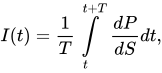
Where - period of the wave, - power carried by the wave through the site .


The wave intensity is related to the average energy density in wave and wave propagation velocity the following relation:


The unit of intensity in the International System of Units (SI) is W / m², in the GHS system - erg / s · cm².
Intensity of electromagnetic radiation
Electromagnetic radiation (for example, light ) is a set of waves , the oscillations in which make the electric field and magnetic induction . Electromagnetic waves carry the energy of an electromagnetic field , the flux of which is determined by the value of the Poynting vector. The intensity of electromagnetic radiation is equal to the average value of the Poynting vector modulus [1] :
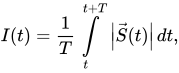
where is the Poynting vector ![{\vec S}(t)={\frac {c}{4\pi }}\left[{\vec E}(t)\times {\vec B}(t)\right],](https://wikimedia.org/api/rest_v1/media/math/render/svg/8b1645a072cf90456f2241fb5e5f868084a81ac5)


For a monochromatic linearly polarized wave with an amplitude of the electric field 

For a monochromatic circularly polarized wave, this value is twice as large:
Sound Intensity
Sound is a wave of mechanical vibrations of the medium. Sound intensity can be expressed in terms of the amplitude values of sound pressure p and vibrational velocity of the medium v :
Notes
- ↑ Here and below in the section, the Gaussian system of units is used