| Equation of state |
|---|
 |
| The article is part of the Thermodynamics series. |
| The ideal gas equation of state |
| Van der Waals equation |
| Berthelot's equation |
| Diterichi equation |
| Beatty-Bridgman Equation |
| Redlich - Kwong equation of state |
| Peng - Robinson equation of state |
| Barner-Adler equation of state |
| Sugi's equation of state - Liu |
| Equation of state Benedict - Webb - Rubin |
| The equation of state of Lee - Erbar - Edmister |
| Mi - Gruneisen equation of state |
| Sections of thermodynamics |
| The beginnings of thermodynamics |
| Equation of state |
| Thermodynamic quantities |
| Thermodynamic potentials |
| Thermodynamic cycles |
| Phase transitions |
| See also “Physical Portal” |
The Redlich – Kwong equation of state is a two-parameter equation of state for a real gas obtained by O. Redlich ( Eng. O. Redlich ) and J. Kwong ( Eng. JNS Kwong ) in 1949 as an improvement of the Van der Waals equation [1] . At the same time, Otto Redlich in his article [2] of 1975 writes that the equation is not based on theoretical justification, but is essentially a successful empirical modification of previously known equations.
The equation has the form:
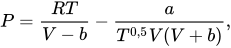
Where - pressure , Pa;

- - absolute temperature , K;
- - molar volume , m³ / mol;
- - universal gas constant , J / (mol · K);
- and - some constants depending on a specific substance.





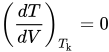
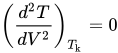
From the conditions of thermodynamic stability at a critical point - and ( - critical temperature ) - you can get that:

![{\ displaystyle a = {\ frac {1} {9 \ cdot ({\ sqrt [{3}] {2}} - 1)}} {\ frac {R ^ {2} T _ {\ mathrm {k}} ^ {2 {,} 5}} {P _ {\ mathrm {k}}}} approx {\ frac {0 {,} 42748R ^ {2} T _ {\ mathrm {k}} ^ {2 {,} 5 }} {P _ {\ mathrm {k}}}},}](https://wikimedia.org/api/rest_v1/media/math/render/svg/2c9b206e4bd0a5908136e4b3824ee147c290e1bf)
![{\ displaystyle b = {\ frac {{\ sqrt [{3}] {2}} - 1} {3}} {\ frac {RT _ {\ mathrm {k}}} {P _ {\ mathrm {k}} }} \ approx {\ frac {0 {,} 08664RT _ {\ mathrm {k}}} {P _ {\ mathrm {k}}}},}](https://wikimedia.org/api/rest_v1/media/math/render/svg/ec3dbdf8eb91e86c0671a41523437882bd2d85f9)
Where - critical pressure .

It is of interest to solve the Redlich - Kwong equation with respect to the compressibility coefficient . In this case, we have the cubic equation:


Where .
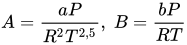
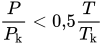
The Redlich - Kwong equation is applicable if the condition .
After 1949, several generalizations and modifications of the Redlich – Kwong equation were obtained (see below), however, as A. Bjerre and T. Bak showed [3], the original equation more accurately describes the behavior of gases.
Gray - Rent - Zudkevich Modification
R. Gray ( RD Gray, Jr. ), N. Rent ( NH Rent ) and D. Zudkevich proposed [4] to adjust the compressibility factor obtained from the cubic Redlich - Kwong equation by introducing a correction term :
Where - modified compressibility factor;
-
- {\ displaystyle - \, \ omega (0 {,} 464419-0 {,} 424568T _ {\ mathrm {r}} ^ {2}) {\ frac {P _ {\ mathrm {r}}} {T _ {\ mathrm {r}} ^ {4} + P _ {\ mathrm {r}} ^ {4}}} \, - \, \ omega (41 {,} 76451266-40 {,} 47298767T _ {\ mathrm {r}}) {\ frac {P _ {\ mathrm {r}} ^ {2}} {(1 + T _ {\ mathrm {r}}) ^ {4} + P _ {\ mathrm {r}} ^ {4}}} \ , -}
- {\ displaystyle - \, \ omega (0 {,} 464419-0 {,} 424568T _ {\ mathrm {r}} ^ {2}) {\ frac {P _ {\ mathrm {r}}} {T _ {\ mathrm {r}} ^ {4} + P _ {\ mathrm {r}} ^ {4}}} \, - \, \ omega (41 {,} 76451266-40 {,} 47298767T _ {\ mathrm {r}}) {\ frac {P _ {\ mathrm {r}} ^ {2}} {(1 + T _ {\ mathrm {r}}) ^ {4} + P _ {\ mathrm {r}} ^ {4}}} \ , -}
Where - reduced temperature - reduced pressure - the factor of acentricity .
Gray and others modification obtained for and .
Other Modifications
Another way to obtain modifications of the original Redlich - Kwong equation of state is to write it in the form:
Where - modifying function.
For the Redlich - Kwong equation itself .
Wilson Modification
G. Wilson [5] [6] ( GM Wilson ) modifying function has the form:
Wilson showed that his form of the equation gives good results on corrections to the enthalpy of pressure not only for polar (including ammonia ), but also for non-polar substances .
Barnet King Modification
Barnet [7] ( FJ Barnès ), and later King [8] ( CJ King ) proposed the following modification in 1973–74:
Barnet and King also applied their modification to mixtures of both hydrocarbons and non-hydrocarbons.
Soave Modification
G. Soave was proposed [9] the following equation:
For hydrogen , a simpler equation was obtained:
West ( EW West ) and Erbar ( JH Erbar ), using the Soave equation for light hydrocarbon systems, came to the conclusion [10] that it is very accurate in determining the parameters of the vapor – liquid phase equilibrium and corrections to the pressure enthalpy.
Literature
- Reed R., Prausnits J., Sherwood T. Properties of gases and liquids: a Reference manual / Per. from English under the editorship of B.I.Sokolova. - 3rd ed. - L .: Chemistry, 1982. - 592 p.
- Wales S. Phase equilibrium in chemical technology: In 2 hours. Part 1. - M .: Mir, 1989. - 304 p. - ISBN 5-03-001106-4 . .
Notes
- ↑ Redlich O., Kwong JNS On the Thermodynamics of Solutions. V. An Equation of State. Fugacities of Gaseous Solutions // Chemical Reviews. - 1949. - T. 44 , No. 1 . - S. 233–244 . (inaccessible link)
- ↑ Redlich O. On the Three-Parameter Representation of the Equation of State // Industrial and Engineering Chemistry Fundamentals. - 1975.- T. 14 , no. 3 . - S. 257-260 .
- ↑ Bjerre A., Bak TA Two-Parameter Equations of State // Acta Chemica Scandinavica. - 1969 .-- T. 23 . - S. 1733-1744 .
- ↑ Gray RD, Jr., Rent NH and Zudkevitch D. A modified Redlich - Kwong equation of state // The American Institute of Chemical Engineers Journal. - 1970. - T. 16 , no. 6 . - S. 991-998 . (inaccessible link)
- ↑ Wilson GM // Advances in Cryogenic Engineering. - 1964 .-- T. 9 . - S. 168 .
- ↑ Wilson GM // Advances in Cryogenic Engineering. - 1966. - T. 11 . - S. 392 .
- ↑ Barnès FJ Ph. D. thesis. Department of Chemical Engineering, University of California, Berkeley, 1973.
- ↑ King CJ Personal communication, 1974.
- ↑ Soave G. Equilibrium constants from a modified Redlich - Kwong equation of state // Chemical Engineering Science. - 1972. - T. 27 , no. 6 . - S. 1197-1203 .
- ↑ West EW, Erbar JH An Evaluation of Four Methods of Predicting the Thermodynamic Properties of Light Hydrocarbon Systems // Paper presented at 52d Annual Meeting NGPA, Dallas, Tex., March 26-28. - 1972.