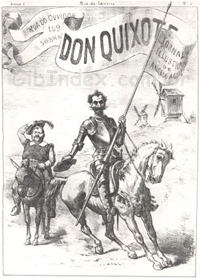
“Don Quixote” is a ballet based on the novel by Miguel Cervantes “ The Cunning Hidalgo Don Quixote of La Mancha ” (Spanish: El ingenioso hidalgo don Quijote de la Mancha) . The most famous production of choreographer Alexander Gorsky to the music of the composer Ludwig Minkus . Subsequently, other choreographers, in particular Vladimir Vasiliev [1] , Alexei Ratmansky and Boris Eifman , created their own versions of this ballet, which significantly differed from the original version.
| Don Quixote | |
|---|---|
| Don quixote | |
 | |
| Composer | Ludwig Minkus E.Napravnik , A.Simon , Zhelobinsky |
| Plot source | Roman Miguel Cervantes |
| Choreographer | Marius Petipa |
| Set design | P. A. Isakov, I. Shangin, F. I. Shenyang ( 1869 ) K.A. Korovin , A.Ya. Golovin , N.A. Klodt ( 1900 ) V. Okunev ( 1996 ) |
| Subsequent revisions | Alexander Gorsky ( 1900 ) |
| Number of actions | ballet in 4 acts 8 scenes with a prologue |
| Year of creation | 1869 |
| First production | December 14, 1869 |
| First Place | Bolshoi Theater , Moscow |
In addition, from 1740 to 1965, ballets with the name Don Quixote, or similar, were created by other composers and choreographers.
Ballet to the music of Minkus
The music of Ludwig Minkus was written for the production of the ballet Don Quixote at the Moscow Bolshoi Theater by choreographer Marius Petipa , the first performance took place on December 14, 1869 .
In Cervantes' novel, the image of the sad knight Don Quixote , ready for any feats and noble deeds, is the basis of the plot. In the ballet, Don Quixote is a secondary character, and the plot focuses on the love story of Kitri and Basil , performing their variations on the town square. The experienced bandmaster Ludwig Minkus was an excellent connoisseur of ballet craft, he was recognized as a ballet composer . His sparkling music, like champagne, delighted his ears and made him dance. Petipa picked up this mood by materializing this cheerfulness in many Spanish and gypsy (La gitane, Gitano) dances, whose real names are chic, moraine and zingar . In classical ballet, it was their stylization , the bolero dances and the Espada dance - these are "Spanish", not Spanish dances.
Pitep’s Moscow production was a comedy with a great deal of expression for the game and with a significant predominance of characteristic dances over classical ones. The ballet withstood no more than thirty performances and in the next season left the theater stage [2] .
In 1871, Petipa reworked ballet for staging on the stage of the Bolshoi Kamenny Theater in St. Petersburg. In 1887, a new edition of Petipa’s performance for the Moscow Bolshoi Theater was put by A. N. Bogdanov . However, the production of the Moscow Bolshoi Theater of 1900 turns out to be decisive in the fate of the ballet - the performance in its edition is staged by choreographer Alexander Gorsky , who already transferred it to the Mariinsky Theater in 1902. Gorsky adds separate numbers to the music of Minkus to the music of E. Napravnik and A. Simon . In the future, Don Quixote will more than once be “enriched” with new dances and new music ( B. V. Zhelobinsky , V. P. Solovyov-Sedy ), but the music of Minkus, like the scheme of Petipa’s performance, will remain the same.
Story
The innkeeper Lorenzo wants to marry his daughter Kitri to the rich nobleman Gamache . But Kitri is in love with the Basil barber. Don Quixote , having read chivalric novels, sees in his imagination the image of Dulcinea , whom Kitri appears to him (in the third picture of the second act). During a festive walk in the pub, Basil pretends to be a suicide scene, and Kitri begs her father to bless their love. Lorenzo hesitates. The outraged Don Quixote orders to fulfill the request. Reluctantly, Lorenzo blesses Kitri and Basil. Basil quickly rises unharmed - his suicide was just a joke. Friends push gait from the zucchini. General fun and dancing continues. In Barcelona Square, everything is ready for the holiday in honor of Kitri and Basil. Guests are gathering in a solemn march. Among them is the noble knight Don Quixote and his squire Sancho Panza. The holiday begins. Don Quixote and Sancho say goodbye to everyone and go in search of new adventures.
Musical numbers and variations
- Overture (Ouverture)
- Prologue Progress Quixote
- Introduction (Allegro assai) Don Quixote and Sancho Panza
- Act I
- Scene One - Market Square in Barcelona . On the square near the zucchini Lorenzo, the people are having fun and, with it, the perky Kitri and Basil in love with her. Lorenzo (Kitri’s father) is not pleased with the poor groom, whose wealthier nobleman Gamache, who wants to marry Kitri, is much more like him . [3]
- Entrée: Kitri and Basil exit. Moreno.
- Dance street dancer. (Allegro).
- The crowd welcomed the Street Dancer and the bullfighter Espada. The general surprise is the appearance of the knight Don Quixote. The traveler is invited to the table. Girls make fun of fat Sancho Panza. Don Quixote is struck by the beauty of Kitri. Wasn't she in the image of the beautiful Dulcinea appearing to him in dreams?
- Scene: Lorenzo, Kitri and Basil. Exit Gamache. Segidilla ( Spanish: Seguidilla ), Street dancer and bullfighter Espada (Moderato). Dance of the bullfighters
- Scene: Don Quixote and Sancho Panza, Dance of Kitri's friends.
- Scene: Don Quixote invites Kitri to a minuet .
- Dance of Kitri and Basil. Variation of Basil. Variation of Kitri. Coda: Basil and Kitri.
- General code .
- Act II
- Scene Two - Tavern (Introduction).
- Exit Kitri and Basil (Entrée)
- Kitri and Basil fled from Lorenzo and Gamache. They wandered into a gypsy camp ...
- Gypsy dance (La gitane)
- Dance of Espada (danse d'Espada)
- Mercedes dance (Danse espagnole de Mercedes)
- Soon Don Quixote appears in the camp. He sees danger, and he enters into battle with a windmill
- Puppet Dance (The madness of Don Quixote, his attack on the theater and the mill). Code
- Scene Three - The Dream of Don Quixote. A scene in the forest (Le rêve de Don Quichotte) of Asleep Don Quixote is haunted by visions: he is in the kingdom of dryads, among whom he sees Kitri in the image of the beautiful Dulcinea
- Variations of Dryads, Amur
- Variation Kitri in the image of Dulcinea
- Variety of Lady Dryad
- Code
- Scene Four - The pursuit of Kitri and Basil overtakes Lorenzo and Gamache, but the lovers manage to escape. Don Quixote guides the pursuers on the wrong path, but the simple-minded Sancho Panza “corrects the mistake” of his master. And the chase continues.
- Act III
- Scene Five - In the zucchini In the zucchini, people are having fun and dancing. Among them are Kitri and Basil. Lorenzo catches up with the lovers: Kitasha should become Gamache's husband. Basil pretends to be a suicide scene, and Kitri begs Don Quixote to persuade his father to fulfill Basil's dying wish - to bless their love. As soon as Lorenzo fulfills his daughter’s wish, Basil “comes to life”.
| The fourth act. Coda. | |
grande pirouette, fouettes | |
| Playback help | |
- Act IV
- Scene Six - Duke's Palace. Holiday Wedding Kitri and Basil. The place of honor among the guests belongs to Don Quixote.
- Characters exit
- Pas de deux Kitri and Basil
- Entrée. Adagio Kitri and Basil
- The first classic variation of Flora (Waltz of the Flowers)
- Kitri variation
- Second classic variation
- Variation of Basil
- Code
- Spanish dance ( Fandango )
- Total code
- Having wished the newlyweds happiness, the noble knight sets off again.
Inside the ballet
At all times during the existence of the play, the scene of Basil’s “suicide” (the scene “in the Tavern” of the fourth picture of the second act) caused the same reaction from the audience - a laugh. The acting skills of the performer and his sense of humor were manifested here. "Basil quickly rises unharmed - his suicide was just a joke."
The third act of ballet is a festive action. The brightest dances in ballet. The apotheosis of the act and the ending of the play was Pas de deux and, of course, its obligatory element - 32 fouet . Pas de deux is performed as a separate concert number at ballet gala and competitions. The combination of music and choreography, as well as the evolution of technical elements in ballet, made it very advantageous for artists. As the historian and critic of the ballet B. A. Lvov-Anokhin said :
“Artistic expressiveness in ballet cannot be achieved without a clean form, no sporting excitement can replace it ... Any virtuoso movement ceases to be a cheap trick if it does not lose its strict classical form ... this is the path to genuine artistry, when the dance ceases to be gymnastics and turns into intellectual art. ”
Vladimir Vasiliev [4] performing for the first time in ballet in 1962, presented a new edition of the main male ballet party, which later became classical. This premiere became revolutionary in the history of this ballet and in the development of male dance of the twentieth century. In particular, in the first act in the first variation of Basil, Vasiliev for the first time after renverse added soutenu, before the second exit of Kitri he performed double pirouettes en dedans with access to the arabesque. In the variation of the third act, he first performed new elements: a double saut de basque en dedans, a pirouette with a gradual lowering of the foot from the high passe through cou-de-pied to the fifth position at high half-fingers (corkscrew), a double round in the air with a fouette on the floor; in the code for the first time performed: double rond de jambes in the air with the right and left legs, turn in the air en dedans with a la second in attitude in a circle after each jete, complicated combinations of rotations - double Grand pirouettes in a la second and attitude in en dehors .
Performance of the play
- 1869 - Bolshoi Theater , premiered on December 14 at the Bolshoi Theater, in Moscow. Choreographer Marius Petipa
- Artists P. A. Isakov , I. Shangin, F. I. Shenyang. Conductor P.N. Luzin
- The parts were performed by: Kitri - A. I. Sobeshchanskaya , Bazil - S. P. Sokolov , Don Quixote - V. Wanner , Dulcinea - P. M. Karpakova , Sancho Panza - V. F. Gelzer , Gamash - D. I. Kuznetsov
- November 9, 1871 - Mariinsky Theater , new edition of Petipa
- Ballet in 5 acts 11 scenes. Artists P. A. Isakov, I. Shangin, F. I. Shenyang. [Conductor A. D. Papkov. The parts were performed by: Kitri - Dulcinea - A.F. Vergin (later A.N. Kemmerer , E.P. Sokolova , M.N. Gorshenkova ), Basil - L.I. Ivanov , Don Quixote - T.A. Stukolkin , Sancho Panza - A.N. Pisho, Gamash - N.O. Goltz
- 1887 - Bolshoi Theater
Ballet in 3 acts, 7 scenes. The new edition of the choreographer A. N. Bogdanov (according to the St. Petersburg edition of M. I. Petipa ). Conductor S. Ya. Ryabov
- The parts were performed by: Kitri - Dulcinea - L.N. Geiten , Basil - N.F. Manokhin , Don Quixote - V. Wanner , Sancho Panza - V.A. Shashkin
Ballet to music by L. Minkus , E. Napravnik , A. Simon and B. Zhelobinsky
- December 6, 1900 - Bolshoi Theater . Choreographer Alexander Gorsky
Conductor - A. F. Arends , Artists: Alexander Golovin , N. A. Klodt (sets), K. A. Korovin (costumes)
- Dances set
- Spanish , to the music of A. Yu. Simon
- Fandango , to the music of E.F.
- The parts were performed by: Kitri - Dulcineya - L. A. Roslavleva , Basil - V. D. Tikhomirov , Don Quixote - A. N. Ermolaev, Sancho Panza - N. P. Domashyov , Espada - M. M. Mordkin , Street dancer and Mercedes - S.V. Fedorova, Lady of the Dryads - M.I. Grachevskaya.
- 1902 - Mariinsky Theater
Edited by Choreographer Alexander Gorsky . Conductor - Ricardo Drigo , artists: Konstantin Korovin , Alexander Golovin , N.A. Klodt
- Parts were performed by: Kitri - Dulcinea - Matilda Kshesinskaya , later: Anna Pavlova , Vera Trefilova , E.V. Geltser , E.A. Smirnova , Tamara Karsavina , Julia Sedova , K.P. Makletsova
- Basil - N. Legat , Don Quixote - A. D. Bulgakov , Sancho Panza - Enrico Cecchetti , Espada - M. M. Mordkin , Street dancer - Olga Preobrazhenskaya , Mercedes - M. M. Petipa , Lady of the Dryads - Julia Sedova , Gamash - P.A. Gerdt , Espada - A.F. Beckefi
- November 19, 1906 - the Bolshoi Theater . Edited by Alexander Gorsky
- Artist Konstantin Korovin , conductor - A.F. Arends
- Parts were performed by: Kitri - Dulcinea - E.V. Geltser , Basil - V.D. Tikhomirov , Don Quixote - V.A. Chudinov , Sancho Panza - V.A. Ryabtsev , Espada - M.M. Mordkin , Mercedes - S . V. Fedorova
- September 30, 1923 - Opera and Ballet Theater , Petrograd
Ballet in 4 acts, 7 scenes with a prologue, choreographer Fyodor Lopukhov (according to A. A. Gorsky ). Conductor - A. V. Gauk. Artists: Konstantin Korovin , Alexander Golovin
- Parts were performed by: Kitri - Dulcinea - Olga Spesivtseva , Bazil - M. A. Dudko, Don Quixote - N. A. Solyannikov , Sancho Panza - L. S. Leontyev, Street dancer - V. K. Ivanova, Gamash - Monakhov, Espada - A.V. Lopukhov
- February 10, 1940 - Bolshoi Theater . Choreographer - Rostislav Zakharov restored the performance of Alexander Gorsky (new dances to the music of V.P. Solovyov-Sedy )
- Gypsy dance was staged by choreographer Kasyan Goleizovsky to the music of Valery Zhelobinsky .
- Conductor - Yuri Fire , artist: V.F. Ryndin
- Parts were performed by: Kitri - Dulcinea - Sulamith Messerer , Basil - Asaf Messerer , Don Quixote - V.V. Smoltsov , Sancho Panza - V. A. Ryabtsev
History of adding dances
| December 14, 1869 | Don Quixote | Ludwig Minkus | Marius Petipa | Marius Petipa | The Bolshoi Theatre |
| December 6, 1900 | Spanish Fandango | A. Yu. Simon E.F. | Alexander Gorsky | Marius Petipa | The Bolshoi Theatre |
| February 10, 1940 | Gypsy dance | Valery Zhelobinsky | K asyan Goleizovsky | Alexander Gorsky | The Bolshoi Theatre |
| 1942 year | Gipsy dance (insert number) | Valery Zhelobinsky | Kasyan Goleizovsky | Branch of the Bolshoi Theater | |
| 1942 year | Dancing: Espada number (I picture 1 act), "Tavern" (II k.1 a.), Bolero - Act IV Dance of Kitri's Friends - Act IV Final, General Dance - Act IV | Ludwig Minkus | Kasyan Goleizovsky | Branch of the Bolshoi Theater |
- 1941 - Theater named after Kirova , Leningrad
Ballet in 4 acts, 7 scenes with a prologue, choreographer Fyodor Lopukhov (according to A. A. Gorsky )
- The script of M.I. Petipa in the processing of Yu. I. Slonimsky , choreographer V.I. Ponomaryov (according to A.A. Gorsky).
- 1942 - Bolshoi Theater
on the stage of the Bolshoi Theater Branch .
- Choreographers M. M. Gabovich and V. V. Smoltsov (after A. A. Gorsky), with dances by Kasyan Goleizovsky to the music of Zhelobinsky [5]
- Танцы: Касьян Голейзовский
- Дирижёр — С. С. Сахаров, художники: Л. А. Фёдоров, В. Максимов
- Партии исполняли: Китри — Дульцинея — Ольга Лепешинская , Базиль — В. Д. Голубин (позднее А. Н. Ермолаев), Дон Кихот — В. В. Смольцов, Санчо Панса — В. А. Рябцев
- 1946 год — Театр им. Кирова
Новые танцы в постановке Н. А. Анисимовой
- Дирижёр — П. Э. Фельдт, художник: Т. Г. Бруни
- Партии исполняли: Китри — Дульцинея — Наталья Дудинская , позднее: Татьяна Вечеслова , Фея Балабина , Базиль — К. М. Сергеев , Эспада — С. Г. Корень
Постановки балета на Западе
In the West, the staging of the ballet Don Quixote was carried out by the entreprise of Anna Pavlova in 1924 in an abridged version, as amended by 1902 Gorsky. In the early 1940s, the ballet was staged entirely with Pas de Deux and plug-in variations of the Russian ballet Monte Carlo (Ballet Russe de Monte Carlo). In 1966, Rudolf Nuriev staged his version of the play for the Vienna State Opera House . In 1973, Nuriev filmed his version of the play in the Australian Ballet . In 1978, at the American Ballet Theater, Mikhail Baryshnikov staged his own version of the play, which is in its version in many theaters in the world, including the Paris Opera. Vladimir Vasiliev put on his version in the American Ballet Theater in 1991. Subsequently, the ballet in his production was performed in the Kremlin and Lithuanian ballets (1994), Tokyo Ballet (2001), Serbian National Ballet (2007), Greek National Ballet (2011) and Bolshoi Theater School in Brazil (2007).
The ballet Don Quixote is considered one of the brightest and greatest creations from classical ballets.
The performance has been staged by many theaters around the world in various versions.
Theater Performances
- 1958 - Finnish National Opera , Helsinki
- 1962 - Vienna State Opera , Vienna
- 1966 - Zurich Opera House , Zurich
- 1972 - Australian Ballet , Sydney
- 1978 - American Ballet Theater (ABT), New York
- 1991 - American Ballet Theater (ABT), Chicago
- 1994 - Tatar Academic State Opera and Ballet Theater named after Musa Jalil . [6]
- 2010 - Samara Academic Opera and Ballet Theater .
Musical Theater named after K. S. Stanislavsky and Vl. I. Nemirovich-Danchenko
Premiere - July 17, 1981
Ballet in 3 acts, five scenes with a prologue. Libretto by Marius Petipa edited by Alexei Chichinadze . Choreographer Aleksey Chichinadze (using choreography by Alexander Gorsky), set designer Marina Sokolova, conductor George Zhemchuzhin
- Characters
- Kitri - Margarita Drozdova , then Galina Krapivina, Margarita Levina, Svetlana Smirnova, Galina Stepanenko , Tatyana Chernobrovkina , Natalya Ledovskaya, Natalya Krapivina, Natalya Somova, Erica Mikirticheva.
- Basil - Vadim Tedeev , then Mikhail Krapivin, Vladimir Kirillov, Valery Lantratov , Vladimir Petrunin, Alexey Dubinin, Vadim Bondar, Victor Dick, Andrey Glazshneider, Georgi Smilevski, Semyon Chudin, Sergey Polunin.
- Espada - Yuri Grigoryev
Alexey Chichinadze:
“I was curious, having retained the most valuable of the choreography of the outstanding Russian choreographer Alexander Gorsky, to rethink and rework a number of ballet scenes. We were looking for a more accurate logic of the development of events, abandoning long pantomime scenes, replacing them with an effective dance. The play has a lot of new choreography, especially in folk dances. ”
- Alexey Chichinadze [7]
American Ballet Theater
Premiere 02.15.1991, troupe American Ballet Theater on the stage of the Chicago Opera
ballet in two acts, five scenes with a prologue
Artist - Santo Loquasto, Music: Ludwig MINCUS, Libretto: Marius Petipa as edited by Vladimir Vasiliev based on the novel by Miguel Cervantes de Saavedra
Choreography: M. Petipa, A. Gorsky, V. Vasiliev
Kitri - Cynthia Harvey (Sylvie Guillem), Basil - Julio Bocca (Riccardo Bustamante)
Mikhailovsky Theater
- Premiere November 21, 1996 - Mikhailovsky Theater
- ballet in three acts, five scenes with a prologue [8] . Performance duration: 3 hours
- Set Designer Vyacheslav Okunev [9] Music: Ludwig Minkus . Libretto: Marius Petipa on the plot of the novel by Miguel Cervantes de Saavedra. Choreography: Alexander Gorsky
- Kitri - Oksana Bondareva, Basil - Aidos Zakan, Espada - Nikolai Korypaev, Street dancer - Victoria Kutepova
- Set Designer Vyacheslav Okunev [9] Music: Ludwig Minkus . Libretto: Marius Petipa on the plot of the novel by Miguel Cervantes de Saavedra. Choreography: Alexander Gorsky
“The classical ballet Don Quixote was first staged by Marius Petipa in 1869 and has come down to us in the production of Alexander Gorsky and other later interpreters. Interestingly, this brilliant ballet is by no means a staging of Cervantes' famous novel, but an independent choreographic work based on “Don Quixote”. ”
- Mikhailovsky Theater [10]
Ratmansky in Amsterdam
- Performance in the National Ballet [11] of the Netherlands, Amsterdam on the stage of the Stopera
Choreographer Alexei Ratmansky . Artist - Jerome Kaplan. Kitri - Anna Tsygankova. Basil - Matthew Golding
- Alexei Ratmansky dreamed of restoring the first Moscow production of Marius Petipa in 1869, which disappeared in 1900 , when Alexander Gorsky re-arranged the ballet. Over the past century, Don Quixote has survived dozens of editions and turned out to be as far from the original as the ballet from Cervantes’s novel.
“Having plunged into history, the choreographer Ratmansky found out that the recordings of the original Petipa were not preserved even in the main depository of the Russian ballet heritage - the Harvard University library. Only the original libretto, musical score with directorial comments, old programs and dashing articles of reviewers survived. As a result, Alexei Ratmansky composed his own version, but “with great respect for ballet traditions,” as he admits in the booklet for the performance. The first thing that the choreographer respected was the prologue: the choreographer returned to him the status of a full-fledged part of the play, in which the history of the journey of Don Quixote is set. Having read the novels, the mad knight sees Dulcinea praying for salvation. This vision will haunt his entire performance, appearing even in the sky in the form of the moon. ”
- Maria Sidelnikova [12]
The originality of Alexei Ratmansky and the eccentricity of his thinking have always met the expectations of the public, both ballet fans with a ticket to the gallery, and lovers of theatrical ballet, occupying places in the boxes of the theater. The definition of “restoration of a performance” has never been the companion of a talented choreographer with a sense of taste.
“The ballet ends on a lyrical note: the choreographer sends the knight in love on a journey - on an endless journey for a beautiful lady.
Of all the finds of Alexei Ratmansky, perhaps the most spectacular moment of the performance was Don Quixote's phantasmagoric nightmare. Before falling into the wondrous world of dryads and cupids, the poor knight is attacked by dancing cacti, bravely cracking them under the thunder and sparkling lightning, and finds himself in a forest cave of marvelous beauty, flooded with magical green-yellow light. ”
- Kommersant
Don Quixote of Eifman
- Premiere - 1994. The genre of the play is tragicomedy . Choreographer - Boris Eifman , libretto by Boris Eifman. Production designer - Vyacheslav Okunev. Soloists: Vera Arbuzova - Kitri , Yuri Ananyan - Basil , Alexander Rachinsky - Don Quixote , Almaz Shamuraliev - Sancho Panza , Sergey Zimin - Patient , Agata Smorodina - Nurse.
- The action of the Eifman ballet begins in a madhouse. Among the prisoners of the hospital is a dreamer who, having read the novel by Cervantes, imagines himself to be Don Quixote.
“Of course, the performance has not lost its public sound even today: in the modern world only a pure-hearted madman can, without thinking about the consequences, stand up for the offended and for justice, as in the days of Cervantes. But, as I already wrote, there is another sense of the Eifman ballet, perhaps the main one, which is enclosed in a scene with a hoop (and then in a similar scene with a ball). Having stepped over the hoop (dropping the ball that the warden gave him to hold on the floor), the man dared to step over the line that was unimportant to him by whom: the government, public prejudice, himself, finally. It turned out that it’s easy to step over the line, it’s very simple to lower the ball to the floor, and the person receives as a gift not only a bright world, but FREEDOM TO THINK and CREATE. And what is creativity, if not the moment of insanity of a normal person? According to Eifman, only the madman opens up other worlds and a different meaning of life. Therefore, among the inhabitants of the hospital, Don Quixote alone is not crazy, but Mad, because he is able to create. "
- Nina Alovert [13]
“Don Quixote is a tragicomedy based on contrasts. Scenes in a madhouse gave a powerful impetus to an inexhaustible Eifman fantasy. The choreographic drawing of mass scenes is based on clinically accurate reproduction of uncoordinated movements of mentally ill people. Eifman is balancing on the blade of a knife: one movement - and he can be accused (and in America - easily) of the lack of political correctness ... There is no mockery in the scenes in the madhouse, but a lot of humor and sadness. ”
- Bella Yezerskaya [14]
Ballets to music by other composers
Ballets based on the novel by Miguel Cervantes “ Don Quixote Lamancha ” were also staged by other choreographers and other music under different names: “Don Quichotte”, “Don Quixotte”, “Gamache Weddings”, “Don Quixote and Sancho Panza”, “Don Quixote Lamanca” , "Portrait of Don Quixote."
- The most famous productions : [15] [16]
Notes
- ↑ Vasiliev, Vladimir Viktorovich (Russian) // Wikipedia. - 2019-01-29.
- ↑ Don Quixote (1871) . www.mariinsky.ru. Date of treatment February 17, 2019.
- ↑ Classic version. Source: Program, summary.
- ↑ Vladimir Vasiliev - Legend of the world ballet . www.vasiliev.com. Date of treatment March 7, 2019.
- ↑ The ballet Don Quixote (1940−1942): Artist V. F. Ryndin, conductor Yu. F. Fire ; Basil - A.M. Messerer , Don Quixote - V.V. Smoltsov, Sancho Panza - V.A. Ryabtsev.
- ↑ Don Quixote . Tatar Academic Opera and Ballet Theater M. Jalil . Date of treatment June 26, 2018.
- ↑ Vladimir Kotykhov. "Don Quixote" - Stanislavsky Theater. - Editorial board of the Theater Poster magazine.
- ↑ Contents of the ballet "Don Quixote" by Minkus, characters, scenes from the spectrum . Opera and Ballet Theater named after M.P. Mussorgsky . Date of treatment January 29, 2011. Archived July 14, 2012.
- ↑ Vyacheslav Okunev (Unavailable link) . Moscow Musical Theater named after K. S. Stanislavsky and Vl. I. Nemirovich-Danchenko . Date of treatment June 26, 2018. Archived November 12, 2011.
- ↑ Mikhailovsky Theater. "Don Quixote". - 1996.
- ↑ Dance life of the Netherlands (unavailable link) . Date of treatment June 26, 2018. Archived on June 20, 2011.
- ↑ Maria Sidelnikova. Don Quixote exported by Alexei Ratmansky in Amsterdam . - The newspaper Kommersant, 02/18/2010. - Vol. Number 29 . - No. 4329 .
- ↑ Nina Alovert . The premiere of the ballet "Don Quixote, or the fantasies of a madman" by Boris Eifman in New York . - “Russian Bazaar”, 2002. - April 5 ( issue No. 15 ( No. 311 ).
- ↑ Bella Yezerskaya . "The Eifman Theater in New York." - New York : The Seagull, May 10, 2002. - Issue. Number 9 . - No. 25 .
- ↑ BALLETS . Balletmusic . Date of treatment June 26, 2018.
- ↑ DON QUIXOTE in the encyclopedia of ballet . www.ballet-enc.ru. Date of treatment June 26, 2018.
Links
- The official website of the Mikhailovsky Theater . Don Quixote Premiere of the production: November 21, 1996
- Don Quixote - Bolshoi Theater
- Don Quixote - Moscow Academic Musical Theater named after K. S. Stanislavsky and Vl. I. Nemirovich-Danchenko
- Official site of the Boris Eifman Theater
- Don Quixote - Perm Academic Opera and Ballet Theater named after Pyotr Ilyich Tchaikovsky
- Ballet terminology
- Repertoire of the Mariinsky Theater Ballet