CMOS sensor is a photosensitive sensor based on CMOS technology .

CMOS matrices use insulated gate field effect transistors with channels of different conductivity.
Content
History
In the late 1960s. many researchers have noted that CMOS structures are sensitive to light. However , charge-coupled devices provided such a higher photosensitivity and image quality that CMOS technology matrices did not receive any noticeable development.
In the early 1990s, the characteristics of CMOS matrices, as well as production technology, were significantly improved. Progress in submicron photolithography has allowed the use of finer compounds in CMOS sensors. This led to an increase in photosensitivity due to a larger percentage of the irradiated area of the matrix.
The revolution in CMOS sensor technology occurred when NASA successfully implemented Active Pixel Sensors (APS) at the Jet Propulsion Laboratory (JPL ) - active-pixel sensors [2] . Theoretical studies were carried out several decades ago, but the practical use of the active sensor was postponed until 1993. APS adds a transistor amplifier for reading to each pixel, which makes it possible to convert the charge into voltage directly in the pixel. It also ensured random access to photo detectors like RAM implemented in microcircuits.
As a result, by 2008, CMOS became practically an alternative to CCD.
At the MWC forum in Barcelona in 2011 , Samsung demonstrated a new type of CMOS sensor that is targeted at smartphones.
Principle of Operation
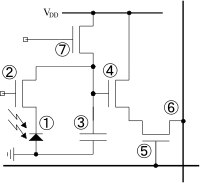
- A reset signal is given before shooting.
- During the exposure, the accumulation of charge by the photodiode
- In the process of reading, the voltage value across the capacitor is sampled
Benefits
- The main advantage of CMOS technology is its low power consumption in a static state. This allows the use of such matrices as part of non-volatile devices, for example, in motion sensors and surveillance systems that are in sleep or standby mode most of the time.
- An important advantage of the CMOS matrix is the unity of technology with the rest, digital elements of the equipment. This leads to the possibility of combining analog, digital and processing parts on a single chip (CMOS technology, being primarily a processor technology, implies not only “capture” of light, but also the process of converting, processing, and cleaning signals not only self-captured, but and third-party CEA components), which served as the basis for the miniaturization of cameras for a wide variety of equipment and their cost reduction due to the rejection of additional processor chips.
- Using the random access mechanism, you can read selected groups of pixels. This operation is called cropped reading ( eng. Windowing readout ). Crop can reduce the size of the captured image and potentially increase the read speed compared to CCD sensors, since in the latter all information must be uploaded for further processing. It becomes possible to use the same matrix in fundamentally different modes. In particular, by quickly reading only a small part of the pixels, it is possible to provide a high-quality mode of live viewing of the image on the screen built into the device with a relatively small number of pixels. You can only scan part of the frame and apply it to display in full screen. Thus, get the opportunity to high-quality manual focus. There is the possibility of reporting high-speed shooting with a smaller frame size and resolution.
- In addition to the amplifier inside the pixel, the amplifier circuits can be placed anywhere along the signal path. This allows you to create amplification cascades and increase sensitivity in low light conditions. The ability to change the gain for each color improves, in particular, white balance .
- Low cost of production compared to CCDs, especially with large matrix sizes.
Weaknesses
- The cell photodiode occupies a significantly smaller area of the matrix element, compared with a CCD matrix with full-frame transfer . Therefore, early CMOS matrices had significantly lower photosensitivity than CCDs. But in 2007, Sony launched a new line of new-generation CMOS sensors and cameras with Exmor technology, which was previously used only for CMOS sensors in specific optical devices such as electronic telescopes . In these matrices, the electronic “strapping” of the pixel, which prevents photons from entering the photosensitive element, was moved from the upper to the lower layer of the matrix, which made it possible to increase both the physical size of the pixel with the same geometric dimensions of the matrix and the availability of elements to light, which, accordingly, increased photosensitivity of each pixel and matrix as a whole. For the first time, CMOS matrices were compared with CCD matrices in terms of photosensitivity, but they turned out to be more energy-saving and devoid of the main drawback of CCD technology - the “fear” of point light. In 2009, Sony improved the EXMOR CMOS sensors with Backlight illumination technology. The idea of the technology is simple and fully consistent with the name.
- The photodiode of the matrix cell has a relatively small size, but the magnitude of the resulting output voltage depends not only on the parameters of the photodiode itself, but also on the properties of each pixel element. Thus, each pixel of the matrix has its own characteristic curve , and the problem of the spread of photosensitivity and contrast ratio of the pixels of the matrix. As a result of this, the first produced CMOS matrices had a relatively low resolution and a high level of the so-called “structural noise”.
- The presence on the matrix of a large volume of electronic elements in comparison with the photodiode creates additional heating of the device during reading and leads to an increase in thermal noise.
See also
- CMOS
- Optical systems
- Bayer Filter
- CCD
Notes
- ↑ CCD vs CMOS: facts and fictions. Archived February 27, 2008 on Wayback Machine - Reprinted from the January issue of PHOTONICS SPECTRA © 2001 Laurin Publishing Co. Inc. (eng.)
- ↑ Principle of Operation and Design of the Active-Pixel Sensors Preprint, Inst. Appl. Math., The Russian Academy of Science). Ovchinnikov A.M., Ilyin A.A., Ovchinnikov M.Yu.
Literature
- Victor Belov. Light for memory (Russian) // “Foto & video”: magazine. - 2005. - No. 3 . - S. 72-75 .