IKAROS ( Interplanetary Kite-craft Accelerated by Radiation Of the Sun ) is a Japanese spacecraft with a solar sail , created by the Japan Aerospace Research Agency . The launch took place on May 21, 2010 at 6:58 local time from the Japanese Tanegashima cosmodrome as a passing payload , together with the PLANET-C Venus climate research apparatus [1] . 45 minutes after launch, IKAROS detached from the last stage of the carrier. The satellite's mission is to test the solar sail in order to travel to other planets . IKAROS was the first space sailing ship ever to demonstrate the possibility of interplanetary travel using sunlight.
| IKAROS | |
|---|---|
| Interplanetary Kite-craft Accelerated by Radiation Of the Sun | |
 Spacecraft with solar sail IKAROS | |
| Customer |  Jaxa Jaxa |
| Operator | |
| Tasks | solar sail tests |
| Span | Venus |
| Launch pad | Tanegashima |
| Launch vehicle | H-IIA202 F17 |
| Launch | May 20, 2010 21:58:22 UTC |
| NSSDC ID | 2010-020E |
| SCN | 36577 |
| Specifications | |
| Weight | ~ 315 kg |
| Dimensions | 1.6 × 1.0 m Sail: 14 × 14 m (Diagonal: 20 m) |
| Mover | Solar sail |
| Project site | |
Content
- 1 General
- 2 Design
- 2.1 Solar Sail
- 3 Perspective
- 4 notes
- 5 Links
General data
The device is designed to test the solar sail. The conclusion was made along the way from the Akatsuki spacecraft , designed to study Venus , on the H-IIA rocket .
The disclosure of the solar sail began on June 3, 2010, and successfully completed on June 10. From the frames transmitted from the IKAROS board, it can be concluded that all 200 square meters of ultra-thin canvas were dealt with successfully, and thin-film solar panels began to generate energy [2] .
The minimum task of the mission was to disclose the sail, and the maximum task was to teach the sailboat to regulate speed and direction depending on solar radiation. Both tasks were successfully completed and an additional program began.
While giving the device rotation in the opposite direction, it became more difficult for him to capture solar radiation, as a result of which he fell into hibernation in January 2012. Only at the beginning of September 2012, the Japanese Aerospace Agency (JAXA) managed to capture two signals from the experimental space sailing ship IKAROS.
Design
Solar Sail
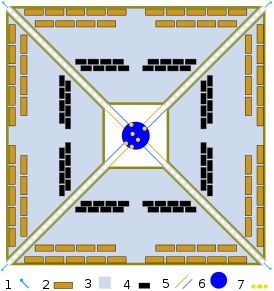
The solar sail (SP) is made of a polyamide film 7.5 microns thick. It is represented by 4 trapezoidal petals. Solar panels and solar rudders are sewn inside the petals. Disclosure of SP occurs due to the rotation of the SC around the axis with a speed of 20 revolutions per minute. Under the force of inertia, 4 weights pull the petals of the joint venture. Thus, when opened, a square of 14 meters is obtained. [3]
Perspective
In the late 2010s, it is planned to launch a second spacecraft with a larger sail with a side of 50 m. It is also planned to install an electric jet engine on the device.
Notes
- ↑ Japan launched a satellite with a solar sail .
- ↑ Small Solar Power Sail Demonstrator 'IKAROS' Successful Solar Sail Deployment JAXA.
- ↑ Project site (inaccessible link) . Archived April 24, 2012.
Links
- IKAROS project (inaccessible link) . Archived on September 22, 2008.
- The Japanese will launch a satellite with a solar sail