Asian tailor ant [3] ( lat. Oecophylla smaragdina ) is a species of tailor ants adapted to inhabit trees.
| Asian tailor ant |
|
| Scientific classification |
|---|
| No rank : | Bilateral symmetrical |
| Subtype : | Tracheo-breathing |
| Infraclass : | Winged insects |
| Treasure : | Fully Transformed Insects |
| Tribe : | Oecophyllini Emery , 1895 |
|
| International scientific name |
|---|
Oecophylla smaragdina Fabricius , 1775 |
| Subspecies |
|---|
- O. s. fuscoides Karavaiev, 1933
- O. s. gracilior forel, 1911
- O. s. gracillima emery, 1893
- O. s. selebensis Emery, 1893
- O. s. smaragdina (Fabricius, 1775)
- O. s. subnitida Emery, 1892 [1]
|
| Area |
|---|
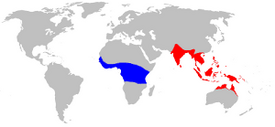 Oecophylla longinoda Oecophylla smaragdina [2] |
|

Uterus of an asian tailor ant

Liquid food exchange (
trophallaxis ) of two Asian tailor ants

Tightening leaves when building a nest
Content
Found in the tropics and subtropics: South India , Southeast Asia (including: Thailand , Vietnam , Malaysia , the Philippines , New Guinea , Indonesia ), Australia [2] .
Ants are green (hence their name is green ant , green tree ant ), breast and legs are light brown, the abdomen may be orange-red. They build nests on the trees, connecting them from the leaves that they fasten with the spider webs of their larvae. One colony can control a territory of up to 1,500 m², occupying more than 10 trees and located in 150 nests. The total number of one family is from 100,000 to 500,000 worker ants [4] .
Parasitic fungi of the genus Ophiocordyceps ( O. oecophyllae ) were found on Oecophylla smaragdina ants [5] .
Aggressive predators consuming many species of invertebrates. Able to protect many types of tree plantations from pests. The larvae and pupae of these ants are used by the local population for feeding poultry and fishing, as well as in traditional medicine in Thailand [6] and Indonesia [7] . Some ant collectors gain up to 200 kg of these insects per year and earn up to $ 12 per day in the summer seasons [6] .
In various parts of South (India) and Southeast Asia (Burma, Thailand), paste from green weaver ants ( Oecophylla smaragdina ) serves as a seasoning for a vegetable (or meat) curry dish [8] . The eggs and larvae of weaver ants , as well as their adult individuals, are used in the preparation of Thai salad “yum” (блюда), in dishes called “yum khai mod daeng” (ยำ ไข่ มดแดง) or salad from eggs of red ants (the dish occurs from the Issan region in northeast Thailand). Weaver ants also use the aborigines of Australia (North Queensland) [9] .
- ↑ Catalog of Life: Oecophylla smaragdina (Fabricius, 1775)
- ↑ 1 2 Dlussky, Gennady M .; Torsten Wappler and Sonja Wedmann. New middle Eocene formicid species from Germany and the evolution of weaver ants (English) // Acta Palaeontologica Polonica : journal. - Polish Academy of Sciences , 2008. - Vol. 53 , no. 4 . - P. 615-626 . - DOI : 10.4202 / app.2008.0406 . (inaccessible link)
- ↑ Striganova B.R. , Zakharov A.A. The Bilingual Dictionary of Animal Names: Insects (Latin-Russian-English-German-French) / . - M .: RUSSO, 2000 .-- S. 297. - 1060 copies. - ISBN 5-88721-162-8 .
- ↑ Green Tree Ants - State of the Environment Report
- ↑ Araújo, JPM; HCEvans, R. Kepler, DPHughes. Zombie-ant fungi across continents: 15 new species and new combinations within Ophiocordyceps . I. Myrmecophilous hirsutelloid species (English) // Studies in Mycology: journal. - 2018 .-- Vol. 90 . - P. 119-160 . - DOI : 10.1016 / j.simyco.2017.12.00.002 .
- ↑ 1 2 The importance of weaver ant (Oecophylla smaragdina Fabricius) harvest to a local community in Northeastern Thailand (English) // Asian Myrmecology: journal. - 2008 .-- Vol. 2 . - P. 129-138 .
- ↑ Césard N. Le kroto ( Oecophylla smaragdina ) dans la région de Malingping, Java-Ouest, Indonésie: collecte et commercialization d'une ressource animale non négligeable. (Fr.) // Anthropozoologica. - 2004. - T. 39 , No. 2 . - S. 15-31 .
- ↑ Bingham CT. Fauna of British India. Hymenoptera Volume 3. - 1903. - P. 311.
- ↑ Bequaert J. Insects as food: How they have augmented the food supply of mankind in early and recent times // Natural History Journal: journal. - 1921. - Vol. 21 . - P. 191-200 .
- Chen Y. and Alue RD, 1994 . Ants used as food and medicine in China. The Food Insects Newsletter 7 (2): 1-10. www.food-insects.com/Vol7%20no2.htm
- Cole AC Jr. and Jones JW Jr, 1948 . A study of the Weaver Ant, Oecophylla smaragdina (Fab.). American Midland Naturalist 39 (3): 641—651
- Hölldober, B. & Wilson, EO 1977 . Weaver ants - social establishment and maintenance of territory. Science 195: 900-902.
- Hölldobler B., 1983 . Territorial behavior in the Green Tree Ant ( Oecophylla smaragdina ). Biotropica 15: 241-250.
- Lokkers C., 1986 . The distribution of the Weaver Ant, Oecophylla smaragdina (Fabricius) (Hymenoptera: Formicidae) in Northern Australia. Australian Journal of Zoology 34: 683–687.
- Peng RK, Christian K. and Gibb K., 1998 . Locating queen ant nests in the green ant, Oecophylla smaragdina (Hymenoptera, Formicidae). Insectes Sociaux 45: 477-480.


