Blue finch [1] ( lat. Fringilla teydea ) is a songbird of the finch family. This animal is a symbol of the island of Tenerife . [2]
| Blue finch |
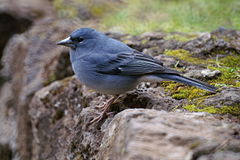
Male | 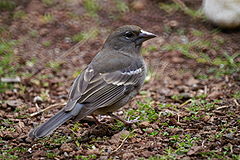
Female |
|
| Scientific classification |
|---|
| No rank : | Bilateral symmetrical |
| Infrastructure : | Passerida |
| Subfamily : | Chaffinch ( Fringillinae Leach , 1820 ) |
|
| International scientific name |
|---|
Fringilla teydea
( Webb , Berthelot & Moquin-Tandon , 1841) |
| Security status |
|---|
Close to vulnerableIUCN 3.1 Near Threatened : 103822567 |
|
Content
The blue finch is 16 to 18 cm long, larger than the finch . The beak, head and chest are stronger than the finch. The plumage pattern is invisible. The wings have two thin, white with a grayish tint stripes. The tail is dark. The male has a bluish-gray head and back, throat, chest and sides are lighter than lead-gray. White spine. The female has a gray-brown upper side and a lower side white with a grayish tint.
The call is a two-syllable “troit”, with a slightly squeaky sound. The singing is shorter and less energetic than the finch, slowing towards the end. It consists of several flowing and several crude sounds from which the latter is stretched. For example, "sitt-itt-sitt-rua-rua-ruruaa."
Blue finch is an endemic bird species that is common only on the islands of Tenerife and Gran Canaria . It is found all year round on both islands. On the island of Tenerife, it is more common, on Gran Canaria less often. Living space is pine forests . Nesting occurs at an altitude of 1,200 to 1,800 m. Feed searches also take place in pine forests, partly on mountain slopes with dense shrubs, in severe winters and also on cultural landscapes at an altitude of up to 500 m down.
The view is at risk.
- Bauer, HG; Bezzel, E .; Fiedler, W .: Das Kompendium der Vögel Mitteleuropas. Passeriformes-Sperlingsvögel. 2., vollst. überarb. Aufl. AULA-Verlag, Wiebelsheim. 2005. ISBN 3-89104-648-0
- Svensson, L .; Grant, PJ; Mullarney, K .; Zetterström, D .: Der neue Kosmos-Vogelführer - Alle Arten Europas, Nordafrikas und Vorderasiens. Franckh-Kosmos Verlags-GmbH & Co., Stuttgart. 1999. ISBN 3-440-07720-9