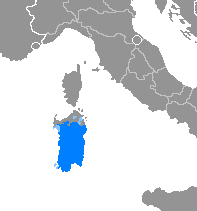
Sardinian (rarely Sardinian , sard. Limba sarda , camp. Lingua sarda ) is the language of the Romance group of the Indo-European family spoken by the population of the island of Sardinia ( Italy ), with the exception of the extreme northern tip, where the Corsican dialect of Italian is spoken , and several cities in the western coast, where they live speakers of Catalan and Ligurian .
| Sardinian language | |
|---|---|
| Self name | Sardu limba sarda |
| Country | Italy , Australia , Germany , USA , UK |
| Regions | Sardinia |
| Official status | Sardinia |
| Total number of speakers | 845 thousand [1] |
| Classification | |
| Category | Italian languages |
Indo-European family
| |
| Writing | Latin |
| Language codes | |
| GOST 7.75–97 | Wed 583 |
| ISO 639-1 | sc |
| ISO 639-2 | srd |
| ISO 639-3 | srd |
| WALS | |
| Ethnologue | |
| Ietf | |
| Glottolog | |

Content
Linguogeography
Area and number
In 2006, out of the 1,600,000 inhabitants of the island, 83% understood Sardinian, 52% could speak it, but only for 26% was he native. The Sardinian carriers are more in the center and in the south of the island. Most often it is the elderly, representatives of the lower and uneducated segments of society. Since the 1970s, the Sardinian has actively ceased to be absorbed by children [2] .
Status
It has the status of a regional language of the European Union . The number of carriers is about 0.85 million.
The total number of speakers (including Sassar and Gallurian dialects) is estimated at 1,200,000 people [3] .
It is estimated that 68.4% of the islanders speak Sardinian spoken well [4] . Nevertheless, the vitality of the Sardinian-speaking community is under threat, and UNESCO considers Sardinian as “definitely endangered” [5] . The UNESCO Courier magazine is published in Sardinian.
Dialects
The Sardinian language type proper is represented in the dialects of the center and north of the island ( logudor and nuor dialects ). Southern dialects ( Campidan ) are more susceptible to the influence of continental dialects, although in some moments they are archaic than Logudorian. In the far north of Sardinia, Sassaric and Gallurian are close to Corsican (which, in turn, is historically a dialect of Sardinian type, which was strongly influenced by Tuscan and Genoese dialects).
History
In the prehistoric period, the autochthonous tribes of Ilyans , Balars, and Kors inhabited Sardinia. There were Phoenician (from the 9th century BC.), Carthaginian (from the 6th century BC.), And Greek trade colonies. In 238 BC. er Sardinia was conquered by the Roman Republic, after which it underwent Romanization . In 456-534 years n. er Sardinia was ruled by vandals. Then, until the beginning of the 9th century, Sardinia was part of Byzantium. After that, some time in Sardinia there existed independent states - the Judicians . From 1323 Sardinia was gradually conquered by Aragon . In 1479, Sardinia became part of the Spanish kingdom. In 1707, Sardinia was captured by Austria, but after 13 years an independent Sardinian kingdom was formed, which in 1861 became part of united Italy [6] .
Linguistic characteristics
Morphology
A number of features of the Sardinian language distinguishes it from all or almost all other Romance languages: for example, the definite article in it goes back not to the Latin pronoun . ille 'that', and to lat. ipse 'myself': cf. in the Nuor dialect su , sa , pl. h. sus , sas (a similar phenomenon occurred in the ancient Pyrenean dialects). Among the archaic features of the Sardinian one is the absence of palatalization of the posterior-speaking front vowels (for example, kentu is one hundred , in Italian cento [ˈtʃento], French cent [sɑ̃], Spanish ciento[θjento] or [sjento] ), the preservation of the final -t and -s in verb conjugation (although the last feature occurs in the South Italian dialects of the so-called Lausberg zone , on the other hand, has disappeared in the Sardinian dialects). However, in Sardinian there was also a lot of innovations, such as the development of epenthetic vowels, various changes in intervocal consonants, etc.
Syntax
The base is the SVO order , but often SOV is also found. The definition usually follows the definition. Questions are constructed using intonation and inversion [7] .
Vocabulary
Most of the vocabulary of the Sardinian language dates back to Latin. A small layer of substrate vocabulary goes back to the Paleosard language , for example, béga “fertile plain”, mátta “tree, plant”. There are borrowings from the Phoenician ( tzikkiría "dill", tzíppiri "rosemary"), Greek ( kaskáre "yawn", kálamu "stifling heat"). Lots of borrowings from Italian, Spanish and Catalan. Arabic also came into Spanish through Sardinian. Sardinian differs from most other Romance languages by the almost complete absence of Germanism . Only a small number of words of Germanic origin passed at one time into Sardinian from popular Latin or fell through Italian through [8] [9] .
Notes
- ↑ The combined numbers of Sardinian, Campidanese (345,000 (2000)) and Sardinian, Logudorese (500,000 (Salminen 1993)) according to Ethnologue 2005, if you add to them the Corsican-Sardinian dialects (Gallurian and Sassar), it turns out 1045 thousand people.
- Ose Andreose A., Renzi L. Geography and distribution of the Romance languages in Europe // Tha Cambridge History of the Romance languages. - New York: Cambridge University Press, 2013. - T. II. - P. 302.
- ↑ Ethnologue report for language code: srd (English) .
- ↑ Oppo, Anna. Le lingue dei sardi , p. 7
- ↑ "Atlas of the World's Languages in Danger" , UNESCO
- ↑ Narumov B.P. Sardinian language // Romance languages. - M .: Academia, 2001. - p. 160. - ISBN 5-87444-016-X .
- ↑ Narumov B.P. Sardinian language // Romance languages. - M .: Academia, 2001. - p. 182. - ISBN 5-87444-016-X .
- ↑ Narumov B.P. Sardinian language // Romance languages. - M .: Academia, 2001. - p. 184. - ISBN 5-87444-016-X .
- Lia Tagliavini C. Le origini delle lingue neolatine. - Bologna: Pàtron Editore, 1982. - P. 392-393.