The sedge of the Otrub , or the wasp harvested ( Latin: Cárex cuprína , Carex otrúbae ) is a perennial herbaceous plant of the genus Sedge ( Carex ) of the sedge family ( Cyperaceae ).
| Sedge Cuts | |||||||||||||||||||||||||
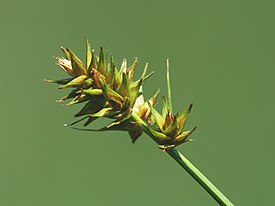 Inflorescence | |||||||||||||||||||||||||
| Scientific classification | |||||||||||||||||||||||||
|---|---|---|---|---|---|---|---|---|---|---|---|---|---|---|---|---|---|---|---|---|---|---|---|---|---|
| |||||||||||||||||||||||||
| International scientific name | |||||||||||||||||||||||||
Carex cuprina ( Sándor ex Heuff. ) Nendtv. ex A.Kern. , 1863 | |||||||||||||||||||||||||
| Synonyms | |||||||||||||||||||||||||
Carex otrubae Podp. , 1922 | |||||||||||||||||||||||||
Content
Botanical Description
A gray-green plant without creeping rhizomes , forming turf.
The stems are thickened, rough, 50–70 cm tall [2] , at the base with light brown or black, whole, less often fibrous split sheaths .
Leaves 3-5 mm wide [2] , shorter than the stem. The membranous side of the leaf sheaths is purple-dotted or transversely wrinkled.
Spikelets androgynous, sometimes lower, pistillate , ovoid, up to 1 cm long [2] , numerous, multiflowered , grouped several times on shortened branches, forming a large, very dense spike - panicle (rarely capitate ) pale or yellow-green inflorescence in 3— 4 cm long [2] . Covering scales are ovoid, pale rusty or whitish, with a green keel and a green, very rough awn, shorter than the sacs. Pouches are flat-convex, ovate or broad-ovoid, markedly widened at the base, (3.5) 4– (4.5 [2] ) 5 mm long, 2–2.6 mm wide, webbed, glossy, without tubercles, mature greenish - yellow or slightly brownish, broadly rounded at the base, with thin veins pronounced on both sides, slightly deviated from the spike axis, below with spongy walls, gradually turning into a slightly conical, serrated, barely or obviously two-serrated nose, front and back equally split. Covering leaves are scaly, lower sometimes with elongated bristle tips or narrowly linear.
The fruit fills the sac completely. Fruits in April and June.
The number of chromosomes is 2n = 58.
The view is described from the Czech Republic .
Distribution
Northern (south), Atlantic , Central and Southern Europe ; Baltic states : Saaremaa and Hiiumaa islands, center and south of Latvia , Lithuania ; European part of Russia : Bryansk , Kaliningrad , Lipetsk , Belgorod and Voronezh regions , Volga delta; Ukraine : Carpathians , the middle part of the Dnieper basin, Black Sea region , Crimea ; Caucasus : all areas, in Southern Transcaucasia Ararat Valley , Nakhchivan Republic ; Eastern Siberia : the vicinity of Minusinsk ; Central Asia : Kopetdag , Syr Darya basin, Northern and Western Tien Shan , Western Pamir-Alai ; West Asia : Turkey , Syria , Iran , Iraq , Afghanistan ; Central Asia : East Tien Shan; North Africa
It grows in marshy and moist, often salt-bearing places, along river banks, outskirts of ditches, sometimes in shrubs and damp forests .
Notes
- ↑ For the conventionality of indicating the class of monocotyledons as a superior taxon for the plant group described in this article, see the APG Systems section of the Monocotyledonous article .
- ↑ 1 2 3 4 5 Krechetovich V.I. Genus 235. Sedge - Carex // Flora of the USSR : in 30 t / h. ed. V.L. Komarov . - L .: Publishing House of the Academy of Sciences of the USSR , 1935. - T. 3 / ed. volumes B.K. Shishkin . - S. 151-152. - 636, XXV p. - 5175 copies.
Literature
- Egorova T.V. Sedges (Carex L.) of Russia and neighboring states (within the former USSR) . - St. Petersburg, St. Louis: St. Petersburg HCFA and the Missouri Botanical Garden, 1999. - S. 491-492. - 772 p.
- Krechetovich V. I. Genus 235. Sedge - Carex // Flora of the USSR : in 30 tons / chap. ed. V.L. Komarov . - L .: Publishing House of the Academy of Sciences of the USSR , 1935. - T. 3 / ed. volumes B.K. Shishkin . - S. 151-152. - 636, XXV p. - 5175 copies.