Clever Geek Handbook
📜 ⬆️ ⬇️

Canonical ensemble

The canonical ensemble is a statistical ensemble that corresponds to a physical system that exchanges energy with the environment (thermostat), being in thermal equilibrium with it, but does not exchange matter , since it is separated from the thermostat by a particle-tight partition. The parameters of the abbreviated description of such a system are the number of particlesN {\ displaystyle N} N and average energyE¯ {\ displaystyle {\ bar {E}}} {\ displaystyle {\ bar {E}}} .

Gibbs Distribution

The canonical ensemble includes microscopic states with different energies. The probability of this particular state with energyEτ {\ displaystyle E _ {\ tau}} {\displaystyle E_{\tau }} depends only on the energy value and is given by the Gibbs distribution

wτ=oneZe-Eτ/kBT{\ displaystyle w _ {\ tau} = {\ frac {1} {Z}} e ^ {- E _ {\ tau} / k_ {B} T}} {\displaystyle w_{\tau }={\frac {1}{Z}}e^{-E_{\tau }/k_{B}T}} ,

where Z is the normalization constant, which is selected from the condition that the sum of the probabilities is 1.

Z=∑τe-Eτ/kBT{\ displaystyle Z = \ sum _ {\ tau} e ^ {- E _ {\ tau} / k_ {B} T}} {\displaystyle Z=\sum _{\tau }e^{-E_{\tau }/k_{B}T}} .

Z is called the partition function .

Classic Case

The volume of phase space occupied by the canonical ensemble ofN {\ displaystyle N} N identical particles, called the partition function , which is given by the formula.

ZN=oneN!∫d3Npd3Nqh3Nexp⁡[-βH(p,q)]{\ displaystyle Z_ {N} = {\ frac {1} {N!}} \ int {\ frac {d ^ {3N} pd ^ {3N} q} {h ^ {3N}}} \ exp [- \ beta H (p, q)]} {\displaystyle Z_{N}={\frac {1}{N!}}\int {\frac {d^{3N}pd^{3N}q}{h^{3N}}}\exp[-\beta H(p,q)]}

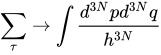
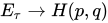
Whereβ=one/kBT {\ displaystyle \ beta = 1 / k_ {B} T} {\displaystyle \beta =1/k_{B}T} . Compliance with the general case:τ→(p,q) {\ displaystyle \ tau \ to (p, q)} {\displaystyle \tau \to (p,q)} ,∑τ→∫d3Npd3Nqh3N {\ displaystyle \ sum _ {\ tau} \ to \ int {\ frac {d ^ {3N} pd ^ {3N} q} {h ^ {3N}}}} {\displaystyle \sum _{\tau }\to \int {\frac {d^{3N}pd^{3N}q}{h^{3N}}}} butEτ→H(p,q) {\ displaystyle E _ {\ tau} \ to H (p, q)} {\displaystyle E_{\tau }\to H(p,q)} . Factorone/N! {\ displaystyle 1 / N!} {\displaystyle 1/N!} appears in accordance with the principle of indistinguishability of particles .

Literature

  • Hill T. Statistical Mechanics, Principles, and Selected Applications. - M.: IL, 1960.
Source - https://ru.wikipedia.org/w/index.php?title=Canonical Ensemble&oldid = 89861083


More articles:

  • Derbent Fortress
  • Elm (Konotop district)
  • Russian Rugby Championship 2010
  • Long live our power
  • Carboni, Amedeo
  • Flag of the rural settlement of Domninskoye
  • Gamburov, Kozma Ivanovich
  • Sobieschanskaya, Anna Iosifovna
  • Kantsyreva, Klavdia Ivanovna
  • - Wikipedia

All articles

Clever Geek | 2019