Bigelova sedge , or Hyperborean sedge ( lat. Carex bigelowii ) is a perennial herbaceous plant, a genus of the sedge ( Carex ) of the sedge family ( Cyperaceae ).
| Sedge bigelow | |||||||||||||||||||||||||
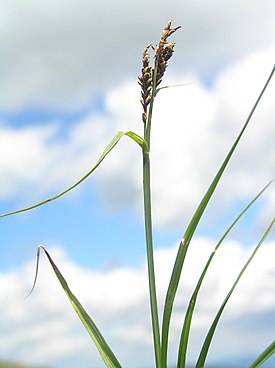 Inflorescence, Slovakia | |||||||||||||||||||||||||
| Scientific classification | |||||||||||||||||||||||||
|---|---|---|---|---|---|---|---|---|---|---|---|---|---|---|---|---|---|---|---|---|---|---|---|---|---|
| |||||||||||||||||||||||||
| International Scientific Name | |||||||||||||||||||||||||
Carex bigelowii Torr. ex Schwein. , 1824 | |||||||||||||||||||||||||
Botanical description

1 - Carex bigelowii subsp. rigida
A green, gray or dark green plant with short creeping rhizomes , forms friable turfs, and almost every shoot in a turf has a creeping rhizome (that is, a clearly defined horizontal underground part). Roots up to 2-3 mm in diameter, with well visible yellowish-whitish or grayish-white hairs.
Stems thin, rough, (8) 20-40 (60) cm tall, surrounded at the base with brown, reddish, purple or yellowish brown, mostly glossy whole leaf sheaths. Characteristically a large number, (8) 10-15 (20), leaves on the stems.
Leaf plates (1) 3-5 (6) mm wide, flat or, sometimes, with edges slightly curled on the bottom side.
Stamen spikelets 1–2, dark brown, purple-black, brown or light brown, (0.8) 1–1.5 (2) cm long, sessile or short-legged (0.3–0.5) 1-2 (2.5) cm long; 2-4 pistillate spikelets (5), spaced, ryhlovaty or, perhaps, thick, from ovate to narrow-cylindrical, (0.5) 1.5-2.5 (3) cm long, the lower part often on the leg 1-3 cm long. The scales of the pistillate spikelets on the top are rounded, acutate or dull, with a light stripe along the midrib , very rarely completely dark (almost black, purple-black or dark brown), sometimes with white-rimmed edges, in length and width almost equal to the sacs or longer and already them. Bags elliptical, broadly ovate or rounded ovoid, (2.2) 2.5-3.5 mm long, flat or slightly biconvex, not swollen, without veins, with a very short spout or without it, at the top, including the spout, purple-black . The bottom covering sheet is shorter or slightly longer than its spikelet, very rarely, but sometimes equal to the inflorescence. At the base of the covering leaves there are black ears.
The number of chromosomes is 2n = 60, 62, 68, 70, 80.
The species is described from the USA ( New Hampshire ).
Spread
Northern Europe : Iceland , Spitsbergen , the Faroe Islands , the northern part of Scandinavia , including the Arctic; Atlantic Europe : Scotland , Wales , Ireland ; The Arctic part of Russia : Murman , Kanin , Timan and Malozemelskaya tundra , the lower reaches of the Pechora , the Polar Urals , Pai-Khoi , Vaigach Island , Novaya Zemlya ( South Island and the southern part of the North ), Yamal , the lower reaches of the Ob River , the Ob-Tazovsky peninsula , the Gydanskaya tundra , the lower reaches of the Yenisei river , Taimyr , Severnaya Zemlya , the pool of Khatanga , lower reaches of the Anabar and rivers Olenyok , the lower reaches and delta of the Lena , the Gulf of Borja , the lower reaches of the Yana and Indigirka , the lower reaches of the Kolyma river , the area Chaun Bay , Wrangel Island , Chukotka peninsula , the island Ratmanova and Arakamchechen pool Anadyr , Korf Bay ; European part of Russia : Kola Peninsula , upper reaches of the Pechora ; Eastern Siberia : the Verkhoyansk Range , the Chersky Range , the north-western outskirts of the Central Siberian Plateau , the Indigirka basins, the sources of the Kolyma, the Dzhutdzhur Range, the Aldan Plateau (the Timpton River basin ), the Tompo and Menkyule rivers ; The Far East : the system of the Stanovoy Range (up to the northern Amur region and Primorye ); Central Asia : Mongolia ; North America : Canada (eastern Arctic coast of Canada and the Canadian Arctic archipelago, Quebec , Manitoba , Newfoundland ), Labrador , Greenland (almost to 80 ° north latitude), northeastern states of the USA , Alaska (including the Arctic), Yukon , Mackenzie River Basin, Victoria Islands and Banks .
It grows along rivers and lakes, in damp and marshy meadows , moss-sedge marshes , in a thicket of bushes and marshy woodland , on dry stony and rocky slopes and plateaus , in the sparse dry larch forests and thickets of cedar elfin wood, dry Rivals , on gravel, sedge-moss, sedge-cotton grass, shrub-moss and lichen tundra; in the mountain and flat tundra, in the upper part of the forest belt and forest-tundra, in the hypoarctic highlands; in the tundra is often a landscape plant.
Systematics
Within a species, five subspecies are distinguished [2] :
- Carex bigelowii subsp. arctisibirica ( Jurtzev ) A.Löve & D.Löve - Arctic-Siberian sedge; Northern and Arctic parts of the European part of Russia, Siberia
- Carex bigelowii subsp. bigelowii - North European part of Russia, North and Atlantic Europe, North America
- Carex bigelowii subsp. ensifolia ( Turcz. ex Gorodkov ) Holub. - Skeleton sedge; European part of Russia, Siberia, Mongolia
- Carex bigelowii subsp. lugens ( Holm ) TVEgorova - Carex mourning; Eastern Siberia, Far East, North America
- Carex bigelowii subsp. rigida ( Raf. ) W.Schultze-Motel - False-lobie; Eastern Siberia, Far East, Mongolia
Notes
- ↑ On the conditionality of specifying the class of monocotyledons as a higher taxon for the group of plants described in this article, see the “APG Systems” section of the article “Monocotyledons” .
- ↑ Carex bigelowii in the Botanic Gardens database at Kew, United Kingdom (Retrieved April 23, 2010)
Literature
- Egorova T. V. Osoky (Carex L.) of Russia and adjacent states (within the former USSR) . - St. Petersburg, St. Louis: St. Petersburg State Hydropharmaceutical Academy and Missouri Botanical Garden, 1999. - p. 468-473. - 772 s.
- Arctic flora of the USSR. Issue III / Comp. T. V. Egorova, V. V. Petrovsky, A. I. Tolmachyov, V. A. Yurtsev; Ed. A.I. Tolmachyova. - L .: Science, 1966. - P. 107-112.