Flag of the municipality Istrinsky municipal district of the Moscow region of the Russian Federation is an identification mark serving as the official symbol of the municipality.
| Flag of the Istra municipal district of the Moscow region | |
|---|---|
| Istra district | |
| Moscow region Russia | |
 | |
| Approved by | March 14, 1997 |
| Proportion | 2: 3 |
| GRG number | 424 |
| Team of authors | |
| Flag idea | K. F. Mochenov , Yuri Mochenov |
| Painter | R. I. Malanichev |
| Computer design | O. G. Afanasyeva |
| Justification symbolism | K.V. Perehodenko |
The flag was approved on March 14, 1997 [1] , as the flag of the Istrinsky District municipality (after the 2006 municipal reform, the Istrinsky Municipal District ), and was entered in the State Heraldry Register of the Russian Federation with assignment of registration number 424.
November 20, 2008, by the decision of the Council of Deputies of the Istra Municipal District No. 11/6 [2] , the previous decision was invalidated and it was established to consider the flag of the Istra District to be the flag of the Istra District (with the approval of the new “Regulation” on the flag).
On October 26, 2012, by decision of the Council of Deputies of the Istrinsky Municipal District No. 12/5 [3] , the name and text of the previous decision were amended (in particular, the paragraph on recognition of the decision of March 14, 1997 as invalid) was approved and a new “Regulation” was approved about the flag of the Istra municipal district.
In the description and drawing of the flag, the last two decisions have not been changed.
By the Law of the Moscow Region of February 22, 2017 No. 21/2017-OZ [4], all municipalities of the Istra municipal district are the urban settlements of Dedovsk , Istra and Snegiri , the rural settlements of Buzharovskoye , Bukarevskoye , Ermolinskoye , Ivanovo , Kostrovskoye , Luchinskoye , Novopetrovskoye , Obushkovskoye , Onufrievskoye , Pavlo-Slobodskoye and Yadrominskoye - were transformed, through their unification, into the urban district of Istra .
By the decision of the Council of Deputies of the Istra Municipal District dated March 14, 2017 No. 4/2 [5], the flag of the Istra Municipal District was approved by the flag of the Istra urban district.
By the decision of the Council of Deputies of the Istra city district of August 17, 2017 No. 2/8 [6], the previous decision was invalidated and the flag of the abolished Istra city settlement was approved by the flag of the city district.
Content
Description
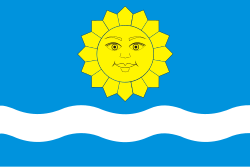
“A rectangular blue panel with a 2: 3 ratio of width to length depicting a horizontal wavy white strip 1/6 of the width of the panel, 1/6 of the width of the panel separated from the bottom edge by a yellow sun about sixteen rays above the strip in the middle.”
Justification of Symbols
The flag was designed taking into account the composition of the coat of arms of the Istra municipal district, which is based on two historical emblems: the coat of arms of the district town of Voskresensk ( Istra , which has been approved since December 30 (31), 1781 ), the description of which reads: the Moscow coat of arms in the upper part of the shield, in the lower “ Golden sun, in a blue field, like an accepted universal sign meaning the name of this city ”, and the coat of arms of the modern city of Istra, approved by the Council of People’s Deputies on March 17, 1989. The white wavy strip in the language of heraldry shows the Istra River, which gave the current name to the city and the region.
The use of two historical emblems as the basis for the composition of the district flag symbolizes the interconnection of the city and the region, the territorial and historical community of the two municipalities. Symbols of the 18th and 20th centuries united on the flag of the district into an inextricable line of history and modernity, aimed at the future.
Blue color (light blue ) is a symbol of honor of nobility, spirituality.
Yellow color ( gold ) is a symbol of wealth, harvest, stability, respect, solar heat and light. The sun is a symbol of peace and prosperity.
White color ( silver ) is a symbol of purity, perfection, peace and mutual understanding.
See also
- Flags of municipalities of the Istra municipal district
Flag of the urban settlement Dedovsk
Flag of the urban settlement of Istra
Flag of Snegiri urban settlement
Flag of the rural settlement of Buzharovskoye
Flag of the rural settlement of Bukaryovskoye
Flag of the rural settlement Ermolinskoe
Flag of the rural settlement of Ivanovo
Flag of the rural settlement of Kostrovskoye
Flag of the rural settlement Luchinskoe
Flag of the rural settlement of Novopetrovskoye
Flag of the rural settlement Obushkovskoe
Flag of the rural settlement Onufrievskoe
Flag of the rural settlement Pavlo Slobodskoye
Flag of the rural settlement Yadrominskoe
Notes
- ↑ Decision of the Istra District Duma of March 14, 1997 No. 13/5
- ↑ Decision of the Council of Deputies of the Istra Municipal District of the Moscow Region of November 20, 2008 No. 11/6 “On the Flag of the Istra Municipal District”
- ↑ Decision of the Council of Deputies of the Istra Municipal District of the Moscow Region dated October 26, 2012 No. 12/5 “On Amending the Decision of the Council of Deputies of the Istra Municipal District of the Moscow Region of November 20, 2008 No. 11/6“ On the Flag of the Istra Municipal District ””
- ↑ Law of the Moscow Region of February 22, 2017 No. 21/2017-OZ “On the organization of local self-government in the territory of the Istra municipal district”
- ↑ Decision of the Council of Deputies of the Istra Municipal District dated March 14, 2017 No. 4/2 “On the Establishment of the Flag of the Istra Urban District of the Moscow Region”
- ↑ Decision of the Council of Deputies of the Istra city district of August 17, 2017 No. 2/8 “On the establishment of the flag of the Istra city district of the Moscow Region”
Literature
- Official symbols of the Moscow region. - Moscow: Heraldic Council under the President of the Russian Federation, Heraldic Commission under the Governor of the Moscow Region, Union of Russian Heraldists, 2003. - 158 p. - S. 39. ISBN 5-900971-20-1