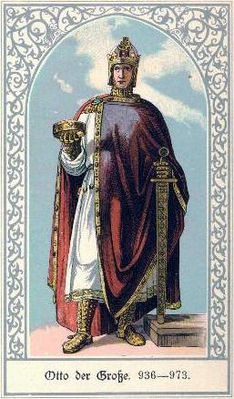
Otto I the Great ( German Otto I der Große , November 23, 912 , Wallhausen - May 7, 973 , Memleben ) - Duke of Saxony (under the name Otto II ) in 936–961, king of Germany with 936, emperor of the Holy Roman Empire since 962, king of Italy since 961. The son of the king of Germany, Henry I and Matilda of Westphalia . During his reign, the Holy Roman Empire was founded.
| Otto I the Great | |||||||
|---|---|---|---|---|---|---|---|
| him. Otto i der große | |||||||
 | |||||||
| Coronation | August 7, 936 , Aachen | ||||||
| Together with | Otton II Red ( May 26, 961 - May 7, 973 ) | ||||||
| Predecessor | Henry I the Birds | ||||||
| Successor | Otton II Red | ||||||
| |||||||
| Coronation | February 2, 962 , Rome | ||||||
| Together with | Otton II Red ( December 25, 967 - May 7, 973 ) | ||||||
| Predecessor | not ( Berengar I Friulsky held the title of Emperor of the West ) | ||||||
| Successor | Otton II Red | ||||||
| |||||||
| Predecessor | Henry I the Birds | ||||||
| Successor | Herman Billung | ||||||
| |||||||
| Predecessor | Eberhard Franconsky | ||||||
| Successor | Otton II Red | ||||||
| Birth | November 23, 912 Wallhausen , Saxony | ||||||
| Death | May 7, 973 (aged 60) Memleben | ||||||
| Burial place | Magdeburg Cathedral | ||||||
| Kind | Saxon Dynasty (Ludolphings) | ||||||
| Father | Henry I of the Birds [1] | ||||||
| Mother | Matilda Westphalian | ||||||
| Spouse | 1st: Edith English 2nd: Adelheid of Burgundy | ||||||
| Children | From 1st marriage: son: Ludolph daughter: Liutgard From 2nd marriage: sons: Henry, Bruno, Otton II Red daughter: Matilda | ||||||
| Autograph | |||||||


Biography
Beginning of the board
King Otton was exactly 24 years old when he was enthroned to the throne of the German state ; he received a name in honor of his grandfather , who lived to see the birth of his grandson ( 912 ). By the age of sixteen, in 929 , he married Edith , daughter of the Anglo-Saxon king Edward , as his father Henry I cared about maintaining ties with his fellow countrymen who moved overseas. He learned to read only after the death of his wife, and the Saxon historian does not miss the chance to notice that he was very capable of book wisdom: “He quickly began to read and understand what he read”; in addition, he was able to explain in Slavic and Romance languages . Otton's appearance was paternal; inclinations and qualities passed from his father to him: he was an equally passionate hunter and also sociable, but his aspirations were more elevated, he recognized himself as if “ porphyritic ” and looked at his royal calling deeply and seriously. No wonder they say about him that he constantly fasted before the days when he needed to appear before the people with a crown on his head.
The Congress of Princes, at which his election was to receive final sanction, was convened on Frankish territory, in Aachen. The lavish atmosphere in which this election took place indicates the extent to which the royal authority managed to establish itself: the dukes were present at the election, many of the nobility and many people. After the princes, that is, the secular nobility, erected and seated him on a throne erected in the hall connecting the palace with the cathedral, the Archbishop of Mainz introduced the crowd gathered in the cathedral “chosen by God, once appointed powerful ruler Henry, now reigning over all the princes of King Otton ... "" If you have this choice for your heart, then raise your right hand to the sky, "the archbishop added. Then the archbishops of Mainz and Cologne made the coronation ; followed by anointing . During the coronation feast, the king was served at the table by the dukes: Giselbert of Lorraine , Eberhard Franconsky (brother of Conrad I ), German Schwabsky , Arnulf of Bavaria , among whom the highest court posts were distributed at this celebration, which everyone tried to give as much importance as possible.
The Rebellion of Eberhard Franconsky and Giselbert of Lorraine
The first years passed safely. The invasions of the Slavs and Hungarians , who wished to take advantage of the change of reign, were successfully reflected; while the Hungarians did not even reach the borders of Saxony. However, the horizon was soon clouded. The first reason for the turmoil that filled the coming years was the primordial tribal envy between the Franconian and Saxon nobles. The latter decided that the current king was not without reason elected from the Saxon tribe, and on this basis many Saxon vassals refused to serve their Franconian lords. Meanwhile, Otton was busy pacifying Bavaria , where he replaced the rebellious Duke Eberhard (son of Arnulf ) with his uncle Bertold , another Eberhard , the Duke of Franconsky , having decided to curb one of his rebellious Saxon vassals, ordered to burn his city. The king punished Eberhard Franconsky for unauthorized punishment, imposing a fine of 100 pounds of silver on him. The leaders of the duke's squads, who complied with his order and burned the city, were sentenced to shameful punishment that seemed insulting to their master: everyone had to bring a dog in his arms to Magdeburg - the residence of the king. Embittered by this, Eberhard soon found an ally in the person of Tankmar , the brother of King Otton, who was older than his years, but descended from an unrecognized church marriage. Eberhard rebelled at a time when Otton was settling matters in Bavaria .
While Otton tried to humble the rebels with meek measures, Tankmar pinned them, captured Otton’s brother Heinrich and “sent him as an ordinary slave” to his ally Eberhard. Tankmar did not last long. While he was hiding in Eresburg , the royal warriors, with the help of the townspeople, broke into the city and, among the desperate slaughter that ensued in the city, killed Tankmar in the church at the foot of the altar .
After that, Eberhard hypocritically began to seek reconciliation with the king, and at the same time, he was preparing another betrayal. He managed to get together and face his captive Heinrich, Otton’s brother, and even convince him that he is more than a brother entitled to the royal crown, since Otton was born at a time when his father was still a duke, and Henry - when his father already been elected to the kings. And a big coalition formed against the king: the restless duke of Lorraine , Giselbert , joined the two conspirators, and even the West Frankish king entered into an alliance with them. The year 939 was a particularly critical year for Otto, especially since the Danes and Slavs took the opportunity to attack: they had to fight at the same time in Saxony , Lorraine , and the Rhine . However, Otton did the trick.
It is difficult to trace the course of his struggle with opponents because of the inaccuracy of the chronicles of that time. It is known that it lasted quite a long time, and then Otton suddenly, one day, was delivered from his main enemies. On October 2, near Andernach, the royal army overtook the enemy’s rearguard, in which both Eberhard and Giselbert were located, while most of their troops had already managed to cross the Rhine with rich booty. In a surprise attack, Eberhard fell after desperate resistance, and Giselbert, along with other fugitives, rushed into the boat, intending to cross the river. However, the boat, crowded with people, sank, and Giselbert drowned. So on one day in 939, two duchies were left without dukes. However, Henry did not abandon his extensive plans. For the sake of their implementation, he even decided to resort to murder and send the killers to his brother, who was ready to give him the Lorraine Duchy. But the conspiracy was discovered, the conspirators captured and executed, Henry himself fled ( 941 ). Despite all this, in the same year the brothers reconciled: Henry sincerely repented and was pardoned. Although the connection of all these phenomena is not entirely clear, one thing is certain: Heinrich justified the generosity of his brother and in the future was always unwaveringly faithful to him.
After Otton had to fight so hard over his crown, he got the opportunity to calmly breathe for several years. An important step was that he did not restore the duchy of Franconian, but took this land into personal control. In 944 he transferred the Duchy of Lorraine to the Frankish nobleman Konrad , for whom he subsequently gave his daughter to Liutgard .
In 946, the West Frankish king Louis , a former ally of the rebellious dukes, was forced to ask Otto for help against his powerful vassals. Otton brought a large army to help him in Gaul, up to 32 thousand people, and triumphantly reached Rouen , but he could not support the Carolingian power that was declining.
At the same time, a fierce struggle was waged in Slavic stamps: on the one hand, from the Zale River and the middle reaches of the Elbe to the Oder River, where Margrave Hero fought, and on the other, from Kiel Bay to the mouth of the Oder, where Margrave German Billung fought with the Slavs. The struggle was accompanied by treachery and ruthless revenge. A well-known example is this: Margrave Hero once invited 30 elders from the land of the Wends to a feast and drank with them, and when they got drunk, he ordered them to be killed. Of course, under such conditions, Christianity could penetrate there only with difficulty, although only it could consolidate the conquests on the outskirts.
However, Otton did not miss a chance here just at this time to pay special attention to missionary activity and persistently carried it out. Church institutions appeared on the border of Slavic lands: in 946 - the Hafelsberg bishopric, in 949 - the Brandenburg bishopric, and the first bishops of these places were ordained archbishop of Mainz . In the north , under the new Archbishop of Hamburg, Adaldag , missionary activity revived. In 948, three new bishops were sent from Hamburg to three newly established Danish-based bishoprics - Schleswig , Ripen ( Ribe ) and Aarhus ( Aarhus ) - at the local cathedral in Ingelheim , where important church matters were discussed under the chairmanship of the papal legate, which Otton especially carefully studied after the death in 946 of his wife Edita.
In 947, Bertold , Duke of Bavaria, died, and Otto transferred the duchy to his brother Heinrich, since Henry sincerely recognized Otton's mental superiority. A year later, German Schwabsky died, whose only daughter was the son of Otton Ludolf . The Duchy of Swabia passed to him, and thus a situation was reached that it was impossible to dream of: at the head of the two duchies were members of the same reigning family, and two important ones, Saxony and Franconia , were in the control of the king himself. All the rulers were in their prime: Henry was a little over thirty years old, Otton was not forty, and at the best time was another member of the same blessed family, which in his own way supplemented the power of Otton.
Bruno , the second son from the marriage of Heinrich and Matilda, entered the monks at an early age and indulged in his calling with amazing zeal in his youth: passionately loving books, he, according to one biographer, "wandered around with his library, like Israel with the ark." As a boy, he had extraordinary information at that time, and when he reached youthful age, his brother king made him his chancellor and entrusted him with the entire state chancellery. With indefatigable zeal Bruno devoted himself to the pursuit of public affairs, continuing to zealously engage in science. He recruited the Greeks, studying their language, and at the same time was in constant relations with Irish and British monks, expelled by the Danes from their native ashes. Bruno partly shared their ascetic views, but this asceticism did not restrain his passion for scientific research and progress. He attracted the king to his studies, in which he found some comfort after the death of his wife, who saddened him greatly. In the middle of the 10th century, among German monasticism and the clergy, in old and new schools of monasteries: St. Gallen , Reichenau , Fulda , Würzburg , Corvey , Handersheim , Quedlinburg , one can see a great mental revival that promised to bring rich fruits in the future. This state, firmly merged after all the worries, had the invaluable advantage that, despite all its particular and local differences, its population nevertheless spoke the same language, possessing such a unifying means, which was not found in either Spain, Gaul, or Italy. . The fact that Vidukind of Corvey speaks of Henry I , calling him “the greatest of the European kings, who created an extensive and strong state with their own works”, can rightfully be applied to the son of Henry Otton I.
First trip to Italy
The capture by Margrave Berengar of the young widow of the King of Italy, Lothar Adelheida, served as an excuse for Otto I to enter Italy . Such a decision led to important consequences. He gathered great military forces: his brother Bruno , brother Henry , the Duke of Bavaria, and his son-in-law Konrad of Lorraine took part in a campaign in which his son Ludolf made an unauthorized, although unsuccessful.
Of course, Berengar could not even think of competing with Otton. He did not even manage to save his captive, who found the opportunity to escape from his captivity. She had her followers in Italy, and she possessed such personal virtues that the widow Otton offered her a hand. Their wedding took place in the same year in Pavia and was solemnly celebrated, and the young, beautiful and intelligent Adelheida was soon able to subjugate the king-spouse to her influence. However, this time he failed to restore the empire of Charlemagne and to be crowned neither the imperial crown, nor the “ iron crown ” of the rulers of Italy. The pope , acting under the influence of his brother Senator Alberich , was not disposed to fulfill Otton's plan, and he did not even think of capturing the imperial crown by force. Soon it became clear what difficulties he had in the new situation in which he found himself as a result of political marriage and the formal transfer of the Italian kingdom under his authority.
With Berengar II, who retained the title of king of Italy, Otton initially coped without much difficulty: in 952 he came to him in Magdeburg to express his humility, and received the kingdom of Lombard from Otto in flax. The next year, a new meeting of the monarchs was planned, at which the final conditions for Berengar's subordination to the power of the German monarch were to be worked out. However, subsequently, taking advantage of Otto I's employment in intra-German affairs, the king of Italy renounced all his duties towards the ruler of Germany.
The rebellion of Ludolph of Swabia and Conrad of Lorraine
Margrave, which were the former Friulian Duchy , were separated from Italy and annexed to Bavaria , where the duke was the brother of Otto Henry , who under the new order enjoyed great influence and location of the queen. This is precisely what caused the dissatisfaction of the son of Otto Ludolph , who had long been in strained relations with Uncle Henry and son-in-law of Otto Conrad of Lorraine .
The struggle began again, again a series of treachery, betrayal and villainy on both sides, as at the beginning of the reign of Otto. Now it is impossible to say whether Ludolf really had reason to fear for succession after Adelheida gave birth to a son, who was named Henry in honor of his grandfather. Заговорщики, к которым пристал хитрый и двуличный духовный сановник архиепископ Фридрих Майнцский , пользовались большим сочувствием в стране. Они заманили короля Оттона в Майнц где он надеялся покончить с ними миром. Слишком поздно он убедился, что попал в западню и находится в их власти. Он вынужден был согласиться на условия, предложенные сыном и зятем, и только тогда получил свободу. Он поступил как истинный сын своего века, не подумав о выполнении вынужденных договоров. Вернувшись в Саксонию , он созвал в Фрицларе съезд князей и предложил на общее обсуждение притязания Людольфа и Конрада в их присутствии. Те не явились и поэтому заочно были осуждены на изгнание вместе с епископом Майнцским и лишены своих герцогств. Однако они были достаточно сильны, чтобы отстаивать свои права с оружием в руках, и началась борьба, наполнившая всю Германию громом оружия. Король с большим войском подступил к Майнцу, выдержавшему многомесячную осаду. Дело дошло до свидания обоих мятежников с королём-отцом перед воротами города: летописец рассказывал, что дядя Бруно резко выговаривал ослепленному Людольфу за его проступок и заблуждение, но тщетно. Между тем, восстание охватило и Баварию , и даже в Саксонии Конраду и Людольфу удалось найти приверженцев.
В Швабии и Франконии мятежники одержали верх даже над королём — он вынужден был без успеха отступить от Регенсбурга , как и от Майнца. Только в Лотарингии перевес оказался на стороне Оттона. Здесь положение вынудило короля принять необычайную меру: когда после смерти архиепископа Кёльнского на его место был назначен Бруно ( 953 год ), король предоставил ему герцогские права на Лотарингию. Серьёзной политической цели у мятежников не было. О какой бы то ни было германской национальной оппозиции против итальянской политики Оттона не могло быть и речи. В основе притязаний, заявленных Людольфом и Конрадом, видны лишь чисто корыстные цели, и тщетно искать им оправдание в благородных побуждениях или заблуждениях.
Пагубные последствия этих раздоров вскоре проявились: ранней весной 954 года венгры , много раз терпевшие поражение от герцога Генриха, огромным полчищем вторглись в Баварию. Эти враги были призваны Людольфом и Конрадом, чтобы облегчить их борьбу против Оттона. Но король собрал войско, как бы для изгнания венгров из Баварии, которую они к тому времени уже успели покинуть, и подчинил себе Баварию.
Вторжение венгров многих образумило, и королевская партия вновь подняла голову. Оттон со своей стороны сумел окончательно сломить сопротивление сына и зятя, назначив в одном местечке около Нюрнберга день, когда они должны были явиться к нему для примирения. Конрад первый покорился ему и сложил оружие, явившись на съезд, на который съехались многие духовные и светские вельможи. Архиепископ Фридрих также явился и попросил себе помилование. Прибыл и Людольф, но, не преодолев ненависти к дяде, тайно уехал со съезда и ещё раз попытался прибегнуть к оружию. Несколькими месяцами позже и он прибегнул к милости короля. Вскоре после этого на одном из съездов Людольф и Конрад были лишены герцогств и коронных ленных владений, но личную собственность им оставили.
В это время умер архиепископ Фридрих , его кафедра осталась свободной, и король передал её своему побочному сыну Вильгельму . Только в 955 году сдался упорно оборонявшийся Регенсбург, и этим закончилась вторая междоусобная война в правление Оттона I.
Битва на реке Лех
Король возвратился в Саксонию и собирался отправиться на северо-восток, чтобы одним ударом закончить борьбу со славянами ( вендами ), которых с трудом сдерживали его маркграфы Герман Биллунг и Геро Железный , как вдруг он узнал о предстоящем вторжении венгров и вынужден был двинуть силы на юг. Полчища врагов на этот раз были более, чем когда-либо, многочисленны и собрались в Аугсбургской долине. Сначала они направились к городу Аугсбургу , где верный приверженец короля, епископ Ульрих , призвал граждан к мужественной обороне. Однако враги отхлынули от города, только когда до них дошло известие о приближении королевского войска.
Известия о знаменитой битве при Лехе (в августе 955 года ), хотя и достаточно подробны, однако не дают точной картины боя. Оттону удалось собрать не особенно многочисленное, но стройное войско из дружин его вассалов, из которых только лотарингцам не удалось прибыть к месту битвы вовремя: тут были и саксы , и баварцы , и швабы , и франки . В королевском войске находилась войсковая святыня, так называемый «ангел» — копье с изображением архангела Михаила . Бывший герцог Лотарингский Конрад искупил свою измену мужеством в борьбе против врагов отечества и пал смертью героя, а исконный враг и победитель венгров — герцог Генрих из-за болезни не смог принять участие в этой решительной битве.
Вначале битва приняла неблагоприятный оборот, поскольку часть неприятелей зашла в тыл королевскому войску и напала на его обоз. Но главная их сила не выдержала стройного натиска немцев — врезавшегося в их полчища отборного конного отряда закованных в железо и тяжело вооружённых всадников. Венгры ударились в бегство, оказавшееся для них гибельнее самой битвы. Оттон настойчиво преследовал бегущих. Его воины никого не брали в плен. Они беспощадно жгли врагов, пытавшихся укрыться в жилищах и других укромных местах. После такого страшного поражения венгры уже не дерзали вторгаться в западные страны.
В октябре того же года под личным предводительством Оттона была одержана большая победа над вендами при Регнице : голову павшего в битве вендского князя принесли королю, беспощадно обезглавили 700 пленников. В этой битве в рядах королевского войска бился и сын Оттона Людольф (в Лехском сражении он не участвовал). Вечером в день победы собравшиеся вокруг короля рыцари и вельможи приветствовали его как императора, как сообщают летописцы того времени. Теперь более, чем когда-либо, он имел право подумать о восстановлении в своем лице той императорской власти, какой некогда обладал Карл Великий .
Последние 18 лет царствования Оттона протекли более мирно и спокойно, нежели первые 19 лет до Лехской битвы. Неутомимо занимаясь делами по внутреннему устройству государства, Оттон непрерывно переезжал из округа в округ. Там, где он появлялся, его уже ожидали накопившиеся разнообразные дела, требовавшие его разрешения, споры и тяжбы, ожидавшие его резолюции. Первым советником Оттона до самого конца оставался его брат Бруно , после смерти его третьего брата Генриха в 955 году бывший соправителем короля. Королева Адельхейда пользовалась гораздо большим влиянием на супруга, чем его мать Матильда, которая после смерти своего сына Генриха посвятила себя исключительно духовным делам: королеве Адельхейде принадлежала честь введения и поддержания при дворе Оттона строгих обычаев и достоинства в отношениях, делавших этот двор непохожим на дворы меровингских и каролингских королей.
Оттон I — правитель Италии
Второй поход в Италию
Только в 961 году Оттон предпринял второй поход в Италию . Здесь давно изменилась прежняя ситуация, поскольку Беренгар не способен был долго выносить положение вассала. В 956 году по поручению короля Оттона его сын Людольф воевал в Италии и победил сына Беренгара Адальберта . Вскоре после этого в 957 году скончался Людольф.
Во внутреннем государственном быте эта смерть не вызвала перемен. Оттон , сын от брака с Адельхейдой , уже подрос; вместе с ним воспитывался другой Оттон , сын Людольфа. Герцогство Баварское было предоставлено 4-летнему сыну Генриха , тоже Генриху , опекуншей над которым была его мать Юдифь.
В 960 году король опять объезжал своё королевство; все знали, что вскоре он должен будет отправиться в Рим . В мае следующего года был назначен съезд епископов и светской знати в Вормсе , и здесь 7-летний Оттон, сын Оттона I и Адельхейды, был избран королём Восточно-Франкского государства и несколько дней спустя коронован в Ахене . После всего этого ради обеспечения будущего король двинулся за Альпы , куда его призывал сидевший на папском престоле Иоанн XII , притесняемый Беренгаром. Когда Оттон пришёл с войском в Ломбардию , могущество Беренгара разлетелось в прах; собранное им войско разбежалось, Оттон беспрепятственно явился под стены Рима.
Коронация Оттона императором и образование Священной Римской империи
Принят Оттон был наилучшим образом: в воскресенье 2 февраля 962 года после торжественной встречи папа вручил ему императорскую корону в церкви святого Петра, а император обещал возвратить прежние церковные владения пап. Сближение с папой было необходимо императору, поскольку он хотел осуществить многие важные планы — возвести Магдебург в архиепископство, учредить епископство в Мерзебурге . Вообще, при управлении государством Оттон более, чем какой-либо государь, вынужден был опираться на епископов, поскольку светская аристократия во многих случаях противилась возрастающему могуществу его государства.
Однако согласие с папой продолжалось недолго. Могущество императорской власти в руках Оттона представляло ощутимую силу, и порочному слабому Иоанну XII это не нравилось. Он стал общаться с Беренгаром , затевая заговор против Оттона; потом принял у себя в Риме сына Беренгара Адальберта , бежавшего к арабам . Но в ноябре 963 года император появился в Риме как победитель и взял с населения клятву, что на будущее время оно никогда не изберёт папу и не допустит посвящения его в этот сан, не испросив на то согласия императора. Тут же он применил свою власть, созвав местный собор для суда над папой Иоанном XII и председательствуя на нём. В обвинительном акте был приведён длинный ряд прегрешений, которыми папа опозорил престол святого Петра. Он был смещён и на его место избран папа Лев VIII .
Конечно, не обошлось без смут и волнений, в которых деятельное участие принимал Беренгар и его супруга Вилла, но в 963 или 964 году они попали в плен к Оттону и были отправлены им в ссылку в далёкий Бамберг . Папа Иоанн ещё раз попытался силой вернуть себе власть, однако, вернувшись в Рим, скоропостижно скончался от удара. Его партия в Риме решила по-прежнему самовольно избрать папу, но Оттон не допустил этого, вторично вступив в Рим победителем и восстановив Льва VIII на папском престоле в 964 году .
Последние годы правления
В начале 965 года Оттон вновь был в Германии . Его мать, вдова короля Генриха , окруженная многими членами его семьи, встретила сына в епископском дворце в Кёльне и приветствовала его как императора. В том же году умер брат, друг и советник императора — архиепископ Бруно . Произошло это в такое время, когда его помощь была более всего необходима, поскольку император был занят учреждением нового Магдебургского архиепископства ( архиепископ магдебургский был поставлен во главе подчиненных ему епископов в Мерзебурге , Цайце , Мейсене , Бранденбурге и Хафельсберге ), и ему приходилось бороться со строптивостью высшего духовенства.
Опять собрав вельмож и князей на съезд в Вормсе , осенью 966 года Оттон в третий раз двинулся в Италию . Замена одного папы другим на этот раз была произведена согласно праву, которое присвоил себе Оттон: новый папа Иоанн XIII был предан императору и все церковные вопросы решал согласно его воле. Но дальнейшие планы, выполнить которые Оттон был намерен в это своё пребывание в Италии , не могли осуществиться так скоро, как он мечтал. Он хотел освободить полуостров из-под власти сарацинов и окончательно присоединить Италию к своему государству. С этой целью он задумывал даже женить своего сына и наследника Оттона на дочери византийского императора Романа II Феофано . Юный Оттон в конце октября 967 года прибыл в Рим и в Рождество был коронован папой как будущий император. Но договориться о браке наследника удалось только после смерти императора Никифора Фоки , убитого Иоанном Цимисхием , воцарившегося на его месте. В 972 году юная Феофано прибыла в Апулию , и её свадьба с Оттоном II была отпразднована с пышностью, достойной столь высокого бракосочетания. Затем Оттон I вернулся в Германию .
Смерть Оттона I
Пасху 973 года Оттон встретил в Кведлинбурге , в кругу своей семьи и многочисленного собрания графов, князей и епископов, съехавшихся по случаю прибытия императора в город. Вскоре после этого, 7 мая 973 года , Оттон скончался на 61-м году жизни.
Family
Браки и дети
- 1-я жена: (с 929 года ) — Эдит Английская ( 910 — 26 января 946 или 947 ), дочь короля Уэссекса Эдуарда I Старшего и Эльфлиды. Children:
- Людольф ( 930 — 6 сентября 957 ), герцог Швабии ( 950 — 954 ), король Италии ( 956 — 957 )
- Лиутгарда ( 931 — 953 ), жена с 947 года Конрада Рыжего (ок. 922 — 10 августа 955 , Аугсбург )
- 2-я жена: (с 9 октября 951 года ) — Адельгейда Бургундская (ок. 931 — 16 декабря 999 ), дочь короля Бургундии Рудольфа (Родольфо) II и Берты Швабской , вдова Лотаря II , короля Италии . Children:
- Генрих ( 952 / 953 — 954 )
- Бруно ( 953 / 954 — 957 )
- Оттон II Рыжий ( 955 — 7 декабря 983 ), император Священной Римской империи с 973 года
- Matilda ( 955 - February 7, 999 ), abbess of Quedlinburg since 966
Ancestors
Notes
- ↑ Otto I the Great // Brockhaus and Efron Encyclopedic Dictionary : in 86 volumes (82 volumes and 4 additional). - SPb. , 1890-1907.
Literature
- Jaeger O. World History: in 4 volumes. - SPb. : Special Literature, 1997. - T. 2: Middle Ages. - 690 s. - 5,000 copies. - ISBN 5-87685-085-3 .
- Widukind of Corvey . Acts of the Saxons = Res Gestae Saxonicarum . - M .: Nauka , 1975. - (Monuments of the medieval history of the peoples of central and eastern Europe).
- Jin Fazoli. Kings of Italy (888–962) / Per. with ital. Lentovskoy A.V. - SPb. : Eurasia, 2007 .-- 288 p. - 1,000 copies. - ISBN 978-5-8071-0161-8 .
- Balakin V.D. Creators of the Holy Roman Empire. - M .: Young Guard , 2004 .-- 356 p. - (The Life of Wonderful People : A Series of Biographies; Issue 1095 (895)). - 5,000 copies. - ISBN 5-235-02660-8 .
- Alfan L. Great empires of barbarians: from the Great Migration of Peoples to the Turkic conquests of the XI century. - M .: Veche, 2006.