
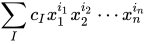
The polynomial (or polynomial from the Greek. Πολυ- “many” + lat. Nomen “name”) from variables Is the sum of monomials or, strictly, is the final formal sum of the form


- where
- - a set of non-negative integers, called a multi-index ,
- - a number called the coefficient of the polynomial , depending only on the multi-index .



In particular, a polynomial in one variable is a finite formal sum of the form
- where
- - fixed coefficients ,
- Is a variable .



Using the polynomial, the concepts of “ algebraic equation ” and “ algebraic function ” are derived.
Content
- 1 Study and application
- 2 Related Definitions
- 2.1 Polynomial Functions
- 3 Types of polynomials
- 4 Properties
- 4.1 Divisibility
- 5 Variations and generalizations
- 6 See also
- 7 Literature
- 8 References
Learning and Application
The study of polynomial equations and their solutions was almost the main object of “classical algebra”.
A number of transformations in mathematics are associated with the study of polynomials: the introduction of zero , negative , and then complex numbers , as well as the emergence of group theory as a branch of mathematics and the identification of classes of special functions in analysis.
The technical simplicity of calculations related to polynomials compared to more complex classes of functions, as well as the fact that the set of polynomials is dense in the space of continuous functions on compact subsets of the Euclidean space (see the Weierstrass approximation theorem ) contributed to the development of series and polynomial methods interpolation in mathematical analysis .
Polynomials also play a key role in algebraic geometry , the object of which is sets defined as solutions of polynomial systems.
The special properties of coefficient conversion for polynomial multiplication are used in algebraic geometry, algebra , knot theory, and other branches of mathematics to encode or express polynomial properties of various objects.
Related Definitions
- Polynomial of the form called a monomial or monomial multi-index .
- Multi-index monomial called a free member .
- Full degree of (non-zero) monomial called an integer .
- Many multi-indices for which the coefficients nonzero, called the support of the polynomial , and its convex hull - the Newton polyhedron .
- The degree of a polynomial is the maximum of the degrees of its monomials. The degree of identical zero is determined by the value .
- A polynomial that is the sum of two monomials is called a binomial or binomial ,
- A polynomial that is the sum of three monomials is called a trinomial or trinome .
- Polynomial coefficients are usually taken from a particular commutative ring (most often fields , for example, fields of real or complex numbers ). In this case, with respect to addition and multiplication, the polynomials form a ring (moreover, an associative-commutative algebra over a ring without zero dividers) which is denoted by .
- For polynomial single variable, solving the equation called its root .
Polynomial Functions
Let be there is algebra over the ring . Arbitrary polynomial defines a polynomial function
- .
Most commonly considered case .
If there is a field of real or complex numbers (as well as any other field with an infinite number of elements), the function completely defines the polynomial p. However, in the general case this is not true, for example: polynomials and of define identically equal functions .
The polynomial function of one real variable is called an entire rational function .
Types of Polynomials
- A polynomial of one variable is called unitary , normalized, or if its leading coefficient is unity.
- A polynomial whose monomials all have the same complete degree is called homogeneous .
- for example Is a homogeneous polynomial of two variables, and not homogeneous.
- A polynomial that can be represented as a product of polynomials of lower degrees with coefficients from a given field is called reducible (over this field), otherwise, irreducible .
Properties
- The ring of polynomials over an arbitrary region of integrity is itself a region of integrity.
- The ring of polynomials in any finite number of variables over any factorial ring is itself factorial.
- The ring of polynomials from one variable over the field is the ring of principal ideals , that is, any of its ideals can be generated by one element.
- Moreover, the ring of polynomials in one variable over a field is a Euclidean ring .
Divisibility
The role of irreducible polynomials in a polynomial ring is similar to the role of primes in an integer ring. For example, the following theorem holds: if the product of polynomials divided by an irreducible polynomial , then p or q is divided by . Each polynomial of degree greater than zero is decomposed in this field into a product of irreducible factors uniquely (up to factors of degree zero).
For example, polynomial , irreducible in the field of rational numbers, is decomposed into three factors in the field of real numbers and into four factors in the field of complex numbers.
In general, each polynomial is from one variable decomposes in the field of real numbers into factors of the first and second degree, in the field of complex numbers into factors of the first degree (the main theorem of algebra ).
For two or more variables this cannot be said. Over any field for any there are polynomials from variables irreducible in any extension of this field. Such polynomials are called absolutely irreducible.
Variations and generalizations
- If negative degrees are also allowed in the definition, then the resulting object is called the Laurent polynomial (see Laurent series ).
- Quasi-polynomial
- Trigonometric polynomial
See also
- Gröbner basis
- Posin
- Spline
- Gauss - Luke Theorem
Literature
- Vinberg E. B. Algebra of polynomials. - M .: Education, 1980 .-- 176 p.
- Kurosh A.G. Course in Higher Algebra, 9th ed. - M. , 1968.
- Mishina A.P., Proskuryakov I.V. Higher Algebra, 2nd ed. - M. , 1965.
- Solodovnikov A. S, Rodina M. A. Problem-solving workshop on algebra. - M .: Education, 1985 .-- 127 p.
- Prasolov V.V. Polynomials . - M .: MCCMO , 2003 .-- 336 p. - ISBN 5-94057-077-1 .
- Faddeev D.K., Sominsky I.S. Collection of problems in higher algebra. - M. , 1977.
Links
- Polynomial / A.I. Markushevich // Great Soviet Encyclopedia : [in 30 vol.] / Ch. ed. A.M. Prokhorov . - 3rd ed. - M .: Soviet Encyclopedia, 1969-1978.