“A Tale of Tsar Saltan” is an opera in 4 acts with a prologue (7 scenes) by Nikolai Andreyevich Rimsky-Korsakov . Libretto by Vladimir Belsky based on the fairy tale of the same name by A. S. Pushkin .
| Opera | |
| The Tale of Tsar Saltan | |
|---|---|
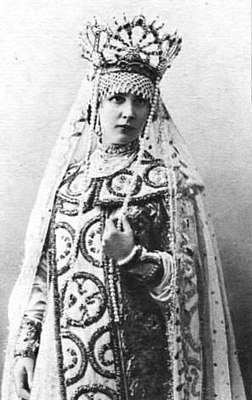 Elena Tsvetkova as Militris (1900) | |
| Composer | Nikolai Rimsky-Korsakov |
| Librettist | Vladimir Belsky |
| Tongue libretto | |
| Plot source | A fairy tale in poems by A. S. Pushkin |
| Action | four |
| First production | December 12 (25), 1902 |
Content
Creation History
The idea of writing an opera on the plot of Pushkin's tale came to the composer shortly after the end of The Tsar’s Bride , and the development of the script began in the winter of 1898-1899. The opera was supposed to be completed by the centenary of the birth of Pushkin (in 1899). An active collaborator of the composer was his librettist V.I. Belsky . In the spring of 1899, the composer began composing music. By the fall, the opera was written, and in January next year, work on the score was completed . The premiere of “Tales of Tsar Saltan” took place on October 21 (November 2), 1900 on the stage of the Moscow private opera - the Solodovnikovsky Theater Partnership. Conductor - Mikhail Ippolitov-Ivanov . Production designer - Mikhail Vrubel .
The composer himself especially loved this opera. After the dramatic “Tsar’s Bride”, she became the embodiment of bright, light humor. In 1901, Rimsky-Korsakov, reviewing the proofs of Saltan, wrote Zabele-Vrubel:
| Sometimes, like last night, when ... reached the Swans aria, a surge of pride, complacency and admiration for one’s own creativity suddenly begins. You think how clever, poetic and beautiful I was then, of course, in the sense of music. [1] . |
Saltan was the last opera in the stage history of which the Moscow private opera played a leading role. Subsequently, Rimsky-Korsakov gave the premieres of his operas to the imperial theaters.
Actors
| The consignment | Vote | Performer at the premiere in Moscow November 3, 1900 (Conductor: Mikhail Ippolitov-Ivanov ) | Artist at the premiere in St. Petersburg December 25, 1902 (Conductor: V. Green) |
|---|---|---|---|
| King Saltan | bass | Nikolay Mutin | Grigory Pirogov |
| Queen Militris | soprano | Elena Tsvetkova | Leonida Balanovskaya |
| Weaver, middle sister | mezzo soprano | Alexandra Rostovtseva | Olga Pavlova |
| Cook, older sister | soprano | Adelaide Veretennikova | Margarita Gukova |
| Swatya Baba Babarikha | contralto | Varvara Strakhova | Nina Pravdina |
| Prince Guidon | tenor | Anton Sekar-Rozhansky | Fedor Oreshkevich |
| Princess Swan (first Swan Bird) | soprano | Nadezhda Zabela-Vrubel | Elena Stepanova / Antonina Nezhdanova |
| old grandfather | tenor | Vasily Shkafer | Konstantin Arseniev |
| Messenger | baritone | Nikolay Shevelev | Leonid Savransky |
| Buffoon | bass | Mikhail Lewandowski | Ivan Disnenko |
| Three shipbuilders | tenor, baritone and bass | ||
| Chorus without singing: Voices of a sorcerer and spirits, boyars, nobles, courtiers, nannies, clerks, guards, army, shipbuilders, stargazers, walkers, singers, servants and servants, dancers and dancers, people, thirty-three sea knights with uncle Chernomor, squirrel, bumblebee. | |||
Story
The action takes place partly in the city of Tmutarakan , partly on the island of Buyan .
Prologue
Winter evening. Village light house. Three sisters are spinning. The older and middle sisters are not too zealous, encouraged by Baba Babarikha:
Do not spin through force
Many days to come!
However, the younger sister, Militris, is not allowed to sit idly by. The elder sisters boast to each other of their pride and beauty and dream of what each of them would do if she became a queen. At the door of the room the king Saltan stopped, passing by with a retinue of boyars. He listens to the conversation of the sisters. The eldest of them promises to arrange a feast for the whole world, the middle one promises to weave canvases, while Militris promises to give birth to a hero for the father-king.
The king enters the room. The stunned sisters and Babarikha fall to their knees. The king tells everyone to follow him to the palace in order to become: Militris - the queen, and her sisters - the cook and weaver. The sisters are annoyed and ask Babarikh to help them take revenge on Militris. The latter offers a plan: when Saltan leaves for war, and his wife gives birth to a son, they will send a letter to the tsar instead of joyful news:
“The queen gave birth to the night
Not a son, not a daughter
Not a mouse, not a frog,
And to the unknown animal. ”
The sisters approve of the plan and triumph in advance of victory.
Action One
The royal court in Tmutarakan. Militris is sad. Near her is Babarikha and the buffoon, a servant, and at the gate - a guard. A cook enters with a tray of dishes. An old grandfather appears and asks to let him go to the prince in order to ridicule him with fairy tales. The Weaver comes - to boast of an intricate carpet woven by her. The prince woke up. Nannies sing to him a cheerful children's song “Ladushki”. The royal court is filled with people. Everyone admires the prince, and the choir performs toasts in honor of him and the queen.
Pushing the crowd, a drunken messenger bursts in with a letter from King Saltan. He complains to the tsarina about how badly he was received by the tsar, and talks about the "hospitable" grandmother who fed him well and got drunk. The clerks read the royal letter:
“The king tells his boyars
Wasting no time
And the queen and the offspring
Throw in a barrel into the abyss of water. "
All at a loss. Militris in despair. The sisters and Babarikh viciously rejoice. Enter Prince Gwidon. The Queen embraces him, pouring out her sorrow in a sad song. Roll out a huge barrel. Under the lamentation and lamentations of the people, the tsarina and her son are walled up in a barrel and escorted to the shore. The cry of the crowd merges with the noise of oncoming waves.
Action Two
The shore of Buyana Island. The orchestra paints a magnificent picture of the water element. On the crest of the wave, a barrel appears or disappears. Gradually, the sea calms down, throws the barrel to the shore, and Militris and the matured prince come out of it. They rejoice in salvation, but the queen is concerned: after all, "the island is empty and wild." Gwidon calms his mother and gets down to business - he makes a bow and arrow. Suddenly, the noise of a struggle and a groan is heard: it is at sea “a swan beating in the midst of a swell, a kite rushing over it.”
Guidon takes aim and fires an arrow from a bow. It got dark. The amazed queen and prince see the Swan bird emerging from the sea. She appeals to her savior Gwidon with gratitude, promises to repay him kindly and reveals her secret:
You didn’t deliver the swan,
The girl was left alive.
You didn’t kill a kite,
He shot the sorcerer.
Swan Bird advises not to grieve, but to go to bed. Militris and Gwidon decide to follow the advice. Mother sings a lullaby to her son. Both fall asleep. Dawn is coming, from the morning fog looms the fabulous city of Lollipop. The queen and the prince wake up, admiring the vision, and Gwidon guesses:
I see:
My swan is amusing.
A jubilant people emerges from the gates of the city, thanks Guidon for getting rid of the evil sorcerer, and asks to reign in the glorious city of Lollipop.
Action Three
Scene One
The shore of Buyana Island. In the distance, a ship carrying guests shipbuilders to Tmutarakan is visible. Guidon stares after them with longing. He complains to the Swan Bird that he was bored with all the wonders of the island, and he wants to see his father, so much so that he himself remains invisible. The swan bird agrees to fulfill his request and orders the prince to plunge into the sea three times to turn into a bumblebee. The famous orchestral flight of a bumblebee sounds - this is Gwidon flies off to catch up with the ship.
Scene Two
The royal court in Tmutarakan. King Saltan sits on the throne - he is sad. Beside him is the cook, weaver, and bridegroom Babarikha. A ship moors to the shore. Merchant guests are invited to the king, they are seated at a table laden with dishes and treated. In gratitude, the guests begin stories about the miracles they saw in the world: the appearance on the deserted island of the beautiful city of Lollipop, in which there live a squirrel that can bite golden nuts and sing songs, and thirty-three heroes.
The cook and the weaver try to distract the king's attention with other stories, and the bumblebee is angry at them for this and stings each with an eyebrow. King Saltan's desire to visit a wonderful island is growing. Then Babarikha talks about the most amazing of miracles: about the beautiful princess, who beauty “eclipses the light of God during the day, illuminates the earth at night”. Then the bumblebee stings Babarikha in the eye, and she screams. A general commotion begins. The bumblebee is caught, but it flies away safely.
Action Four
Scene One
The shore of Buyana Island. Evening. Gwidon dreams of a beautiful princess. He calls the Swan bird, confesses her love for the princess and asks to find her. The swan does not immediately fulfill his request: she is not sure of his feeling. But Guidon insists and is ready to go for his beloved "at least for the distant lands." And finally Swan says:
No, why look far away?
I will say, taking a deep breath:
Know your fate has come
That princess is me!
In the thickening darkness, the Swan Princess appears in the dazzling brilliance of her beauty. The morning comes, and the song comes - the queen Militris goes to the sea, accompanied by the servants. Gwidon and the Swan Princess are asking her to consent to the marriage, and Militris blesses them.
Scene Two
The orchestra entry tells of the city of Lollipop and its miracles: squirrel, heroes, the Swan Princess. On the island of Buyan await the arrival of Saltan. The bell rings. The ship is mooring at the marina. The king’s retinue descends to the shore, and behind her is Saltan, accompanied by the cook, weaver and Babarikha. Gwidon welcomes a distinguished guest, seated next to him on the throne and offers to admire miracles. According to the Tsarevich’s sign, heralds trumpet, announcing the appearance of a crystal house with a wonderful squirrel, and then - knights with Uncle Chernomor, and, finally, the Swan Princess leaves the tower.
Everyone is delighted and covers their eyes with their hands, blinded by her beauty. Saltan is thrilled and asks the sorceress Swan to show him Queen Militris. She answers:
The gift of miracles to the princess is given:
Take a look at the tower, King Saltan.
On the porch appears the queen. The duet of Saltan and Militris is joyful and excited. The king asks about his son. Gwydon steps forward and says:
My darling, it's me!
The cook and weaver fall at the feet of King Saltan, begging for forgiveness. Babarikha runs away in fear, but in joy the king forgives everyone.
Records
Audio Records
| Year | Organization | Conductor | Soloists | Publisher and catalog number | Caption text |
|---|---|---|---|---|---|
| 1952 | Stuttgart Radio Symphony Orchestra | Hans Mueller Edge | Tsar Saltan - Wilhelm Shirp, Tsarina Militris - Maud Cunitz, Weaver - Hetty Plümacher, Baba Babarikha - Res Fischer, Tsarevich Guidon - Christo Bajew, Princess Lebed - Friederike Sailer, Old grandfather - Franz Fehringer, Messenger - Robert Titze | Walhall Eternity Series WLCD 0242 (2008) | German |
| 1955 | Bolshoi Theater Choir and Orchestra | Vasily Nebolsin | Tsar Saltan - Ivan Petrov , Tsarina Militris - Evgenia Smolenskaya , Weaver - Larisa Nikitina , Cook - Elena Shumilova , Babarikha - Evgenia Verbitskaya , Tsarevich Gvidon - Vladimir Ivanovsky , Tsarevna Lebed - Galina Oleinichenko , old grandfather - Pavel Aleksey Ivanov , the messenger , buffoon - Mark Reshetin | D 05010-5 (1959), Melody D 032909-14 (1972) | |
| 1959 | Croatian National Theater in Zagreb | Demetrius Zebra | Tsar Saltan - Zdravko Kovac, Queen Militris - Nada Toncic, Weaver - Tatiana Slastenko, Cook - Bjanka Decman, Babarikha - Mariana Radev, Princess Gvidon - Janec Lipusek, Princess Swan - Maria Glavasevic, Old Grandfather - Franco Paulik Bel , buffoon - Milivoy Bacanovic | Philips A 02014-6 L (1960) |
Video
| Year | Organization | Conductor | Soloists | Manufacturer or publisher and catalog number | Notes |
|---|---|---|---|---|---|
| 1978 | Dresden State Opera | Siegfried Kurtz | Tsar Saltan - Rolf Wollard, Tsarina Militris - Lidija Rushizkaja, Babarikha Baba - Barbara Hoene, Tsarevich Gvidon - Stephan Spiewok, Tsarevna Swan - Ilse Ludwig (-Jahns) | VIEW Video 1406 | German |
Notes
- ↑ Cit. by: Rimsky-Korsakov A.N. N. A. Rimsky-Korsakov. Life and art. Vol. IV. M .: Muzgiz, 1937.S. 146.