American toad [2] ( lat. Anaxyrus americanus [1] ) - amphibian family of true toads .
| American toad |
 |
| Scientific classification |
|---|
| No rank : | Bilateral symmetrical |
| Squad: | Tailless Amphibians |
|
| International scientific name |
|---|
Bufo americanus Holbrook , 1836 [1] |
| Synonyms |
|---|
- Anaxyrus americanus (Holbrook, 1836)
|
| Subspecies |
|---|
- Bufo americanus americanus
- Bufo americanus charlesmithi
|
| Area |
|---|

|
| Security status |
|---|
Least ConcernedIUCN 3.1 Least Concern : 54570 |
|
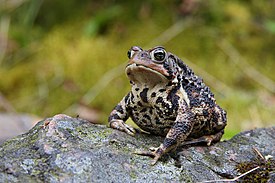
The total length reaches 5-11.1 cm. The head is of moderate size. The body is slightly elongated. The parotids are elongated, separated from the bone ridges behind the eyes, or connected with them by a short spur. Postorbital ridges high, without pronounced swelling. The skin of the back is covered with a large number of small and medium warts. Warts are also developed on the dorsal side of the lower leg. A characteristic feature is small dark spots on the back with greatly enlarged warts.
Color varies from tan to brown. On the sides there is a green pattern. Warts are usually reddish or brown.
It inhabits various biotopes from suburban landscapes to mountain deserts. Keeps near ponds, preferring wet shelters and shelters. It feeds on insects and other invertebrates.
The female lays up to 2000 eggs. Larvae appear in 2-14 days. Tadpoles grow pretty fast. Metamorphosis lasts 50–65 days.
The species is distributed from the province of Manitoba ( Canada ) to northern Texas along the entire eastern coast of the United States , an isolated population lives on the island of Newfoundland .