Peter of Amiens ( Latin: Petrus Ambianensis , aka Peter the Hermit , Latin: Petrus Heremita ), is an ascetic to whom the organization of the first crusade was attributed.
| Peter Amiensky | |
|---|---|
| Date of Birth | |
| Place of Birth | |
| Date of death | |
| A place of death | |
| A country | |
| Occupation | |
Peter was born around 1050 in Amiens , was a military man, then retired from the world and became a monk, a hermit. At that time, the Christian world was obsessed with the idea of crusades.


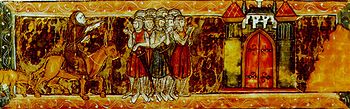
Dad was the main engine of this movement, in which the ascetic mood of an entire era was clearly reflected; but according to the legends recorded by Albert of Aachen and William of Tire, the head of the crusade was not Pope, but Peter, who even carried the pope with his inspiration. Of small stature, having a miserable appearance, he was fraught with great valor.
He was crazy "quick and insightful, spoke pleasantly and fluently." Arriving in Palestine, Peter was deeply saddened to learn about the plight of Christians. During a conversation with the Jerusalem patriarch Simon, Peter advised him to turn for help “to the Pope Bishop and the Roman Church, to the kings and princes of the West,” and he expressed his readiness to go to them and beg them for help. Confidence in success arose in the "miserable, poor and devoid of any means of pilgrim" due to the help of Christ the Savior. He appeared to Peter in a dream, encouraged him and ordered a crusade. In Rome, Peter appealed to Pope Urban II.
He listened to the appeal, blessed Peter to preach, and promised his zealous assistance. Peter went to Vercelli , from there to Clermont , went through all the countries, urging them to fight for the Savior. The people surrounded him in droves, brought him gifts and glorified his holiness. “Everything that he neither said nor did - revealed divine grace in him” . Everyone recognized his power. No one knew better than him to settle disagreements and reconcile the most cruel enemies. Many pulled out, like a shrine, the wool from his mule. Peter did not eat bread, eating wine and fish. Having gathered a large army, Peter decided to direct his way through the land of the Hungarians. Then all the lands and all the princes and knights in all of France rose to the liberation of the Holy Sepulcher . According to this legend, Peter had already done half the work when Pope Urban arrived in Clermont with a call for a campaign (in 1095 )
The legend in that version, which is set forth by William of Tire , Abbot Guibert Nozhansky and Anna Komnina , pushed the pope into the background, putting forward Peter. Meanwhile, contemporaries do not know Peter, do not ascribe to him the initiative of the Crusades, do not talk about him as about the messenger of God who excited the West. In the north of France, Peter was known only as one of many popular preachers; English and Italians, he was not at all known. To his contemporaries he seemed to be an ordinary ascetic fanatic who had gathered a militia from peasants, beggars, serfs, and tramps. The leaders of these hordes were Peter and Gauthier the Pauper . Plachevna was the fate of the first militia.
Constant skirmishes, Jewish pogroms , battles in Hungary and Bulgaria, general disorder deprived the leaders of influence on the masses. Czechs, Hungarians and Bulgarians destroyed the crusaders. After crossing into Asia, Peter left the militia, which was soon exterminated by the Turks, and joined the army of Gottfried of Bouillon . When the crusaders in 1098 were besieged by Emir Kerboga in Antioch , there came such a famine that many fled in droves, others descended from the walls on ropes and went into the woods.
Among the “rope runaways” was Peter, but he did not manage to escape, because he was caught by Tancred of Tarentsky and forced to swear that Peter would not run away. The name of Peter is mentioned during negotiations with Carboga near Antioch. After the capture of Jerusalem, Peter returned to his homeland, arrived in Picardy, and founded the Augustinian monastery in Yui in 1099 , the rector of which he died in 1115 .
Notes
Literature
- Sybel, "Geschichte des ersten Kreuzzuges", where legends of the crusade are examined.
- Peter Amiensky // Brockhaus and Efron Encyclopedic Dictionary : in 86 volumes (82 volumes and 4 additional). - SPb. , 1890-1907.