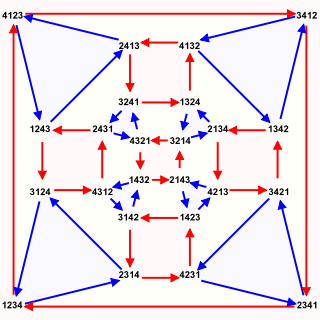

( permutation matrix multiplication table )
The following six matrix positions are available:
 The table is asymmetric with respect to the main diagonal, i.e. the group is not abelian.
Symmetric group - the group of all permutations of a given set (i.e. bijection ) relative to the operation of the composition .


The symmetric group of the set usually indicated , if then also denoted by . Since for equipotent sets ( ) their permutation groups ( ), therefore, for a finite group of order the group of its permutations is identified with .




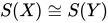

The neutral element in the symmetric group is the identity permutation .

Content
- 1 permutation groups
- 2 Properties
- 3 views
- 4 notes
- 5 Literature
Permutation Groups
Although usually the group of permutations (or permutations) is called the symmetric group itself, sometimes, especially in English literature, permutation groups of the set called subgroups of a symmetric group [1] . The degree of the group in this case is called the power .
Each end group isomorphic to some subgroup of the group ( Cayley's theorem ).
Properties
The number of elements of the symmetric group for a finite set is equal to the number of permutations of the elements, that is, the power factorial : . At symmetric group non-commutative.
Symmetric group allows the following task :
- .
We can assume that rearranges and . Maximum order of group elements - Landau function .
Groups solvable when symmetric group is insoluble .
A symmetric group is perfect (that is, the conjugation map is an isomorphism) if and only if its order is different from 2 and 6 ( Hölder's theorem ). When Group has another . By virtue of this and the previous property, for all automorphisms are internal, that is, every automorphism has the form for some .
The number of classes of conjugate elements of a symmetric group equal to the number of partitions [2] . Many transpositions is the generating set . On the other hand, all these transpositions are generated by just two permutations so that the minimum number of generators of a symmetric group is two.
The center of the symmetric group is trivial for . Commutant is an alternating group ; with Is the only nontrivial normal subgroup , but has another normal subgroup - the Klein quadruple group .
Views
Any subgroup permutation groups representable by a group of matrices from , with each permutation there corresponds a permutation matrix (a matrix in which all elements in cells equal to 1, and other elements are equal to zero); e.g. permutation represented by the following matrix :
A subgroup of such a group, composed of matrices with determinant equal to 1, is isomorphic to an alternating group .
There are other representations of symmetric groups, for example, the symmetry group (consisting of rotations and reflections) of the dodecahedron is isomorphic , and the rotation group of the cube is isomorphic .
Notes
- ↑ Aigner M. Combinatorial Theory. M .: Mir, 1982.- 561 p.
- ↑ sequence A000041 in OEIS
Literature
- Vinberg E. B. The course of algebra. - M .: Factorial Press, 2001.
- Kargapolov M. I, Merzlyakov Yu.I. Fundamentals of group theory. - M .: Science, Fizmatlit, 1982.
- Kostrikin A. I. Introduction to Algebra. Part III. The main structure. - M. publishing house = Fizmatlit, 2004.
- Kurosh A.G. Group Theory. - M .: Science, Fizmatlit, 1967.
- Postnikov M.M. Galois Theory. - M .: Fizmatlit, 1963.