Lead ibis [1] ( Latin: Theristicus caerulescens ) is a South American bird from the ibis family.
| Lead ibis |
 |
| Scientific classification |
|---|
| No rank : | Bilateral symmetric |
|
| International Scientific Name |
|---|
Theristicus caerulescens ( Vieillot , 1817 ) |
| Security status |
|---|
Least concernIUCN 3.1 Least Concern : 22697435 |
|
Content
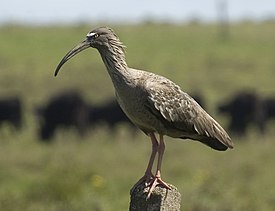
Lead ibis reaches a length of 71 to 76 cm. The plumage is heterogeneous, gray-black, sometimes with a bluish glow, depending on the light. Bill is dark gray. Characterized by a white stripe on the forehead and luxurious gray feathers of the tuft. Pronounced sexual dimorphism is absent.
Lead ibis is common, but not very often in eastern Bolivia, central Brazil, and in the Gran Chaco of northern Argentina and Paraguay. The bird prefers open meadows, pastures and savannahs; it is also found in humid areas and in small bodies of water.
The food of a lead ibis consists of insects and their larvae, worms, snails and their eggs, less often also from small amphibians.
Lead ibis does not nest in colonies. Separate nests are built on tall trees at a height of 8 to 20 m, usually near water. As a material for the construction of nests used branches, for laying grass and leaves. In laying 2 to 3 eggs. Hatching lasts about 28 days.
- ↑ Boehme RL , Flint V. Ye. The five-language dictionary of animal names. Birds. Latin, Russian, English, German, French / Under total. ed. Acad. V.E. Sokolova . - M .: Rus. lang, "RUSSO", 1994. - p. 27. - 2030 copies. - ISBN 5-200-00643-0 .
- J. del Hoyo, A. Elliott, J. Sargatal (Hrsg.) (1992): Handbook of the Birds of the World . Vol. 1. Ostrich to Ducks. Lynx Edicions, Barcelona, ISBN 84-87334-10-5