
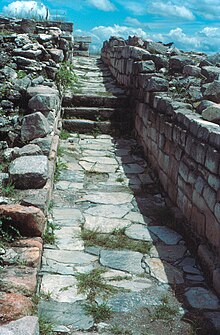

Quetlahuchitlan , ast. Cuetlajuchitlan , the “place of poinsettia ” is an important archaeological site in the Mexican state of Guerrero , 35.5 km east-southeast of the city of Iguala de la Independencia , near the Paso Morelo area in the county of Witsuko de los Figueroa (Huitzuco de los Figueroa). It belongs to the middle and late classical periods of Mescal culture.
Located on the top of the mountain, the settlement was discovered only in 1991 during the construction of the Cuernavaca - Acapulco motorway. In order to avoid the destruction of the settlement, a tunnel was laid under it.
Of about 35 hectares of the area of the ancient city, only about 2 hectares have been excavated.
The most impressive finds of ceremonial complexes include several monolithic rectangular basins with vertical side walls (almost destroyed by now). These pool baths resemble similar bathtubs found in various places on the border of the modern Mexican states of Puebla and Tlascal , for example, in Xochitecatl . It is assumed that the baths played a ceremonial role, based on their location and the complexity of their manufacture.
Literature
- Rubén Manzanilla López / Jorge Arturo Talavera González: Cuetlajuchitlán, Sitio Preurbano en la Región Mezcala . In: Arqueológia Mexicana 82 (2006). ISSN 0188-8218