| ||||||||||||||||||||||||||||||||||||


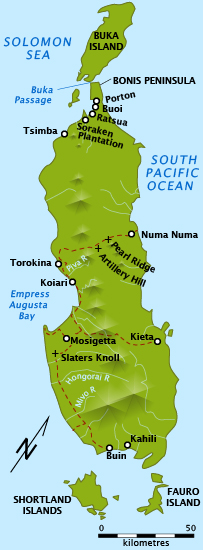
The bougainville campaign its surroundings in the South Pacific during World War II .
At that time, Bougainville Island was part of the Australian Mandate Territory of New Guinea , although geographically it is part of the Solomon Islands archipelago . Therefore, the Bougainville campaign is seen as part of the larger New Guinean campaign , as well as the campaign in the Solomon Islands .
In March-April 1942, Japanese forces occupied Bougainville and began construction of an airfield and naval base at Buin in the southern part of the island, an airfield on Buka Island north of Bougainville [6] [7] , and a naval base near Shortland Islands . In this way, Japanese bases provided protection and security for their main foothold in Rabaul , New Britain , and support for their garrisons in the Solomon Islands.
Content
General Background
In March-April 1942, the Japanese landed on Bougainville and began the construction of numerous airfields on the island. [8] The main airfields were located on Buka Island on the Bonis Peninsula and near Kahili and Kieta, [8] in addition, a naval base was built in the south in Buin. [9] These bases enabled the Japanese, along with other bases, to conduct operations in the southern Solomon Islands and attack Allied communications between the United States, Australia and the southwestern Pacific. [eight]
In the final stages of Operation Catville , the Allied forces planned to use the Bougainville airbases to ensure the isolation and neutralization of Rabaul. Estimates of the number of Japanese troops on Bougainville at the beginning of the campaign vary in a wide range from 42,000 to 65,000 troops in the army, navy and workers. [3] In November 1943, the US Marine Corps landed on Cape Torokina on Bougainville [8] and established a coastal bridgehead , in the area of which the Allies ultimately built three airfields. The invasion forces were later replaced by US Army soldiers in January 1944, [8] which were subsequently replaced by Australian police units in October 1944. [10] The campaign ended with the surrender of Japan in August 1945. [eleven]
Campaign Progress
November 1943 - November 1944
The Allied operation to return Bougainville, which was defended by the Japanese 17th Army, began with a landing on Cape Torokin of the 1st Amphibious Corps of the 3rd US Marine Corps Division on November 1, 1943. [8] The Allies captured the coastal bridgehead near Cape Torokin for the construction of an airfield for fighters, given that their range will reach Rabaul. The allies at this time had not yet planned to completely clear the Bougainville from Japanese troops. The attempt of the Japanese fleet to attack the landing troops was reflected by the American fleet in the battle in the bay of Empress Augusta on November 1-2. A subsequent attempt by the Japanese ground forces to attack the Allied bridgehead was reflected in the battle at the Koromokin lagoon .
On November 6-19, 1943, the last regiment of the 3rd Marine Division and the 37th Army Infantry Division landed from the 1st amphibious corps of the United States Marine Corps, which were supposed to expand the coastal bridgehead. This was followed by protracted and often heavy fighting in the jungle, in which there were many losses from malaria and other tropical diseases. With the exception of clashes between patrols, all hostilities for expanding the bridgehead took place in the maritime sector. The most important combat clashes were the battle on the Beer Trail , the battle on the coconut grove , the battle on the Beer River and the battle for a height of 600A.
In November and December, the Japanese transferred field artillery to a hill near the Allied bridgehead, concentrating it on the hills along the Torokina River, which dominated the eastern part of the perimeter. Japanese artillery began shelling airfields and field depots. The 3rd Marine Division expanded the perimeter of defense, capturing heights as a result of a series of operations on December 9-27. One of the heights, the Hellzapoppin Ridge, was a 300-foot (91 m) natural fortress with steep slopes and a narrow ridge that dominated most of the bridgehead. The Japanese built large artillery positions on the slopes from the opposite side, using natural and artificial camouflage. 21 Marine Regiments attacked the Hellzapoppin Range, but were driven back on December 18. Several aircraft raids on a narrow ridge did not reach the goal. Ultimately, as a result of the coordinated actions of aviation, artillery and infantry at Christmas, the Hellzapoppin Ridge was captured.
On December 15, 1943, the 1st amphibious corps of the marine corps was replaced by the 14th army corps [8] , and on December 28 the 3rd division of the marine corps was replaced by the American division . The 14th Corps held the bridgehead defense during a major Japanese counteroffensive on March 9-17, 1944; the height of 700 and the artillery height was defended by the 37th Ohio Infantry Division, and the height of 260 was defended by the division of the Americas. The counterattack was repelled with heavy casualties for the Japanese army, which led most of its troops deep into the island and into the northern and southern parts of Bougainville. [12]
On April 5, 1944, the 132nd Infantry Regiment of the Americas division, during the sweeping of the territory in the area of the Empress Augusta’s bay, successfully attacked and captured the Japanese-held village of Mavavia. Two days later, while continuing to clean up, the regiment discovered a fortified area, where he destroyed about twenty firing points using Bangalore torpedoes and bazookas . Later, the 132nd Infantry Regiment, together with units of the Fijian Self-Defense Forces, was tasked with capturing the heights west of the Zaua River. The regiment, along with allied units, captured the heights of 155, 165, 500 and 501 in heavy fighting, which ended on April 18, when the last Japanese defenders were killed or retreated. [13]
The Japanese, isolated and cut off from foreign aid, had to focus on survival, including by creating agricultural farms on the island. [12] The Americans received reinforcements from the 93rd Infantry Division, the first African - American infantry regiment to take part in the fighting in World War II. The Allies made every effort to build many airfields on the coastal bridgehead, from where they carried out fighter and bombing operations against Rabaul , Kavieng and other Japanese bases in the South Pacific region. The air cover over Bougainville was mainly carried out by the Royal New Zealand Air Force , the Marine Squadron and the US Army , which were subordinate to the Solomon Islands Air Command ( “AIRSOLS” ).
After studying all the reports, Australian intelligence officers estimated the loss of the Japanese at 8,200 killed in the fighting during the American phase of the operation and another 16,600 who died from illness and malnutrition. [14]
November 1944 - August 1945
From October to December 1944, US ground forces transferred all operations on the island to the main forces of the Australian 2nd Corps, a police unit. [10] The Australian 3rd Division and 11th Brigade were deployed to Bougainville to assist the Fiji Infantry Regiment . The Australian 23rd Brigade began to carry out garrison service in the nearby islands. [15] The Australians found that the Japanese forces on Bougainville, which now numbered about 40,000, still remained at the forefront and, despite a decrease in combat readiness, were organized into military formations, including the 38th separate mixed brigade and 6th division. The Australian 2nd Corps began to conduct aggressive actions aimed at the defeat and destruction of these troops. [14]
The final stage of the Allied campaign, which began with hostilities on November 29 and the offensive on December 30, developed simultaneously in three directions: to the north, where it was planned to drive Japanese troops to the narrow Bonis Peninsula; in the center, the capture of the Pearl Range was supposed to give Australians control over the east-west railways and protection against potential counterattacks, as well as a path to the east coast; and the main attack to the south, where the main Japanese forces were concentrated. [sixteen]
After the capture of the Pearl Range in the central sector in December 1944, the northern and southern sectors became the main campaign areas, operations in the central sector were limited to patrols along the Numa-Numa road. [17] In the north, Australians were advancing along the coast to the Genga River, sending patrols to inland areas, expelling the Japanese from the hills. [18] After capturing the Tsimba ridge in February 1945, they continued their advance towards Ratsuya, forcing the Japanese to retreat to the Bonis Peninsula. Here, the Australians met with strong defense, and in June, an attempt to get around Japanese positions from the flank by landing amphibious forces at the Portok plantation failed. Ultimately, it was decided to stop advancing to the Bonis Peninsula and keep the front at Ratsua [19] , while the main resources were directed to the southern sector towards Buin. In the southern sector, after a short but bloody Japanese counterattack near Slater Hill , the Australians prevailed and confidently headed south, crossed the Khongorai , [20] Hari and Mobai rivers. However, shortly after approaching the Miwo River, the offensive came to a halt due to tropical rains that flooded many bridges and roads along which Australian lines of communication ran. In this regard, infantry fighting became impossible for almost a month until the end of July, and only in early August did the Australians resume patrolling along the Miwo River. [21]
The fighting on Bougainville ended with the surrender of Japanese troops on Bougainville on August 21, 1945. The Japanese Empire signed an act of surrender in Tokyo Bay on September 2, 1945. At the last stage of the campaign, 516 Australians died and another 1,572 were injured. At the same time, 8,500 Japanese were killed, [22] and another 9,800 died from disease and malnutrition. About 23,500 soldiers and workers were captured where they remained until the end of the war. [14]
During the campaign, three Victoria Crosses were awarded: one Fijian and two Australians. Corporal Stefanai Sukanivalu with Fiji was awarded a posthumous award for bravery at Mavarak on June 23, 1944. [23] Corporal Reg Ratti was rewarded for his actions during the battle for Slater Hill on March 22, 1945, and Private Frank Partridge was rewarded for one of the last battles of the campaign on July 24, 1945 at Ratsua. [24] [25] The Victoria Ratti and Partridge Crosses were the last such rewards in the war, the Australian police were no longer awarded such awards.
Notes
- ↑ Shaw, Isolation of Rabaul , p. 246, Lofgren, Northern Solomons , p. 27, & Gailey, Bougainville , p. 191. This number includes 96,000 American and 30,000 Australian soldiers.
- ↑ 1 2 Shaw, Isolation of Rabaul , ss. 185-86.
- ↑ 1 2 Rottman, Japanese Army , pp. 70-72 (45,000) and AWM, Australia in the War of 1939-1945 (42,000). Gailey, Bougainville , p. 211 and Long, The Final Campaigns , ss. 102–103 are reported by 65,000 Japanese in Bougainville and adjacent islands. The Long estimate was confirmed by Australian intelligence officers, who updated the data at the end of the war and published it in AWM / Australia in the War of 1939-1945 .
- ↑ Shaw, Isolation of Rabaul , p. 281, Lofgren, Northern Solomons , p. 32 and Gailey, Bougainville , p. 210. By country: 7,270 US troops and 5,160 Australia.
- ↑ Rottman, Japanese Army , ss. 70-72, AWM, Australia in the War of 1939-1945 and Gailey, Bougainville , p. 211. Included are those who died from all causes: military, from illness, malnutrition, and accidents. Australians counted between 21,000 and 23,500 Japanese who survived on Bougainville at the time of Japan's surrender at the end of World War II. If the initial number of Japanese troops on Bougainville is 65,000 according to Gailey and Long, then the number of dead Japanese should be greater. Long, according to the text of the book, has 16,700 dead as a result of hostilities and 26,400 dead from illness and malnutrition.
- ↑ W. Murray, AR Millett. A War To Be Won. - 2001 .-- P. 169-195.
- ↑ R. Spector. Eagle Against The Sun. - 1985. - P. 152-153.
- ↑ 1 2 3 4 5 6 7 Keogh 1965, and. 414.
- ↑ Murray 2001, p. 169-195, Spector 1985, ss. 152-53.
- ↑ 1 2 Maitland 1999, p. 108.
- ↑ Keogh 1965, p. 420.
- ↑ 1 2 Keogh 1965, p. 415.
- ↑ Gailey, Harry A., Bougainville, 1943-1945: The Forgotten Campaign , University Press of Kentucky (2003), ISBN 0-8131-9047-9 , 9780813190471, p. 171
- ↑ 1 2 3 Long 1963. ss. 102-103.
- ↑ Keogh 1965, p. 416.
- ↑ Johnston 2007, ss. 30-31.
- ↑ Keogh 1965, p. 421.
- ↑ Long 1963, p. 122.
- ↑ Long 1963, p. 234.
- ↑ Maitland 1999, p. 122.
- ↑ Long 1963, p. 222.
- ↑ Maitland 1999, p. 124.
- ↑ Casualty Details: Sefanaia Sukanaivalu . Commonwealth War Graves Commission. Date of treatment December 26, 2009. Archived April 23, 2012.
- ↑ Maitland 1999, p. 121.
- ↑ Long 1963, p. 236.
Literature
In Russian
- Samuel Eliot Morison . The American Navy in World War II . Breakthrough of the barrier at the Bismarck archipelago, June 1942 - May 1944. - M .: AST , 2003. - T. 6. - 600 p. - (Military Historical Library). - 5,000 copies. - ISBN 5-7921-0617-7 .
In English
- Eric Bergerud. Touched with Fire: The Land War in the South Pacific. - New York, NY: Penguin Books, 1997 .-- 566 p. - ISBN 0-140-24696-7 .
- Harry A. Gailey. Bougainville, 1943-1945: The Forgotten Campaign . - 2. - Lexington, KY: University Press of Kentucky,2003 . - 248 p. - ISBN 0-8131-9047-9 .
- The Australian Army in World War II . - 1. - Oxford, UK: Osprey Publishing, 2007. - 64 p. - ISBN 1-846-03123-0 .
- Gavin long The Final Campaigns . - 1. - Canberra: Australian War Memorial, 1963. - Vol. 7. - 667 p. - ( Australia in the War of 1939-1945 . Series 1 - Army).
- William L. McGee. The Solomons Campaigns, 1942-1943: From Guadalcanal to Bougainville: Pacific war turning point. - 1. - Tiburon, CA: BMC Publications, 2002. - Vol. 2. - 639 p. - (Amphibious Operations in the South Pacific in World War II). - ISBN 0-970-16787-3 .
- , A War To Be Won: Fighting the Second World War . - Cambridge, MA: Harvard University Press , 2001 .-- 736 p. - ISBN 0-674-00680-1 .
- George Odgers. Air War Against Japan, 1943–1945 . - 2. - Canberra: Australian War Memorial, 1968 . - Vol. 2. - 533 p. - ( Australia in the War of 1939-1945 . Series 3 - Air).
- Gordon Rottman Japanese Army in World War II: The South Pacific and New Guinea, 1942–43 . - 1. - Oxford, UK: Osprey Publishing, 2007. - 96 p. - ISBN 1-841-76870-7 .
- Ronald H. Spector. Eagle Against The Sun: The American War With Japan. - 1. - New York: MacMillan, Inc., 1985. - 589 p. - ISBN 0-029-30360-5 .
Links
- Wikimedia Commons has media related to the Bougainville Campaign