Mohs scale ( mineralogical hardness scale ) - a ten-point scale designed for rough estimation of the relative hardness of materials by scratching. The division of the scale by points is based on a set of reference minerals . As standards , 10 minerals are arranged in order of increasing hardness [1] .
It was proposed in 1811 by the German mineralogist Friedrich Moos .
Scale values from 1 to 10 correspond to 10 fairly common minerals from talc to diamond . The hardness of a mineral is measured by searching for the hardest reference mineral that it can scratch; and / or the softest reference mineral that scratches the given mineral. For example, if a mineral is scratched by apatite , but not fluorite , then its hardness is in the range from 4 to 5.
Designed for rough comparative diagnostics of the hardness of materials according to a softer-harder system. The test material either scratches the standard and its hardness on the Mohs scale above, or is scratched by the standard and its hardness below the standard. Thus, the Mohs scale only informs about the relative hardness of minerals. For example, corundum (9) is 2 times harder than topaz (8), but it is almost 4 times less hard than diamond (10). The table below shows the correspondence of the Mohs hardness to the absolute hardness measured by a sclerometer .
| Mohs hardness | Reference mineral | Absolute hardness | Picture | Machinability | Other minerals with similar hardness |
|---|---|---|---|---|---|
| one | Talc (Mg 3 Si 4 O 10 (OH) 2 ) | one | 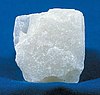 | Scratched with a fingernail | Graphite |
| 2 | Gypsum (CaSO 4 · 2H 2 O) | 3 |  | Scratched with a fingernail | Halite , chlorite , mica |
| 3 | Calcite (CaCO 3 ) | 9 |  | Copper scratched | Biotite , gold , silver |
| four | Fluorite (CaF 2 ) | 21 |  | Easy to scratch with a knife, window glass | Dolomite , Sphalerite |
| five | Apatite (Ca 5 (PO 4 ) 3 (OH-, Cl-, F-)) | 48 | 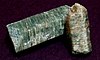 | With an effort it is scratched with a knife, window glass | Hematite , lapis lazuli |
| 6 | Orthoclase (KAlSi 3 O 8 ) | 72 | 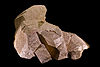 | Scratches the glass. Filed | Opal , rutile |
| 7 | Quartz (SiO 2 ) | 100 |  | Diamond treats, scratches glass | Pomegranate , tourmaline |
| eight | Topaz (Al 2 SiO 4 (OH-, F-) 2 ) | 200 | 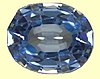 | Diamond treats, scratches glass | Beryl (heliodor, aquamarine, emerald), spinel , |
| 9 | Corundum (Al 2 O 3 ) | 400 |  | Diamond treats, scratches glass | Varieties of corundum - Sapphire Ruby |
| ten | Diamond (C) | 1600 |  | Cuts glass | close to Elbor , but there is no natural analogue |
In addition to the Mohs scale, there are other methods for determining hardness, but different hardness scales cannot be unambiguously correlated with each other. Practice has adopted several more accurate systems for measuring the hardness of materials, none of which covers the entire spectrum of the Mohs scale.
See also
- Brinell hardness
- Vickers hardness
- Shore hardness
- Rockwell Hardness
Notes
- ↑ Mohs scale // Great Russian Encyclopedia : [in 35 vol.] / Ch. ed. Yu.S. Osipov . - M .: Great Russian Encyclopedia, 2004—2017.
Literature
- Moosa scale // Millipedes - Bluegrass. - M .: Soviet Encyclopedia, 1954. - S. 268. - ( Great Soviet Encyclopedia : [in 51 vols.] / Ch. Ed. B. A. Vvedensky ; 1949-1958, vol. 28).
Links
- Dr. Bill Cordua, THE HARDNESS OF ROCKS AND MINERALS / Lapidary Digest, 1998
- Hobart King, Mohs Hardness Scale. A rapid hardness test for field and classroom use. (eng.)
- Material Hardness / CALCE and the University of Maryland, 2001
- 10 steps of the Mohs scale - PORTAL “SCIENTIFIC RUSSIA”, January 17, 2014