Stepan Andreevich Nozdrovsky (August 16, 1888–1949) was a military pilot, scientist and inventor of aviation instruments, who was awarded the Order of Saint George of the 4th degree and four soldiers of St. George's Cross .
| Stepan Andreevich Nozdrovsky | ||||||||||
|---|---|---|---|---|---|---|---|---|---|---|
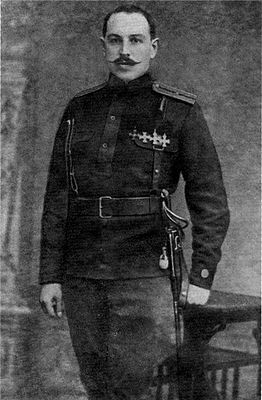 Warrant Officer Nozdrovsky Stepan Andreevich | ||||||||||
| Date of Birth | August 16, 1888 | |||||||||
| Place of Birth | Krichev | |||||||||
| Date of death | 1949 | |||||||||
| Place of death | Moscow | |||||||||
| Affiliation |  Russian empire White movement → Russian empire White movement →  the USSR the USSR | |||||||||
| Type of army | aviation | |||||||||
| Years of service | 1914-1927 | |||||||||
| Rank | captain | |||||||||
| Commanded | 10th Fighter Aviation Squad | |||||||||
| Battles / Wars | World War I Russian civil war | |||||||||
| Awards and prizes |
| |||||||||


Content
Origin
Of the nobles. Nozdrovsky was born on August 16, 1888 in the m. Krichev of the Mogilev province into the family of a state councilor. Orthodox.
Biography
In 1906 he graduated from the 12th St. Petersburg gymnasium, and in 1911 - the Imperial St. Petersburg University . While still a student at the Physics and Mathematics Faculty of St. Petersburg University, Nozdrovsky was seriously interested in aviation.
In 1911, after graduating from university, he worked at the S. Schetinin plant. Soon Nozdrovsky entered the school of aviation. The examination flight of S. Nozdrovsky, completed in August 1913, became a world record: five "eight" were completed in 6.5 minutes.
In 1913 he graduated from the school of the Imperial All-Russian Aeroclub (IVAK) and was left at the school as an instructor.
Military Pilot
On July 31, 1914, he joined the service as an ordinary "hunter" in the Special (Volunteer) Aviation Squad, later renamed the 34th Corps Aviation Squad (XXXIV KAO), formed from the personnel of the IVAK aviation school by its chief lieutenant N. A. Yatsuk . Produced in the ranks: corporal (10/12/1914), junior non-commissioned officer (12/06/1914), senior non-commissioned officer (12/09/1914). The first St. George's Cross pilot of the 34th KAO Nozdrovsky received "for several times successfully made aerial reconnaissance, and on 09/11/1914, despite shelling by German artillery and infantry, he continued reconnaissance into the enemy units, and on 12.09.1914, seeing the direction of the enemy the enemy airplane, with the movement of its aircraft, forced the enemy to return. ”
By March 1915, S. A. Nozdrovsky was rewarded with all four degrees of the Cross of St. George and was promoted to ensign for military distinction (03/20/1915).
On August 22, 1915, during the German Sventsyansky breakthrough , he and the observer, the staff captain Leonkov, carried out several reconnaissances in the Yanov- Vilkomir region , during which they discovered the advance of significant enemy forces in the direction of Sventsyan . This information made it possible for the command to take measures that had prevented the enemy from breaking through Molodechno . For these intelligence S.A. Nozdrovsky was awarded the Order of St. George, 4th degree.
July 5, 1916 Stepan Andreevich was appointed commander of the 10th Fighter Aviation Squad. Second Lieutenant (30.08.1916).
In August 1917, seconded to the Office of the Military Air Fleet. The lieutenant (09/17/1917).
Since March 1918, S. A. Nozdrovsky was the head of the aviation school of the private Kazan Society of Aeronautics.
Participation in the White Movement
In August 1918, after the capture of Kazan by the army of General Kappel and parts of the Czechoslovak Corps, Lieutenant Nozdrovsky joined the White Army of the Eastern Front.
From August to October 1918, he served as head of the operational department of the Air Fleet Directorate of the Northern Group of Forces.
From November 8, 1918 to January 1919 - Assistant Head of the Air Fleet Administration for the operational unit.
From January 1919 to January 1920 - Head of the technical department at the same department. Soon, for the distinction of service, he was promoted to captain (1919) and was appointed a member of the Irkutsk Air Navigation Laboratory.
At the service in the Red Army
Since February 1920 in the Red Army . From May 1920 - Head of the Aeronautical Laboratory of the 5th Army , then - Head of the Air Navigation Department of the Scientific Experimental Workshops of the Main Directorate of RSC VVF.
From January 1923 to May 1924, he was a permanent member of the Scientific Committee of the Main Directorate of RSC VVF.
From May 1924. - Lecturer at the Academy of the Air Force of the Red Army to them. Zhukovsky .
In 1924, Stepan Andreevich Nozdrovsky was one of the first to patent the principle of constructing a uniaxial gyroscopic stabilizer. He and his staff in a short time prepared the first squad of navigators for military aviation. During the flight Moscow - Mongolia - China - Japan on the plane of Mikhail Gromov there was a gyroscopic compass, the author of which was Stepan Andreevich Nozdrovsky. The Directorate of the Leningrad plant "Electrosila" appealed to the command with a request to send Nozdrovsky to start production of devices for the national economy. Here is what was written in the 23-volume "Technical Encyclopedia", published under the editorship of Professor L. K. Martens in 1927-1938 in the article "Development of Aviation Instruments":
“Already in 1919, the domestic plant Aviapribor produced instruments for the air fleet, and from 1922 this plant switched to mass production. In 1923, the factory manufactured: oil and gasoline pressure gauges, aerothermometers, tachometers, altimeters, inclinometers and speed indicators. The plant brought together many designers and instrument-makers, whose names are now widely known (S. A. Nozdrovsky, S. S. Tikhmenev, G. O. Friedlander, and others. ”[5]. The editorial staff of this encyclopedia also entered Stepan Andreyevich Nozdrovsky. He was responsible for the sections relating to the development of aviation, in particular, in the first volume of the encyclopedia was published his article: "Aviation instruments."
On November 20, 1925, Stepan Andreevich Nozdrovsky was dismissed from the ranks of the Red Army "as a former white officer."
On May 1, 1926, at the personal request reviewed by the head of the Red Army Air Force Directorate, he was again recruited as a senior observer pilot at the Scientific Experimental Airfield of the Red Army Air Force.
On February 5, 1925, he received a letter of gratitude, announced in Order No. 46 of the Red Army Air Force "for the flight Moscow-Smolensk-Vitebsk-Gomel-Moscow".
On August 15, 1927, Stepan Andreevich Nozdrovsky was again dismissed from the ranks of the Red Army air force "for the impossibility of further use." Perhaps the early dismissal from the ranks of the Red Army saved Stepan Andreevich from a wave of repressions of the 1930s against former officers: he simply fell out of sight of the OGPU - NKVD [1] . Having miraculously escaped repression, he was forced to work as a worker, as an engineer, and often change jobs. [1] . Nevertheless, Stepan Andreevich did not give up his scientific work, and in 1939 his book "General Theory and Method of Calculating Measuring Instruments" was published by the Oborongiz Publishing House.
During the Great Patriotic War, Associate Professor S. A. Nozdrovsky worked at the Air Force Academy. Zhukovsky , heading the department navigational faculty. In subsequent years, Stepan Andreevich Nozdrovsky worked at the Department of Mechanical Instruments at the Moscow Aviation Institute (MAI).
He lived in Moscow [2] . He died in 1949. He was buried at Vvedensky cemetery in Moscow (station 21).
Awards
- Insignia of the Military Order of St. George for the lower ranks, (ZOVO):
- St. George Cross 4th century No. 38420 — by the Order of the 10th Army No. 66 of October 12, 1914 “for aerial reconnaissance of September 11 and 12, 1914”;
- St. George Cross 3rd st. No. 9358 - Highest granted 06.12. 1914 "... for air reconnaissance on October 2, 3 and 13, 1914";
- St. George Cross 2nd st. No. 629 — by the Order of the 3rd Siberian Army Corps No. 9 of January 15, 1915 “for aerial reconnaissance on November 21 and 27, 1914, accompanied by throwing bombs and carried out under heavy artillery fire”;
- George Cross 1st st. No. 293 - "for aerial reconnaissance on December 20, 1914, November 1, 19, and 27, 1915, and for a flight from Lyka to Osovets."
- Order of St. Anne 4th century with the inscription "For courage" (1915 or 1916),
- Order of St. Anne 3rd century. with swords and bow (07.27.1916),
- Order of St. George 4th century (03/04/1917)
- Order of St. Vladimir 4th century with swords and bow (03/17/1917),
- Order of St. Stanislav 3rd century. with swords and bow (09/13/1917).
Proceedings
- Nozdrovsky S.A. The Importance of Aviation Devices and Scientific and Technical Means for the Work of the Aviation Air Fleet / Proceedings of the 1st All-Russian Congress of Engineers in the Military Industry. - Vol. 1. - M .: Publication of the Main Directorate of the military industry, 1922. - 162 p. + 8 l. photos.
- Nozdrovsky S. А. General theory and method of calculating measuring devices. - M .: Oborongiz, 1939.
Literature
- Collection of journals "Niva" for the years 1913-1917.
- Technical Encyclopedia, ed. prof. L.C. Martens 23 tt. - M .: Soviet Encyclopedia, 1927-1937.
- Volkov S.V. Tragedy of the Russian officers. - M .: Tsentrpoligraf, 2002.
- Military Order of the Holy Great Martyr and George the Victorious. Bio-bibliographic reference. - M .: Russian World, 2004.
- M. Neshkin, V. Shabanov. M. Aviators - Knights of the Order of St. George and the St. George Arms of the period of the First World War, 1914-1918. - M .: ROSSPEN, 2006.
- Kalikhman D. M. FORGOTTEN NAMES: TWO DESTINIES IN THE FAULT OF THE RUSSIAN REVOLUTION, NEWS 1 (29) 2009 July - September, INTERNATIONAL PUBLIC ORGANIZATION “ACADEMY OF NAVIGATION AND MOTION CONTROL”
Links
- D. M. Kalikhman “FORGOTTEN NAMES: TWO DESTINIES IN THE FAULT OF THE RUSSIAN REVOLUTION”
- D. M. Kalikhman “FORGOTTEN NAMES: TWO DESTINIES IN THE FAULT OF THE RUSSIAN REVOLUTION” (end)
- Service record of Stepan Nozdrovsky
- Yu.A. Gagarin Air Force Academy
- Kazan sky pioneers (inaccessible link)
- The amazing fate of the Russian ace
Notes
- ↑ 1 2 D. M. Kalikhman “FORGOTTEN NAMES: TWO DESTINIES IN THE FAULT OF THE RUSSIAN REVOLUTION” (end)
- ↑ Kalikhman D. M. in his article wrote that “a student of the Moscow Aviation Institute of the late 1950s, and later a candidate of technical sciences, one of the creators of the national rocket and space technology, who worked at RSC Energia,” Yury Alekseevich Bazhanov told, that Stepan Andreevich Nozdrovsky lived in one of the rooms of the MAI student dormitory. He was a very modest man, and none of the students even imagined that an outstanding inventor, scientist and hero of the First World War was near them. But, for obvious reasons, this information cannot be considered as documented. ”