The coefficient of utilization of installed capacity ( KIUM [1] ) is the most important characteristic of the efficiency of work of electric power enterprises. It is equal to the ratio of the arithmetic mean power to the installed capacity of the electrical installation for a certain time interval [2] . In nuclear energy , a slightly different definition is given: KIUM is equal to the ratio of the actual energy production of the reactor installation for a certain period of operation to the theoretical energy production when working without stops at rated power [3] . It is easy to notice that the value of KIUM for both methods of calculation will be the same, however, the last definition, firstly, corresponds to the international concept of KIUM (with the exception of the phrase reactor installation , which in general can be replaced by an electrical installation , the definition will remain correct and will fully correspond international value), and secondly, involves a simpler calculation of its value.
The importance of KIUM consists in the fact that this parameter characterizes the efficiency of the power plant as a whole, including not only its technological excellence, but also the qualifications of the personnel, the organization of work by both the management of the station itself and the organization of the entire industry at the state level, and also takes into account many other factors.
In most countries, there is a stubborn struggle for a high KIUM of power plants, which is especially important in light of the latest global trends in increasing energy efficiency and energy saving . This characteristic plays a special role in nuclear energy, which is associated with some specific features of ensuring high KIUM in this area. For this reason, the most common mention in the media of this parameter is when covering NPP performance indicators.
Content
Example of a simple calculation
Suppose that an abstract power plant with an electric capacity of 1,000 MW generated 648,000 MW-hours in a 30-day month . If the station would operate this month with full installed capacity, it would generate over this period of time: 1000 MW × 30 days × 24 hours = 720,000 MW-hours . Divide the amount of electricity generated by the value of the potential generation with a full load of installed capacity for this period and get 0.9. Therefore, KIUM in this case will be 90%.
It should be noted that the KIUM strictly depends on the period of time for which it is calculated, therefore, reporting the KIUM value on a certain date does not make sense, this parameter is usually calculated for a long period, most often for a year.
Factors Affecting KIUM
Despite the apparent simplicity of achieving a high KIUM value (it is enough to work at full capacity and without downtime), this parameter depends on many complex and difficultly predicted technical and administrative factors.
As a rule, dispatch centers of regional power grids place at power plants applications for a particular generation capacity for every hour or even shorter periods of time, based on the forecast of consumption. With a noticeable deviation of the actual generation and actual consumption in the electric network, a decrease or, even worse, an increase in the voltage and frequency of the alternating current, a decrease in the efficiency and resource of the energy system as a whole is observed. Therefore, for inaccurate execution of dispatch requests to either side of the power plant, they are fined. Usually, during the day, the power consumption changes 3-5 times, with morning and evening peaks, daytime half-peak and nighttime decline, therefore a high KIUM of the entire power system is impossible in principle. According to the technical ability to dynamically change power, various types of power plants are assigned different maneuverability. NPPs are considered the least maneuverable because of the potential danger of accidents when changing the physical operating conditions of the reactor, as well as solid fuel fired power plants, and the inability to quickly extinguish or ignite coal. Thermal power plants using liquid fuel and gas are more maneuverable, however, the efficiency of their turbines drops significantly at part load. The easiest way to maneuver is the production of hydroelectric power stations and PSPPs , but, with the exception of certain regions like Siberia, the total generation of hydroelectric power stations in the energy balance does not allow them to do just that.
For most renewable energy stations (hydro, wind and solar), an additional limitation of the KIUM is the uneven availability of the energy source - the required volumes of water, wind, and solar lighting.
Actual KIUM
According to the US Energy Information Administration (EIA), for 2009 the average KIUM in the USA was: [4]
- Nuclear Power: 90.3%
- Coal: 63.8%
- Natural gas thermal power plants: 42.5%
- Hydroelectric Power: 39.8%
- Other renewable sources: 33.9%
- Thermal power plants for oil: 7.8%
Among them:
- Wind generators: 20-40%. [5] [6]
- Photovoltaics (solar) in Massachusetts : 13-15%. [7]
- Photovoltaics in Arizona : 19%. [8] [9]
- thermal solar stations in California 33%. [ten]
In other countries
- Solar thermal stations with storage and combustion of natural gas (in Spain): 63% [11]
- Hydropower, world average: 44%, [12]
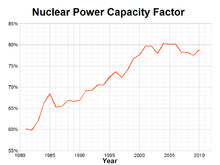
- Nuclear energy: 70% (average for 1971-2009 in the USA). [13]
- Nuclear power: 88.7% (average for 2006–2012 in the USA). [14]
Notes
- ↑ English Capacity factor, Installed Capacity Utilization Factor (ICUF)
- ↑ GOST 19431-84 Energy and electrification. Terms and Definitions.
- ↑ VNIINM named after A. A. Bochvar (inaccessible link)
- ↑ Electric Power Annual 2009 Table 5.2 April 2011
- ↑ Wind Power: Capacity Factor, Intermittency, and what happens when the wind doesn't blow? (PDF). Renewable Energy Research Laboratory, University of Massachusetts Amherst . Date of treatment October 16, 2008. Archived October 1, 2008.
- ↑ Blowing Away the Myths (PDF). The British Wind Energy Association (February 2005). Date of treatment October 16, 2008. Archived July 10, 2007.
- ↑ Massachusetts: a Good Solar Market Archived on September 12, 2012.
- ↑ Laumer, John Solar Versus Wind Power: Which Has The Most Stable Power Output? . Treehugger (June 2008). Date of treatment October 16, 2008.
- ↑ Ragnarsson, Ladislaus. The possible role and contribution of geothermal energy to the mitigation of climate change / O. Hohmeyer and T. Trittin. - Luebeck, Germany, 2008-02-11. - P. 59–80. (inaccessible link)
- ↑ Ivanpah Solar Electric Generating Station (unavailable link) . National Renewable Energy Laboratory . Date of treatment August 27, 2012. Archived October 12, 2015.
- ↑ Torresol Energy Gemasolar Thermosolar Plant . Date of treatment March 12, 2014.
- ↑ Hydropower p. 441
- ↑ US Nuclear Industry Capacity Factors (1971 - 2009) . Nuclear Energy Institute . Date of treatment October 26, 2013.
- ↑ US Nuclear Capacity Factors . Nuclear Energy Institute . Date of treatment October 26, 2013.