"The Three Musketeers" ( French Les trois mousquetaires ) is the historical and adventure novel of Alexander Dumas the father , first published in the Parisian magazine Le Siècle in 1844 from March 14 to July 11. The book is dedicated to the adventures of a young man named d'Artagnan , who left the house to become a musketeer , and his three muscular friends Athos , Porthos and Aramis between 1625 and 1628.
| Three Musketeers | |
|---|---|
| Les trois mousquetaires | |
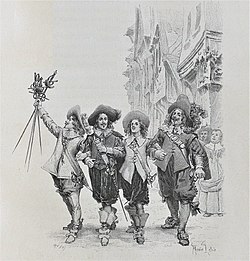 "D'Artagnan walked between Athos and Porthos ...", fig. Maurice Leloir (1894) | |
| Author | Alexandr Duma co-authored by Auguste Mack |
| Genre | historical - adventure novel |
| Original language | French |
| Original published | 1844 |
| Translator | V. Waldman, D. Livshits, K. Ksanina |
| Cycle | |
| Next | Twenty years later |
The story of d'Artagnan continues in two other trilogy novels: Twenty Years Later and Viscount de Brazhelon, or Ten Years Later .
Content
Story
The young poor Gascon nobleman d'Artagnan (which means "from Artagnan") left his home in April 1625 and went to Paris , hoping for a place in the musketeer regiment. On the way to Mengue ( French: Meung-sur-Loire ), he got into a fight with Count Rochefort , close to Cardinal Richelieu , and he stole his letter of recommendation. Upon arrival in Paris, d'Artagnan is sent to an audience with the captain of the royal musketeers, Mr. de Treville , but he explains that, according to the existing rules, he cannot give a newcomer a place in his regiment before he shows his prowess or does not serve in another, less prestigious, part of two years, and directs him to the Guards Regiment des Essard .
Further, due to a series of accidents, on the same day, d'Artagnan insults one after another three experienced musketeers - the friends of Athos, Porthos and Aramis - and receives calls from all three to a duel. But the duel at which he appeared at noon on the same day, in the wasteland behind the abbey , was interrupted by the appearance of the Cardinal's guards , who wanted to arrest the four for violating the decree banning duels. In response, D'Artagnan and his three rivals united and defeated the superior opponent, becoming friends after that. Cardinal Richelieu complained about the tricks of the musketeers to King Louis XIII , he scolded de Treville, but secretly remained proud that he had such people.
D'Artagnan hired a servant named Planchet and settled in the house of the haberdasher Bonacieux and his wife Constance, whom he soon fell in love with. Constance serves as the chambermaid of Queen Anne of Austria , who vies with the cardinal for influence on the king. The Queen on a date gave the English Minister hopelessly in love with her, the Duke of Buckingham, twelve of her diamond pendants , which the king had previously given her. The cardinal, learning about this from the spies, decides to compromise the queen: he persuades the king to arrange a ball and invite Anna to appear on it in pendants so that he can admire them. In addition, Cardinal’s agent, Milady , travels to England and kidnaps two pendants from Buckingham, cutting them to a ball.
The queen does not know what to do, and in desperation shares her problem with Constance. Constance talks about the situation to d'Artagnan, and he, out of love for her, is ready to go to London to save the honor of the queen. Athos, Porthos and Aramis, with the assistance of de Treville, receive vacations and the opportunity to accompany d'Artagnan. During the journey, all the musketeers are disabled by traps and ambushes arranged by the cardinal - only d'Artagnan, having fought near Calais with the cardinal's envoy, Count de Ward, gets to the port and crosses the English Channel to London. There he meets with Buckingham, receives pendants from him (two stolen ones had to be replaced with copies urgently made by Buckingham's jeweler) and delivers them back to Paris, literally at the last moment. The queen appears at the ball in the pendants, the cardinal is confounded.
Once, having noticed an unrestrained conversation between a lovely girl and an Englishman, d'Artagnan challenges the latter to a duel. The Musketeers defeated the British in a duel, Lord Winter, whom d'Artagnan spared, introduced him to a girl who turned out to be the widow of the late elder brother of the Lord - Lady Claric. D'Artagnan burned with passion for her, but from her maid Catti found out that milady loves Count de Ward. Replacing the letters of de Ward, d'Artagnan thus causes in Milady hatred of the count who supposedly rejected her. She decides to end de Ward with the hands of d'Artagnan and spends the night with him. Then d'Artagnan and notices the stigma on her shoulder and recalls the secret of Athos, once told to him - he once had a wife, but, having discovered that she was branded, Athos found out that she was a thief and a commoner (noblemen not stigmatized), killed her (as he believed), rightfully the feudal lord of that time, and went to the musketeer service. Milady, in anger, is trying to kill d'Artagnan, but he manages to escape.
Meanwhile, the king begins the siege of the rebellious fortress of La Rochelle , the stronghold of the Huguenots . The three musketeers and d'Artagnan, now also a musketeer, show miracles of daring and heroism in the war. Milady organizes several attempts on the life of d'Artagnan, but unsuccessfully. The Cardinal conceived the assassination of Buckingham and for this purpose sent Milady to London. In this woman, Athos recognized his ex-wife, Countess de La Fer . The Musketeers warned Lord Winter of the danger, Milady was arrested, barely stepping on the land of England. However, she managed to seduce Captain Felton , a foster child and subordinate Lord Winter, playing on his religious feelings and saying that she was allegedly raped by Buckingham; Felton helps her escape and kills Buckingham.
Milady returns to France and finds herself in a Carmelite monastery. In the same monastery, beloved d'Artagnana Constance, hid after the story with the pendants. Milady entered into her confidence and tried to abduct. When the four musketeers suddenly arrive at the monastery, milady poisons Constance. Musketeers track down the villain and sentenced to death. The Lille executioner, whose brother’s life also killed Milady, carried out the sentence.
Musketeers expected severe punishment for their actions. But Richelieu, secretly afraid of his companion, appreciated the potential of d'Artagnan and, as a sign of reconciliation, gave him a patent for the rank of lieutenant of musketeers. Immediately after the campaign, Porthos married a rich widow, and Aramis became an abbot. Only Athos served as a musketeer already under the leadership of d'Artagnan until 1631 and retired, having received an inheritance.
Creation History
The Three Musketeers was originally published chapter by chapter in the newspaper Le Siècle from March 14 to July 11, 1844. This is a traditional novel with a sequel, a feuilleton novel : the chapter broke off at the most interesting place so that the reader would look forward to the continuation . Thus, the reader’s perception of the book at that time was different from the present, when the book is read all at once:
For us, Constance died, my lady cut off her head, Porthos married the prosecutor, Aramis took the tonsure, Athos left the service and left for the province. And let's imagine what the first readers of The Three Musketeers thought when Athos pointed a gun at his ex-wife and ... And you need to wait for the next feuilleton. How much did Monsieur and Madame crave for murder, and how much did reconciliation between spouses? And how many were dissatisfied with the fact that Athos merely took the open sheet from his wife?
- Vera Kamsha “A Thousand and One Series”
Since Dumas was paid in the newspaper line by line, he invented Grimaud - the servant of Athos, who spoke exclusively in monosyllables. Thus, the line on which there was one word “yes” or “no” was paid in the same way as a full line of text. By the time they wrote "Twenty Years Later," the publishers had decided to pay Dumas nonetheless, and Grimaud immediately became a little more talkative [1] [2] [3] [4] .
Originally, the name of d'Artagnan was Nathaniel in the manuscript. Publishers did not like it and was struck out.
Dumas, constantly using the work of literary blacks , worked on the “Three Musketeers” together with Auguste Macke (1813-1886). The same author helped him with the creation of the Count of Monte Cristo, Black Tulip, and Queen's Necklace. Later, Mack filed a lawsuit and demanded the recognition of 18 novels, written by him in collaboration with Dumas, as his own works, but the court recognized that his work was nothing more than preparatory.
Literary sources
In the preface to the book, Dumas wrote that some memoirs found in the French National Library served as the basis of the novel. Later it turned out that this source of inspiration was “Memoirs of Herr d'Artagnan, Captain-Lieutenant of the First Company of the Royal Musketeers” ( Mémoires de Monsieur d'Artagnan, capitaine lieutenant de la première compagnie des Mousquetaires du Roi ). True, the book was written not at all by d'Artagnan, but was composed by a writer named Hacien de Courtil de Sandraz , who published it in Cologne (1700) 27 years after the death of the musketeer. Dumas took this book at the Marseille Municipal Library and did not return it, as evidenced by the numerous letters of complaint addressed to the library and left unanswered.
The story of pendants : The Larochefoucault 's Memoirs (1662, full edition 1817) mentions how Countess Lucy Carlyle (daughter of Count Henry of Northumberland ) cut diamond pendants from the Duke of Buckingham at a ball. Also used Rederer "Political and gallant intrigues of the French court." The abduction of Constance was taken from the "Memoirs" of Mr. de La Porte, valet Anna of Austria.
“Memoirs,” of which Dumas speaks in the preface, as if he simply published them in the form of a book, according to him, were written by the Count de La Fer. That is, speaking the language of literary scholars, it is Athos who is the narrator in The Three Musketeers.
Prototypes of the protagonists
The image of d'Artagnan was created by de Curtil, and therefore of Dumas, on the basis of a real person:
- Charles de Batz-Castelmore, Earl of d'Artagnan ( fr. Charles de Batz de Castelmore, comte d'Artagnan , b. Between 1611 and 1615 - d. 1673) - Gascon and musketeer, who also died during the siege of Maastricht , like the book hero. But he did not live in the era of Richelieu, but under Mazarin (in 1625 he was not 18 years old, as in a book, but no more than 14), he was not a marshal and held the title of count, while the character is less noble, although he became a marshal. The real d'Artagnan became a musketeer in 1644 , was a confidant of Mazarin during the Fronde , participated in the arrest of Fouquet , died at the Battle of Maastricht in 1673 .
The nicknames of the three musketeers may have been formed by de Curtil from the names of real people.
- Armand de Sillèg d'Atos d'Autvielle ( French Armand de Sillègue d'Athos d'Autevielle , 1615-1643) - died from a wound received in a duel, even before the Count d'Artagnan was enrolled in the musketeers.
- Isaac de Porto ( fr. Isaac de Portau , 1617-1712) - became a musketeer in 1643 [5] .
- Henri d'Aramitz ( French Henri d'Aramitz , 1620—?) - a nobleman, secular abbot in Seneschalism Oloron, enlisted in 1640 in the musketeer company commanded by his uncle. At the end of his life, he retired to his domain with his wife and four children.
The narrative begins in April 1625, and the siege of La Rochelle took place in 1627. During this period, the real d'Artagnan was no more than 14 years old, Athos - 12, Porthos - 10 [5] , and Aramis - 7. To introduce these events into the story, Dumas “aged” his characters.
- Milady - Countess Lucy Carlyle , an abandoned lover of Buckingham, who out of jealousy became Agent Richelieu, is considered her prototype.
- Rochefort - used the image of the person who appeared in the “Memoirs of d'Artagnan” under the name of Rhone , or Rosna (Rosnai), as well as the book “ Memoires de MLCDR ” ( Monsieur le comte de Rochefort ), memoirs of Henri Louis de Aluagni, Marquise de Rochefort ( mistake in the name: his name was Charles-Cesar (Charles-Cesar de Rochefort de Saint-Pointe, 1615-1687)), and he became a count only after the death of his father in 1663), also probably fake, written the same de Curtil, who specialized in similar literature at the end of the 17th century . Until recently, Rochefort was considered a fictional character. But data appeared confirming the veracity of what was written by Hacien de Curtil. Back in 1901, the essay on Gerald Brenan's “Agent Cardinal” was published at Macmillan's Magazine . [6] . Also in the book of Julia Pardoe (Julia Pardoe) “ The Life of Marie de Medicis ” ( The Life of Marie de Medicis - Volume 3 ) cited unpublished Memoirs of a Rambur, who participated with Rochefort in the capture of Saint-Mar . Very often he is confused with Henri-Louis d'Aluagni and Count de Rochefort-Luce. But neither one nor the other are related to Rochefort Dumas.
Characters
Protagonists
- D'Artagnan (Mr. D'Artagnan the Son)
- Athos (Count de la Fer)
- Porthos (Baron du Vallon de Brasier de Pierrefon)
- Aramis (Chevalier Rene d'Erble, Bishop of Vannes)
Real historical figures
- Cardinal Richelieu
- King Louis XIII The Fair
- Queen Anne of Austria
- duke of buckingham
- Musketeer Captain Lieutenant De Treville
- La Porte
- Duchess de Chevreuse
- John felton
- King of England Charles I
Fictional Characters
- Milady . She is Anna de Beil, she is Lady Claric, she is Baroness Sheffield, she is Charlotte Buckson, she is Countess de La Fer, she is Lady Winter. Cardinal's spy.
- Count Rochefort . A loyal adviser to the cardinal. Probably has a real historical prototype .
- Constance Bonacieux . The wife of haberdasher Bonacieux and the mistress of d'Artagnan. Poisoned milady at the Carmelite monastery. (In a book called “Constance” it is rarely called, only 15 times, almost everywhere in the novel it appears as “Ms. Bonacieux”; her name became more often mentioned in the film adaptations, in particular, in the Soviet 1979).
- Planchet . Servant of d'Artagnan.
- Grimaud Servant of Athos.
- Bazin . Servant of Aramis.
- The musketon . The lackey of Porthos.
- Catti . Girl seduced by d'Artagnan. Maids of the Milady, then the Duchess de Chevreuse .
- Mr. Bonacieux . Husband of Constance Bonacieux, tradesman, haberdasher. He began to work for the cardinal after deception, intimidation and bribery. He was arrested when Richelieu became unnecessary.
- Lord Winter . English nobleman, brother of Milady's second husband (who died from a mysterious illness, probably poisoned by her). My lady was arrested, intending to send her to remote colonies, and subsequently took part in the trial of her.
Films
The novel is one of the most often filmed literary works in the world and has been filmed many times, starting from the end of the XIX century . There are more than 20 American and French film adaptations, films and cartoons based on the novel. Also, filmmakers from Australia, Brazil, Great Britain, Germany, Spain, Italy, the USSR and other countries turned to the story of musketeers.
Continuations
The popularity of the novel led to the emergence of many sequels dedicated to its heroes.
- Georg Bourne "Anna of Austria, or the Three Muskoters of the Queen" (1872).
- Paul Makhalen (pseudonym Emil Blonde). “The Son of Porthos” (1883, under the name of A. Dumas).
- Paul Mahalen. “The daughter of Aramis” (1890, under the name of A. Dumas).
- Paul Mahalen. "D'Artagnan" (1896).
- Evgeny Evtushenko . The End of the Musketeers (1988).
- Roger Nimier. “Love d'Artagnan, or Fifteen Years Later” (Russian translation 1993).
- Nikolai Harin. “Three Musketeers Again” (1993).
- Eduard Glissan. "Memoirs of Messire d'Artagnan" (Russian translation 1995).
- Alexander Bushkov . “D'Artagnan - Guard of the Cardinal” (2002).
- Daniel Kluger . The Musketeer (2007).
- Julia Galanina “Yes, that same milady” (M.: “Forum”, 2005)
Notes
- ↑ American literary gazette and publishers' circular. - The University of California, 1864
- ↑ André Maurois. Alexandre Dumas: a great life in brief. - Knopf, 1966
- ↑ William Conant Church. The Galaxy. - Volume 23. - Volumes 7-12 of American periodical series, 1850-1900. - WC and FP Church, 1965. (Original from the University of California).
- ↑ André Maurois. The Titans: a three-generation biography of the Dumas. - Harper, 1957 .-- 508 pages.
- ↑ 1 2 Porthos Archived December 10, 2012.
- ↑ https://archive.org/details/macmillansmagazi83macmuoft
Links
- Dumas. Three Musketeers - the text of the novel in Russian and French.
- Three musketeers in the library of Maxim Moshkov
- “ Around the World ”: “France. Paris of the Three Musketeers " (inaccessible link) , " France. In the footsteps of three musketeers ” (inaccessible link) .
- S. Nechaev. Three d'Artagnan: Historical prototypes of the heroes of the novels “Three Musketeers”, “Twenty Years Later” and “Viscount de Brazhelon” - M.: Astrel: ACT CORPUS, 2009. - 411 c.