Liu Ji (Chinese 呂 紀; worked from about 1439–1505) is a Chinese artist in the flower-bird genre.
| Lu ji | |
|---|---|
| Date of Birth | |
| Place of Birth | |
| Date of death | |
| A country | |

Lu Ji was a native of Ningbo, Prov. Zhejiang, however, as is the case with many court artists of the Ming era, the dates of his birth and death are not known. It is believed that he was born in 1429 during the reign of Emperor Xuande (1425-1435), and died in 1505 under the Emperor Hongzhi (1487-1505). Like Lin Liang, he initially gained recognition in his city as a master of the genres of "flower birds" and "palaces and arbors" (that is, an image of architecture). During the reign of Emperor Chenghua (1464-1487), Lu Ji entered the service of the Imperial Palace, where, working as an artist, he received a salary for the position of guardian of the imperial wardrobe. He created his works in the Hall of Benevolence and Wisdom, that is, in the same place as his colleague Lin Liang. And like Lin Liang, Lu Ji rose to the rank of commander of the imperial guards (i.e. bodyguards). Historical records indicate that Lu Ji received many orders from the emperor and the courtiers, for the implementation of which an atelier was created, where he worked with assistants. The poet Han Huai (1462-1538), in one of his poems in The Shuangs Anthology, writes: "... in modern times, paintings by Lu Ji are the best." History has preserved evidence that the artist zealously abided by all the rules and rituals of the court, thanks to which he achieved good relations with court officials. But he enjoyed special protection from the emperor Hongzhi, who valued him so highly that when the elderly master became hopelessly ill, the flow of ministers and aristocrats summoned by the emperor to his dying bed did not subside.

Like many major Chinese artists, Lu Ji was involved in copying paintings by ancient masters of the Tang and Song era, which he had the opportunity to study in the collection of the imperial physiognomist Yuan Zhongche (1376-1451), who was his fellow countryman. He studied the art of depicting birds with his contemporaries - Bian Jingzhao and Lin Liang. The paintings of the bird-flower genre created by Lui Ji fall into two categories. The first includes works executed in a detailed style with a clear ink and tint. He learned this from Bian Jingzhao . Examples of this style are Cassia, Chrysanthemum and Mountain Birds (Gugun, Beijing), Camellia and Silver Pheasant (Gugun, Beijing), Autumn Herons and Hibiscus (Gugun, Taipei) and a number of other works. In the works of Liu Ji of this type, the deep influence of the South Sun masters Ma Yuan and Xia Guia is felt both in the general construction of the composition and in the depiction of rocks and background trees. Gradually, he developed his own style, which had a wide influence on the whole painting of the flower-bird genre, both among court painters and outside the courtyard. This style is usually considered the "Minsk academic style of painting flowers and birds."
A completely different artistic style was borrowed by Lu Ji from Lin Liang - this is the sketching style, the “free hand” style that was used in monochrome works. Liu Ji achieved no less success in this direction than Lin Liang himself; There were rumors about him that in his advanced years, Li Ji faked works of Lin Liang, and sold them. Typical of this style is the scroll “White heron, eagle and falling lotus flowers” (Gugun, Beijing). It depicts a funny scene: the appearance of an eagle, which disturbed the peace of the lotus pond on an autumn day. A flap of eagle wings, the panicky bustle of birds, together with the flutter of reeds in the wind and the falling fading lotus flowers are definitely written off from nature. This way of depicting a spiritual scene involving animals and plants originates from the time of the Northern Song, and artists such as Tsui Bo .
The flower-bird genre, like Chinese painting in general, is full of hidden symbolism. Almost every plot has a second, additional meaning. For example, in the painting of Lu Ji "Autumn herons and hibiscus" depicts three herons. The hieroglyph “heron” in Chinese has a second meaning - “think”. The three herons shown are an invitation to “think three times”, that is, to think something carefully.
Lu Ji is considered the largest artist in the genre of "flower-birds", who managed to synthesize and summarize all the creative achievements of his predecessors. His work influenced not only the painting of Chinese artists of the Ming and Qing era, but also the work of Japanese painters.

Liu Ji. Autumn herons and hibiscus. Gugong, Taipei.
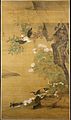
Liu Ji. Mandarin ducks and mallow. Metropolitan Museum of Art, New York

Lu Ji. Blossoming apricot and peacocks. Gugong, Taipei

Liu Ji. Snow covered landscape with birds. Gugong, Taipei

Liu Ji. Wild pheasant in the snowy winter. Gugong, Taipei.

Liu Ji. Herons in flight. Fan painting. Gugong, Taipei.


Bibliography
- Vinogradova N. A. "Flowers and birds" in the painting of China. M. 2009.
- Three Thousand Years of Chinese Painting. Yale University Press. 1997. pp 205—208