
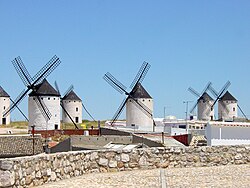


Grinder - a mechanism for grinding something. A classic example of a mill is a flour mill . One type of hand mill is the millstone .
Content
History
The choice of the type of mill is determined by the size of the initial particles, the hardness of the material being milled and the productivity. Historical predecessors of the mill - a grain grader and a stupa . Later they began to use the muscular strength of people and animals, and then the power of water and wind. There were mills, grinding and grinding. The main element of grinding mills is the millstone . Currently, in everyday life, the most well-known type of mills are coffee grinders and impact type blenders , similar to hammer mills, as well as auger meat grinders .
Types of mills
By type of drive distinguish:
- Manual - a small mill, the millstones of which are rotated by hand. Examples: millstone , mill for grinding coffee beans ( coffee grinder ), spices , salt.
- Water
- Windmill
- Electric
According to the principle of grinding, mills are divided into:
- ball
- screw crushers
- bubbly
- jet
- hammer hammers
- disc
- centrifugal drums
- Swirl Mill
- Roller mill
- Rod Mill
According to the incoming raw materials and the resulting products, the mills are divided into:
- bakery mill
- pasta mill (mill for hard wheat)
A grain mill uses the general principles of roller mills, but it has an important difference. A modern industrial mill first carefully destroys the grain to separate the outer part ( bran ) - this process is called the shelling of the shell, then grinds into flour or grains the core of the grain (flour of the highest grade). Some types of laboratory grain mills imitate an industrial grinding system to determine the suitability of the grain and its market value.
Modern mill lines for flour consist of bunkers (filling), where the flour is set and the desired qualities are obtained, the devices directly grinding, the devices dividing the resulting flour or grains into fractions. At the same time, the flour can pass through the “grinding” and fractional mechanisms several times, until an iterative approach can achieve the flour of the desired fraction. Often mill lines are supplied with fine grain cleaning and granulation mechanisms.
By-products of the processing of the mill are:
- flour with a high content of bran particles (flour VOSCH)
- feed grain products (I, II, III, IV and V categories)
- bran (loose, granulated)
- wits
- waste waste
As a separate class, the so-called low-power laboratory mills are based on the same principles, but much more diverse in execution.
See also
- Millstone
- Flour Mill
- Crusher
- Kruporushka
Literature
- Bezhkovich A.S., Zhegalova S.K. and others. Housekeeping and life of Russian peasants: Monuments of material culture. - M .: Soviet Russia , 1959. - P. 163-116. - 257 s.
- Shangina I.I. Mill. Windmill, watermill // Russian traditional way of life: Encyclopedic dictionary. - SPb. : Alphabet-Classic , 2003. - P. 85-94. - 688 s.
- Mill // Brockhaus and Efron Encyclopedic Dictionary : 86 t. (82 t. And 4 extra.). - SPb. , 1890-1907.