Johann Hudde ( Dutch Johannes van Waveren Hudde , Latinized Huddenius ) ( April 23, 1628 , Amsterdam - April 15, 1704 , ibid. ) - Dutch mathematician and statesman [1] .
| Johann Hoodde | |
|---|---|
| Johannes van Waveren Hudde | |
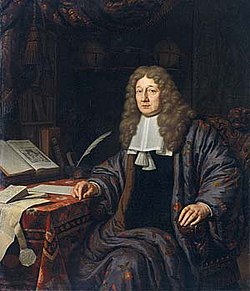 Portrait of Johann Hudde by M. van Musser | |
| Date of Birth | April 23, 1628 |
| Place of Birth | Amsterdam |
| Date of death | April 15, 1704 (75 years old) |
| Place of death | Amsterdam |
| A country | Republic of the United Provinces |
| Scientific field | maths |
| Alma mater | Leiden University |
| supervisor | Frans van Schouten |
Content
Biography
Johann Hudde was born April 23, 1628 in the family of Gerrit Hudde ( Dutch: Gerrit Hudde ), a wealthy merchant who represented Amsterdam on the board of the Dutch East India Company , and Maria Jonas de Witsen ( Dutch. Maria Jonas de Witsen ). He studied at Leiden University , where he studied law ; at the same time he took private mathematics lessons from his teacher, Frans van Schouten . From 1654 to 1658, Khudde was actively engaged in mathematics as part of a research group organized by van Schouten in Leiden, which was engaged in the further development of Descartes' analytic geometry . In the years 1658-1663. Khudde continued his education in France [1] .
In 1663, Khudde returned to Amsterdam. In the city of Amsterdam, in which he joined in 1667, Khudde held successively the posts of a member of the magistrate, judge and burgomaster (in this post he worked for 30 years). Like his father, he also dealt with the affairs of the Dutch East India Company . Politically, he held moderate views [1] [2] .
Scientific activity
Khudde set out the results of his research in mathematics in letters to his teacher, Leiden professor Frans van Schouten . Of these, two studies (dating back to the time of the Khudde student body) were translated by Schouten into Latin and in 1659 were published in his publication Geometry by Descartes under the headings De reductione aequationum (written in July 1657) and De maximus et minimis "(Written in January 1658). In the first of these studies, Khudde, by the term "reductio", was the factorization of the polynomial on the left side of the algebraic equation ; this study contained a method for solving cubic equations and the rule, the rule for determining the number of equal roots in equation [2] [3] .
In the second study, Khudde offers the , used to find local extrema of an algebraic polynomial and is a modification of Fermat's lemma [3] .
According to Leibniz , who visited Khudda in 1676, the latter was engaged in a lot of determining the equation of the line from its points and, in his own words, as if he was able to find the equation of the contours of the face of each person. The third letter to Khudda, which appeared in print, was also a letter sent to F. van Schouten (in 1659), the subject of which was the tangent method (printed in 1713 in the Journal litteraire) [2] .
Khudde was also involved in probability theory and demographic statistics . Together with Jan de Witt, he (one of the first) compiled mortality tables in 1671 and used them to calculate the size of life annuity [4] [5] .
Notes
- ↑ 1 2 3 Johann Hudde in the MacTutor archive .
- ↑ 1 2 3 Hudde, Johann // Brockhaus and Efron Encyclopedic Dictionary : in 86 volumes (82 volumes and 4 additional). - SPb. , 1890-1907.
- ↑ 1 2 Boyer CB, Merzbach UC A History of Mathematics. 2nd edition. - New York: John Wiley & Sons, 1991 .-- 736 p. . - P. 373.
- ↑ Renyi A. On the history of probability theory // Renyi A. Trilogy on mathematics. - M .: Mir, 1980 .-- 376 p. - S. 184-186.
- ↑ Alter G. Plague and the Amsterdam Annuitant: A New Look at Life Annuities as a Source for Historical Demography // Population Studies , 37 , 1983. - P. 23-41.
Literature
- Hudde, Johann // Brockhaus and Efron Encyclopedic Dictionary : in 86 volumes (82 volumes and 4 additional). - SPb. , 1890-1907.
Links
- O'Connor JJ, Robertson EF Johann van Waveren Hudde . - Materials archive MacTutor . Date of treatment 2014-13-02.