The Temple of the Peoples ( Peoples Temple) , a common mistake of translating as “People’s Temple”, is a new religious movement founded in 1955 by Jim Jones in Indianapolis , Indiana . Jones used the Temple of the Nations to spread a message that combined elements of Christianity with communist and socialist ideas, as well as an emphasis on racial equality. [1] [2] [3] [4]
| Temple of the Nations | |
|---|---|
| English Peoples temple | |
 One of the three tombstones of the memorial complex dedicated to those killed in Johnstown, Auckland , California , USA. One of the three tombstones of the memorial complex dedicated to those killed in Johnstown, Auckland , California , USA. | |
| General information | |
| Place of creation | Indianapolis , Indiana |
| date of creation | 1955 year |
| Dissolution date | 1979 year |
| Founder | Jones, Jim |
| Religion | |
| Religion | Christianity |
| Flow | Protestantism |
| Ideology | Eclecticism Pentecostalism Christian socialism Christian communism New thinking |
| Spread | |
| Country | USA Guyana |
| Regions | IN USA: Indiana California In Guyana: Johnstown |
| Number of followers | 3,000-5,000 (more than 20,000 claimed but not confirmed) |
The Temple of the Peoples is best known for the events of November 18, 1978 in Guyana , when 918 people died as a result of the massacre in his remote settlement called Johnstown , as well as the killing of US Congressman Leo Ryan and members of his delegation in the nearby port of Caitum. The Johnstown massacres resulted in the largest U.S. civilian casualties as a result of a deliberate act committed prior to the September 11 attacks .
The group moved to California in the 1960s and established several branches throughout the state, including its headquarters in San Francisco . At its peak, the Temple had 20,000 members (although 3-5,000 are more likely) and ties to many left-wing political figures .
Becoming (1955-65)
Formation
The founder of the “Temple of the Nations” Jim Warren Jones was born in 1931 in Crete, Indiana . Since childhood, he began to be interested in religion , as a teenager preached on the streets. Before the formation of the church, Jim Jones was fascinated by communism and disappointed in the persecution of communists in the United States. [5] This, among other things, served as a source of spiritual inspiration for Jones. As he himself described in a biographical record: [5] [6]
| I thought: “How can I demonstrate my Marxism?” The thought was to penetrate the church. Therefore, I consciously decided to study this perspective. |
Although he was afraid of retaliation for being a communist, Jones was surprised when a Methodist superintendent (whom he had not met through the US Communist Party ) helped him get into the church, [5] even though he knew that Jones was a communist . [7] In 1952, Jones became a pastor’s student at the Somerset Southside Methodist Church in Indianapolis, but left the church because he forbade him to integrate African Americans into his community. [6] In 1954, at the age of 24, he founded his own religious group on a rented plot in Idrianapolis, first calling it “Church of the Word of Christ” [6] ( Eng. Disciples of Christ ), which was renamed “Temple of the Nations” a year later [ 8] . The new movement preached the achievement of "apostolic socialism" [9] [10] . Jones had previously witnessed a “healing” ministry in a Seventh-day Baptist church and came to the conclusion that such “healings” can attract people and generate income, helping to achieve his social goals. [6] Temple members deliberately faked “healings” because they found that increased faith generated financial resources to help the poor and fund the church. [6] These “healings” included chicken liver and other animal tissues, which, according to Jones (and members of the Temple Confederation), were cancerous tissues removed from the body. [eleven]
In 1956, Jones bought his first church building in the racial-mixed district of Indianapolis. At first he called this church “Wings of Liberation.” [12] , and later, in the same year, renamed it the “Gospel Church of the Temple of the Nations”, first applying the phrase “Temple of the Nations”. [6] Jones' healings and alleged clairvoyant revelations attracted spiritualists. [12]
Extension in Indiapolis
To increase publicity, the Temple organized large religious “meetings” with other Pentecostal pastors, and Jones continued to hide the fact that he used religion to achieve social goals. [12] These conventions were attended by 11,000 people, [12] because Jones and other preachers performed “healings” and impressed them by revealing personal information — usually numbers, such as addresses, phone numbers, or social security numbers are private. Detectives can easily spot them in advance. [12] Jones and Temple members also traveled to various cities in Indiana and Ohio to search and raise funds. [13]
The temple emphasized egalitarian ideals, inviting members to be present in everyday clothes so that poor members did not feel at ease and providing shelter to those in need. [14] At that time, the Temple increased its African American membership from 15% to almost 50%. To try to get further benefits, the Temple hired African-American preacher Archie Ijams (who had previously abandoned organized religion). [12] Pastor Ijames was one of the first to take part in Jones' socialist collective program. [14] In 1959, the church joined the Christian Church (disciples of Christ) and was renamed the Temple of the Nations of the Gospel Christian Church. [6] This affiliation was a successful attempt to raise dwindling membership and restore the organization’s reputation.
In February 1960, the Temple opened a canteen for the poor and expanded social services, including rental assistance, employment services, free canned food, clothing, and coal for heating in winter. [14] Jones and his wife helped increase Temple cooking soup services to an average of 2,800 meals per month. [14]
The prestige of the Temple rose even more when Jones was appointed to the Indianapolis Human Rights Commission.
Religious Communism
Jones read a lot about the "Father of God" (American spiritualist), founder of the International Peace Mission. [15] Jones and Temple members visited the Divine several times, and Jones studied his notes and the notes of his sermons. [16] The temple printed “Divine” texts for its parishioners and began to preach that parishioners should abstain from sex and only adopt children. [sixteen]
In 1959, in a sermon in a temple in Delaware Street, Jones tested the new fiery rhetorical style that Divine used. [17] The speech also marked the beginning of the main idea of the Temple “We are against them.” [17] Jones eloquently stated that the nursing home was created on the basis of “ From each according to his ability, to each according to his needs ”, citing Karl Marx's “Critique of the Gothic Program” . [18] He did this, knowing that his Christian audience recognized the resemblance to a text from the Acts of the Apostles (4: 34-35), which states:
| There was no one in need between them; for all who owned lands or houses, selling them, brought the price of the sold and put it at the feet of the Apostles; and everyone was given what anyone had a need for. [18] |
Jones repeatedly quoted this passage to portray Jesus Christ as a communist, while at the same time attacking much of the text of the Bible . [18]
The temple began to tighten its organization, [14] asking its members more than in other churches. [14] Parishioners were required to spend Thanksgiving and Christmas with the Temple “family”, and not with blood relatives, [14] the process of excommunicating members from their families and redirecting their lives to a full commitment to the social and political life of the Temple began. [14] Jones began to offer a deal with the socialist collective, which he called “religious communism”, in which members donated their wealth to the Temple in exchange for a Temple that meets the needs of all these members. [14] Pastor Ijames was one of the first to do this. [14]
The temple failed to convert most Midwestern residents into communist ideals, even when they were disguised as religion. [19] While admiring Batista’s ouster in Cuba by Fidel Castro in 1959, Jones went to Cuba in 1960 to try and convert the poor Cuban blacks to his congregation in Indiana, [19] but the plan failed. [nineteen]
The religious message of the Temple during this period went over to the transition between atheism and the subtle idea that Jones was a Christ-like figure. [20]
In 1961, Jones stated that he had a vision of Chicago hit by a nuclear attack . [21] He claimed that Indianapolis would also be destroyed, [21] convincing the assistants that the Temple should have sought a new place.
A 1962 Esquire magazine article lists nine of the safest places for nuclear war. Belo Horizonte , Brazil , tops the list due to its location and atmospheric conditions. [22] Jones traveled to Brazil from 1962 to early 1963 . [23] He asked for money from the Temple while he was in Rio de Janeiro , but the Temple did not have enough funds for such a request due to financial cuts in the absence of Jones. [23] Jones sent a preacher, who was a follower in Brazil, back to Indiana to help stabilize the Temple. [24]
Jones returned to Indiana in 1963. [6] Although he always spoke of the virtues of the social gospel, Jones did not reveal until the late 1960s that his gospel was in fact communism. [6] By that time, he openly disclosed in the sermons of the Temple his concept of "apostolic socialism." [6] [25] During this period, Jones preached to the new members that the Holy Spirit was within them, but that Jones' healing power demonstrated that he was a special manifestation of the "Christ of the Revolution." [6] He also preached that the United States was the Antichrist, and capitalism the “system of Antichrist.” [6]
One of the main distinguishing features of his group was its ethnic composition. It included representatives of the most diverse nations, unlike most Indiana religious groups of the time, where white and black people belonged to different parishes. This fact was one of the reasons for the hostile attitude of people towards the organization. Many Indiana residents saw heresy in the Temple of the Nations and the organization’s activities, and Jim Jones, for these reasons, was forced to move and settle in San Francisco .
After Jim Jones and his followers were heavily criticized, the Temple of the Peoples moved to Redwood Valley in 1965 in California [26] . At this time, the group consisted of about 80 people. These were mainly representatives of national and racial minorities, poor people, drug addicts, prostitutes, and homeless people. Many were attracted to the organization by the Temple of Nations social programs, such as a free dining room for the poor, a kindergarten, an elderly care program, free medical care, and legal assistance in obtaining benefits.
In California (1965-74)
Relocation to California
Jones was preaching about the inevitable nuclear holocaust, after which the surviving elect would create a new socialist paradise on earth. [6] In 1965, he predicted that this would happen on July 15, 1967 . [6] Accordingly, Jones preached that the Temple should move to Redwood Valley, California. [6] In July 1965, Jones brought approximately 140 members, half of whom were black, to the Redwood Valley and officially opened his church there. [13] [27] The addition of Deputy District Attorney Timothy Stone significantly increased the Temple's authority in the area, rapidly increasing membership. [27]
Jones began to ridicule traditional Christianity as the “religion of the departed” and rejected the Bible as an excuse for white people to dominate women and enslave colored people. [6] He wrote a pamphlet that he will distribute in the Temple - “The Letter of Kiletus,” [28] pointing to the contradictions, absurdities and atrocities in the Bible. Jones preached that the “Divine principle” is equated with love, and love is equated with socialism. [6]
Urban expansion
Due to the limited expansion in the Redwood Ukiah Valley region, it ultimately seemed necessary to relocate the church's power center to an urban area. [29] In 1970, the Temple began to conduct services in San Francisco and Los Angeles . [30] He created permanent facilities in these cities in 1971 and 1972 , respectively. [29]
By 1972, the Temple called the Redwood Valley "the mother church" of the "political movement throughout the state." [29] From the very beginning, the main objective of the Los Angeles facility was to recruit members and serve as an intermediate station for weekly bus trips through California. [29] The temple established a permanent state in Los Angeles and organized bus trips to Los Angeles every two weeks. [29] Significant attendance and fees in Los Angeles helped support the temple’s high membership requirements. [29] The facility in Los Angeles was larger than in San Francisco. [29] Its central location on the corner of Alvarado and Hoover Streets allowed easy geographic access for a large number of blacks from Watts and Compton . [29] Attracting people to Los Angeles and San Francisco helped increase the membership of the Temple of the Peoples from a few hundred to nearly 3,000 by the mid -70s . [31] Later, when the Temple’s headquarters moved from the Redwood Valley to San Francisco, the Temple persuaded many Los Angeles members to move north to their new headquarters. [29]
In the mid-1970s, the sect's headquarters moved to San Francisco. After moving, she became more politically active. Supporting the election of the mayor of San Francisco, George Moscone , the founder of the sect received a high post in the city municipality. Unlike other leaders of new religious movements, Jim Jones was one of the country's top political and public figures - he met several times with Vice President Walter Mondale and US First Lady Rosalynne Carter [32] . For example, State Governor Jerry Brown and other famous politicians attended a dinner party in September 1976 in honor of Jim Jones. [33] In the course of the first half of the 1970s, the “Temple of the Nations” developed so much that it had nine nursing homes and six general educational institutions for children at its disposal; the organization’s monthly had a circulation of 30 thousand copies. In addition, the organization conducted educational work at the Santa Rosa Youth College ( Eng. Santa Rosa Junior College ).
With the increase in the number of members of the organization, many problems arose with relatives of people who decided to connect their lives with the “Temple of the Nations”. Lawsuits were launched against the organization, accusing the “Temple of the Nations” of zombifying people. Publications appeared in the press calling the organization a " destructive cult ", telling about the forcible retention of its members in the ranks of the organization, that Jones suppresses the will of people, extort money from them by deception; that cruel punishment for misconduct is widespread in the organization. Relatives of the Temple of the Nations members tried to get the federal government to thoroughly investigate Jones. In this regard, Jim Jones decided to leave the United States .
Organizational
Although some descriptions of the Temple of the Nations emphasize Jones' autocratic control over the Temple’s activities, the Temple actually had a complex leadership structure with decision-making power unevenly distributed among its members. Inside this structure, members of the Temple involuntarily and gradually underwent sophisticated methods of controlling consciousness and changing behavior, borrowed from post-revolutionary China and North Korea . [34] The Temple clearly defined the psychological boundaries that “enemies”, such as the “traitors” of the Temple, crossed at their own risk. [34] While the secrecy and caution Jones required in recruiting led to a decline in overall membership, they also helped him promote self-worship as the “ultimate socialist.” [34]
In the 1970s, the Temple established a more formal hierarchy for its socialist model. [35] At the top was the Temple Staff - a group of selected white women with higher education who performed the most important missions of the Temple. [35] Они обязательно приспосабливались к философии «цель оправдывает средства» . [35] Самым первым участником была Сэнди Брэдшоу — социалистка из Сиракьюс , штат Нью-Йорк . [35] Среди других были: Кэролайн Лейтон — коммунистка с 15 лет, у которой был ребёнок с Джонсом; Шарон Амос, которая работала в отделе социальных служб; Патти Картмелл — секретарь Джонса; и Тери Буфорд — бывшая контрактиница военно-морскго флота, ставшая пацифисткой. [35] Группу часто презирали как элитарную в эгалитарной организации Храма и рассматривали как тайную полицию. [35] [36] [37]
Комиссия по планированию храма была её руководящим советом. [36] Членство быстро увеличилось с 50 до более 100. [36] [37] В течение недели члены собирались на встречи в различных местах долины Редвуд, иногда до рассвета. [36] Комиссия по планированию несла ответственность за повседневную деятельность Храма, включая принятие ключевых решений, финансовое, юридическое планирование и надзор. [38] Комиссия по планированию работала над различными другими комитетами. Такими как Комитет по диверсиям, который выполнял такие задачи, как написание огромного количества писем политикам от вымышленных людей, отправленных по почте из различных мест по всему США, [39] и Комитета Миртлса, который предпринял действия против перебежчиков Ал и Джинни Миллс. [40]
Группа рядовых членов, которых посторонние называли «войсками», состояла из представителей рабочего класса, которые были чернокожими на 70-80 %. Они расставляли стулья для встреч, заполняли ящики для подношений и выполняли другие задачи. [35] Многие из них были привлечены квази-социалистическим подходом Храма. Как из-за политических предложений Храма, так и из-за того, что очень страстные общины Храма все ещё поддерживали знакомые формы евангельских молитв и чёрных евангелий. [35] Джонс также окружил себя несколькими десятками в основном белых, привилегированных членов в возрасте от двадцати тридцати, которые имели навыки в области права, бухгалтерского учёта, ухода за больными, преподавания, музыки и администрирования. [35] Эта последняя группа занималась связями с общественностью, финансовыми обязанностями и более рутинными делами, в то же время получая зарплату за хорошо оплачиваемую работу вне дома. [35]
Вербовка, исцеление верой и сбор средств
Храм использовал от десяти до пятнадцати автобусных крейсеров типа Greyhound, чтобы каждую неделю перевозить участников вверх и вниз по калифорнийским автострадам для вербовки и сбора средств. [41] Джонс всегда ехал на автобусе номер семь, в котором находились вооруженные охранники и специальная секция, обшитая защитными металлическими пластинами. [41] Он сказал членам церкви, что Храм не будет беспокоиться о планировании поездки, если не сможет собрать 100 000 долларов, а цель Храма — получать ежегодный чистый доход от поездок на автобусе в размере 1 миллиона долларов. [41]
Since the 1970s, the bus caravan also traveled quarterly throughout the United States, including Washington , DC . [41] In June 1973, a representative of George Brown Jr. introduced a long and laudatory description of the Temple to the Congress Chronology. [41] The Washington Post newspaper published an article dated August 18, 1973, which stated that Temple visitors became winners in the Tourists of the Year nomination by spending an hour cleaning the Capitol territory. [41] The temple distributed booklets in cities along the fundraising journey, boasting Jones' prowess in “spiritual healing” without mentioning the Marxist goals of the Temple. [41] Stops included major cities such as Houston , Detroit and Cleveland . [41] Temple members pretended to be locals and acted as a front man in various false healings and “revelations”. [41] Local viewers did not realize that they were a minority in the audience. [41] Weekly revenue from donations and healing services ranged from $ 15,000 to $ 25,000 in Los Angeles and $ 8,000 to $ 12,000 in San Francisco. [42] There were small fees from trips around the “mother church” in the Redwood Valley. [42]
The Temple also established True Enterprises, a direct mail affiliate that sent between 30,000 and 50,000 mailings each month to people who attended temple services or wrote to the Temple after listening to radio broadcasts from the Temple. [42] Donations were sent from across the continental United States, Hawaii, South America, and Europe. [42] In addition to receiving donations, the Temple sold trinkets such as pieces of Jones clothes, healing oil, Temple rings, key chains and lockets. [42] During peak periods, revenue from the postal program ranged from $ 300 to $ 400 per day. [42] This even surprised Jones. [42]
Although Jones had previously asked Temple members to destroy his photographs because he did not want Temple members to worship him, as Catholics "worshiped gypsum statues." Ginny and Al Mills (who subsequently resigned) convinced Jones to sell anointed and blessed photographs to raise money. [42] Jones was worried that "someday I will be caught for fraud." [42] In 1973, the Temple also formed Fraternal Records, a subsidiary that released records from the Grand Interracial Youth Choir and Orchestra. [43]
Size and Volume
Despite the Temple's exaggerated claims of 20,000 or more parishioners, one source claims that its largest actual registered membership was about 3,000. [44] However, 5,000 photographs of individual membership cards were found in Temple records after its dissolution. [45] Regardless of its official membership, the Temple also regularly recruited 3,000 people only for its services in San Francisco. [46] Of particular interest to politicians was the Temple’s ability to attract 2,000 people to work or visit in San Francisco in just six hours. [27]
By the mid-1970s, in addition to their places in Redwood Valley, Los Angeles and San Francisco, the Temple of the Peoples had created satellite communities in nearly a dozen other California cities. [34] Jones mentioned locations in San Francisco, Ukiah , Los Angeles, Bakersfield , Fresno and Sacramento . [47] The temple also contained a branch, college and dormitory program at Santa Rosa College. [48] [49]
At the same time, Jones and his church have earned a reputation with the help of the poorest residents of the city, especially racial minorities, drug addicts and the homeless. The Temple of the Peoples has established strong ties with California's social security system. [50] In the 1970s, the Temple of the Peoples owned and operated at least nine nursing homes , six foster homes , and a state-owned 40-acre (160,000 sq. M) ranch for people with developmental disabilities . [51] The Temple Elite dealt with member insurance claims and legal issues, effectively acting as a client advocacy group. For these reasons, the sociologist John Hall described the Temple of the Nations as a “charismatic bureaucracy,” [52] oriented toward Jones as a charismatic leader, but functioning as a bureaucratic social service organization.
Kinsling Series
In 1972, The Examiner of San Francisco and Indianapolis Star presented the first four parts of a seven-part Temple account of Lester Kinsolving, his first public disclosure. [53] Kinsolving talked about several aspects of church affairs, his healing lawsuits, and Jones’s ritual of throwing the Bible in the church, shouting: “This black book has kept you humans for 2,000 years. She has no power. ” [54] The temple picketed the “ Examiner ”, shouting at the editor in the car (sitting between the strong guards of the Red Brigade Temple) and threatened lawsuits for defamation. [53] Both newspapers canceled the series after the fourth of seven parts. [53] Soon after, Jones made grants to newspapers in California with the stated goal of supporting the First Amendment to the US Constitution . [55]
Deserts
Sometimes shoots occurred. [56] In 1973, when eight mostly young members, known as the Gang of Eight, fled together. [57] Since the Gang of Eight knew of ominous threats to potential members, they suspected that Jones would send a search group to find them. [57] Their fears were confirmed: Jones used several search groups, including one scan of a highway from a chartered plane. [58] The Gang of Eight drove three trucks loaded with firearms to Canada , avoiding surveillance of US Highway 101. [57] Because they were afraid to carry firearms across the border between Canada and the US, the Gang of Eight instead went to the Montana Hills. where they wrote a long letter documenting their complaints. [58]
Former Temple member Ginny Mills later wrote that Jones summoned 30 members to his home and stated in disbelief that in light of the G8 desertion, we should all kill ourselves and leave a note stating that because of the persecution, the socialist group may exist at present. [59] Jones became furious, waving his gun at a meeting of the Planning Commission, threatening potential defectors and calling the “gang of eight” “ Trotsky defectors ” and “ Coca-Cola revolutionaries.” [60] Although the Temple did not fulfill the suicide plan described by Jones, he conducted fake suicide rituals in subsequent years. [59]
Dawn (1974-78)
San Francisco Temple
Moving to San Francisco allowed Jones to return to urban recruitment and acquired a more political meaning, as he allowed the Temple to show its true political motives. [61] By the spring of 1976, Jones openly admitted even to an outsider that he was an atheist. [62] Despite Temple concerns that the IRS was investigating religious tax exemptions, by 1977, Jones' wife, Marcy, admitted to The New York Times that Jones was not brought to religion because of faith, but because it served the purpose of social change through Marxism. [27] She stated that as early as age 18, when he watched his idol Mao Zedong defeat the nationalists in the Chinese Civil War , Jones realized that the path to social change in the United States was to mobilize people through religion. [27] She admitted that “Jim used religion to try to get some people out of the opiate religion,” and tossed the Bible onto the table, shouting, “I have to destroy this paper idol!” [27]
With the move to San Francisco, the Temple increasingly emphasizes that its members live in the community. [63] It emphasized physical discipline, first of children, and then of adults. [64] The San Francisco Temple also carefully checked the novices through an extensive observation process. [29]
The temple differed from most new religious movements in its openly political message. [65] He combined these genuine political sympathies with the feeling that he could help get a lot of votes to win the support of a number of prominent politicians. [66] Jones said that after moving to San Francisco, he became interested in politics, and legal changes reinforced political groups such as the Temple. [67] [68]
After the Temple mobilized volunteers and voters who played an important role in the victory of George Moscone in the 1975 elections, Moscone appointed Jones as chairman of the San Francisco Housing Administration Commission. [69] [70] Jones and the Temple received support, among others, from Governor Jerry Brown , Vice Governor Mervyn Dimally, MP Willy Brown, Mayor of San Francisco George Moscone, Art Agnos and Harvey Milk . [71] Willy Brown visited the Temple many times and publicly supported Jones, even after investigations and suspicions of cult activity. [72] [73]
After growing up in political circles in San Francisco, Jones and Moscon met privately with Vice Presidential candidate Walter Mondale in San Francisco a few days before the 1976 presidential election . [74] Jones also met with First Lady Rosalynne Carter several times, including a private dinner, and corresponded with her. [75] [76]
Jones used his position in the Housing Authority to lead the fight against evicting tenants from the San Francisco I-Hotel. [77] Further, the Temple entered into an alliance with San Francisco Sun Reporter publisher Carlton Goodlett and often received favorable references in this edition. [78] He also often received favorable reviews from the San Francisco Chronicle columnist Herb Kahn and other local newspaper and television reporters. [79]
The temple sparked police suspicions after Jones praised the radical group, the Symbionist Liberation Army , and its leaders attended temple meetings in San Francisco. [80] Additional suspicions were raised after the Joyce Shaw desertion and death shortly after her husband, Bob Houston. [81] After growing tensions between the Temple and the Nation of Islam in San Francisco, the group spent a large “spiritual” anniversary at the Los Angeles Convention Center, which was attended by thousands, including prominent politicians, to quench the conflict. [82]
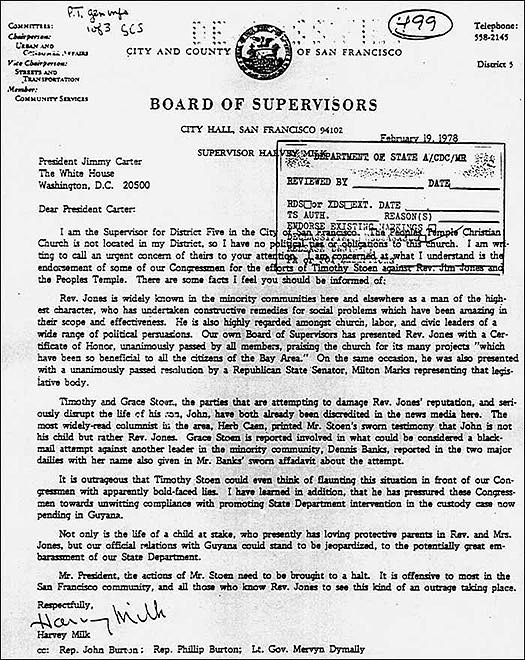
While the Temple created media alliances, moving to San Francisco also opened up a media study group in San Francisco. When Jones and hundreds of Temple members fled to Guyana after a media investigation, Mayor Moscone issued a press release stating that the City Hall would not investigate the Temple. [67] [83] At this time, Harvey Milk spoke at political rallies in the Temple of the Peoples [84] and wrote a letter to President Carter after the investigation began, praising Jones and stating that the leader of those trying to get relatives out of Johnstown tells “a daring lie ". [85] [86] [87]
Mass murder or suicide in Johnstown Agricultural Commons
In 1974, the Temple of the Peoples signed a land lease agreement in Guyana with an area of 3852 acres (15.59 square kilometers ). [88] The community created on this site was called the People's Temple Agricultural Project, or, unofficially, Johnstown. At the beginning of 1977, only 50 people lived in it. [89]
Jones saw in Johnstown both a “socialist paradise” and a “refuge” from a media screening that began with Kinsolving’s articles. [90] Former Temple member Tim Carter said the Temple moved to Johnstown because “in the year 74, what we saw in the United States was creeping fascism ” [91] Carter explained: “It was obvious that multinationals were getting much bigger “Their influence is growing in government, and the United States is a racist place.” [91] He also said that the Temple concluded that Guyana was “a place in a black country where our black members could live in peace,” “it was a socialist government,” and it was “the only English-speaking country in South America .” [91]
Strengthening media control based on statements by former members put additional pressure on Jones, especially after a 1977 article by Marshall Kilduff at New West Magazine . [30] Shortly before publication, editor Rosalie Wright called Jones to read him an article. [92] Wright explained that she did this just before publication because of “all the letters of support we received in your name from the Governor of California (Jerry Brown)” and others. [93] Even while talking on the phone, listening to the charges contained in the article, Jones wrote a note to the Temple members in his room, which said: “We are leaving tonight. Tell Georgetown (Guyana). ” [93]
After Jones left for Guyana, he urged members of the Temple to follow him there. The population grew to over 900 by the end of 1978. [89] [94] Those who moved there promised a tropical paradise, free from the supposed evil of the outside world. [95]
In Johnstown, members of the "Temple of the Nations" were engaged in cleaning and ennobling the area, growing crops. In the village were built: a sawmill , a club , a kindergarten , a nursery . The inhabitants of the village worked quite a lot (11 hours a day), in the evenings they organized meetings or studied.
Regarding the real life of ordinary members of the movement in the village, there are conflicting opinions. During the existence of the village, many people visited it, and left mostly positive reviews about the life of the inhabitants of Johnstown. On the tape recordings of the evening meetings that Jones made, jokes are heard, laughter, which these reviews confirmed. However, some of the former settlers have reported numerous human rights violations in Johnstown, torture, harsh corporal punishment for misconduct, and drug addiction of Jones and his entourage.
On November 17, 1978, Leo Ryan, an American congressman from the San Francisco area investigating allegations of abuse at the Temple of the Peoples, visited Johnstown. [96] During Ryan’s visit, several Temple members expressed a desire to leave with him, [97] and on November 18 they accompanied Ryan to the local runway in Port Kaitum. [98] They were intercepted by self-styled Temple guards who opened fire on the group, killing Ryan, three journalists, and one of the defectors. [99] A few seconds of shooting from the incident were captured on video by Bob Brown, one of the journalists killed in the attack. [99]
That evening, in Johnstown, Jones ordered his congregation to drink Flavor Aid, a grape-flavored drink mixed with cyanide . [100] [101] Two sectarians committed suicide while in another city in Guyana - Georgetown , after slaughtering two of their children.
Johnstown population growth
Entrance to Johnstown
Homes in Johnstown
Congressman Leo Ryan
Consequences
A total of 918 people died, including 276 children. [102] According to the official investigation, they committed the so-called. "Revolutionary suicide." This was the largest loss of American civilians as a result of a deliberate act prior to the events of September 11, 2001. [103] [104] [105] This number includes four who died at Temple Headquarters in Georgetown that night. [106]
San Francisco Temple headquarters was besieged by national media and relatives of Johnstown victims. [107] Mass suicide was one of the most famous events in US history, as measured by the Gallup poll, and appeared on the covers of several newspapers and magazines, including Time , for several months. [108]
In addition, according to various press reports, [109] [110] after suicides in Johnstown, surviving Temple members in the United States announced their fears of becoming a victim of the “shock group” of survivors in Johnstown. Similarly, in 1979, the Associated Press announced a statement by an assistant to the US Congress that "120 white brainwashed killers left Johnstown in anticipation of a code word that activates their activities." [111]
Temple Insider Michael Prox, who was ordered to deliver a suitcase containing Temple funds for handing over to the Communist Party of the Soviet Union, [112] [113] committed suicide in March 1979, four months after the Johnstown incident. В дни, предшествовавшие его смерти, Прокс направил записки нескольким людям вместе с 30-страничным манифестом, которое он написал о Храме Народов. Херб Кан перепечатал один экземпляр в своей хронике в Сан-Франциско . [114] Затем Прокс организовал пресс-конференцию в Модесто , штат Калифорния, во время которой он зачитал заявление для восьми присутствовавших журналистов. Затем он извинился, отошёл в туалет и застрелился. [114]
До трагедии член храма Паула Адамс вступала в романтические отношения с послом Гайаны в США — Лоуренсом «Бонни» Манном. [115] Адамс позже вышла замуж за Манна. [116] 24 октября 1983 года Манн застрелил Адамс и ребёнка пары, а затем застрелился сам. [116] Дезертировавший член Гарольд Корделл потерял 20 членов семьи в вечер отравления. [117] Семья Боги, которая также дезертировала, потеряла свою дочь Марили (18 лет), в то время как перебежчик Вернон Госни потерял своего сына Марка (5 лет).
Массовое самоубийство Храма Народов помогло внедрить в общественное мнение идею о том, что все Новые религиозные движения деструктивны. Старший научный сотрудник социолог Оксфордского университета Брайан Р. Уилсон возражает против этой точки зрения, указывая, что только пять таких событий произошли в сходных религиозных группах: Ветвь Давидова , Солнечный Храм, Аум Синрикё и Небесные Врата. [118]
По другой версии, получившей поддержку в СССР [119] , члены коммуны погибли в результате спецоперации, последовавшей за убийством конгрессмена. Основанием для таких утверждений послужила противоречивая информация с места трагедии, трехдневная задержка с началом расследования смертей, в ходе которого, вопреки американским законам, даже не было осуществлено вскрытие тел всех жертв трагедии. Выборочное обследование части тел, проведенное главным патологоанатомом Гайаны доктором С. Л. Муту, дали ему основания для категорического утверждения, что большинство погибших (не менее 700) были убиты. Об этом же на пресс-конференции в г. Модесто 13 марта 1979 заявил объявивший себя тайным осведомителем ЦРУ член Храма М. Прокс.
Банкротство и роспуск
В конце 1978 года Храм объявил о банкротстве, и его активы были переданы во внешнее управление . [120] В свете судебных процессов 4 декабря 1978 года адвокат компании Чарльз Гарри подал прошение о роспуске Храма Народов. Прошение было удовлетворено в Верховном суде Сан-Франциско в январе 1979 года. [121] Несколько членов Храма оставались в Гайане до мая 1979 года, чтобы завершить дела, а затем вернулись в США. [120]
Здания храма в Лос-Анджелесе, Индианаполисе и долине Редвуд не повреждены, и некоторые из них используются церковными общинами. [120] Центрально-испанская церковь адвентистов седьмого дня находится в бывшем здании храма в Лос-Анджелесе, на улице Альварадо, 1366. [122]
После трагедии посёлок Джонстаун на долгое время превратился в город-призрак , в середине 1980-х годов был практически полностью разрушен в результате пожара. Земля, на которой находятся руины поселения, никем не используется из-за своей мрачной славы.
Бывшая штаб-квартира храма в Сан-Франциско (бульвар Гири в 1859 году) была разрушена во время землетрясения в Лома Приета в 1989 году. Так как владелец не пожелал восстанавливать здание, оно было разрушено. В конце 1990-х годов Почтовая служба США открыла на этом месте почтовое отделение. Сайт сейчас занят почтовым отделением . В здании организации в Индианаполисе теперь располагается театр «Феникс». ( англ. Phoenix Theatre )
Комитет по иностранным делам Палаты представителей хранит 5000 страниц материалов, связанных с Храмом. За последние три десятилетия запросы на свободу информации от нескольких лиц, направленные на раскрытие этой информации, были безуспешными. [123] [124] [125]
В начале 1979 года «Храм народов» был официально запрещён в США как деструктивный культ . Происшествие в Джонстауне на долгое время снизило репутацию различных культов и новых религиозных течений в США. Конгрессмен Лео Райан был посмертно награждён Золотой медалью Конгресса в 1983 году.
Владельцы здания бывшего похоронного бюро в американском городе Довер 8 августа 2014 года обнаружили в нём 38 контейнеров с кремированными останками девяти жертв массового ритуального самоубийства . Установить связь погибших с событиями в Джонстауне помогли найденные в здании свидетельства о смерти. После опознания тела были доставлены в крупнейший в США морг расположенный на военной базе в Довере [126] .
Отношения с СССР
Джонс и его единомышленники неоднократно высказывали свои симпатии Советскому Союзу . В интервью, данном корреспонденту ТАСС , побывавшему в посёлке, Джонс заявил, что он выбрал для поселения Гайану, потому, что это страна социалистической ориентации. В декабре 1977 года члены коммуны Дебора Тушет, Шэрон Амос и Майкл Прокс имели беседу с консулом посольства СССР в Гайане Фёдором Тимофеевым в Джонстауне. Гости передали ряд документов коммуны, спустя неделю жена Джонса — Марселина рассказала историю создания организации и то, что несмотря на их переезд из США, коммуну продолжают преследовать [119] [127] . В коммуне стали распространяться слухи о скором переезде общины в СССР . 17 марта 1978 года коммуна направила Тимофееву письмо, с прошением о переносе денежных средств [128] . 19 марта было послано ещё одно письмо с ещё более настоятельной просьбой [129] . 20 марта делегация из Джонстауна посетила посольство СССР и дала знать о своем намерении просить у СССР политического убежища , а также о желании разместить в Госбанке СССР значительные денежные средства организации, принять советское гражданство и переехать в Союз [130] . Это заявление озадачило дипломатов, и они немедленно занялись обсуждением данного вопроса с Москвой, которая рекомендовала, для начала, отправить в Советский Союз делегацию от «Храма народов». 18 сентября 1978 года пришло ещё одно письмо [129] . 27 сентября Фёдор Тимофеев и врач посольства Н. Федоровский приехали в Джонстаун, чтобы сообщить о решении, принятом в Москве, после чего все члены коммуны окончательно поверили в скорый переезд. Для решения практических вопросов переселения был намечен визит Джонса в СССР в конце ноября — начале декабря 1978 года [130] . 25 октября 1978 года от коммуны пришло письмо с поздравлениями в честь 61-й годовщины Октябрьской революции [131] . Однако развивать дальнейшие отношения с Советским Союзом помешала трагедия.
Художественные отражения
- Вуаль- фильм
- « Три дня в Джонстауне » — фильм (2007)
- «Jonestown Slumber Party» — песня шведской прогрессив-метал-группы Loch Vostok со второго альбома, «Destruction Time Again».
- « Outlast 2 » — видеоигра, сюжет которой основан на трагедии в Джонстауне (2017).
- « Секунды до катастрофы » — серия «Джонстаунская секта самоубийц» (2012).
- «Guyana (Cult of the Damned)» — песня американской хеви-метал -группы Manowar с альбома « Sign of the Hammer » 1984 года.
- Американская история ужасов (American Horror story), 7 сезон, серия 9 «Пей Кул-Эйд» ( «Drink the Kool-Aid» ) (2017)
- «Koolaid» — песня немецкой хеви-метал группы Accept с альбома «The Rise of Chaos» 2017 года.
- « Far Cry 5 » — видеоигра, сюжет и синопсис которой имеет множество параллелей с историей «Храма Народов».
- «Church in the darkness» — видеоигра, главный антагонист в которой — секта в Южной Америке с социалистическими укладами.
- The People's Temple — песня английской метал-группы Jonestown с анонсированного альбома «DYATLOV» (2018)
Notes
- ↑ http://jonestown.sdsu.edu/wpcontent/uploads/2013/10/DissolutionPeoplesTemple.pdf
- ↑ Barker, Eileen New Religious Movements: A Practical Introduction . Bernan Press, 1990. ISBN 0-11-340927-3 . - pp. 10—20
- ↑ Астахова А. С. Глава третья «Функционирование новых религиозных движений» // Новые религиозные движения в трансформирующемся российском обществе: социальные процессы интеграции и изоляции. Автореферат диссертации на соискание учёной степени кандидата социологических наук. Казань, 2011.
- ↑ Олейник, 2009 , с. 143.
- ↑ 1 2 3 Jones, Jim — «Transcript of Recovered FBI tape Q 134» Alternative Considerations of Jonestown and Peoples Temple . Jonestown Project: San Diego State University. Jonestown Project: San Diego State University.
- ↑ 1 2 3 4 5 6 7 8 9 10 11 12 13 14 15 16 17 Wessinger, Catherine. How the Millennium Comes Violently: From Jonestown to Heaven's Gate . Seven Bridges Press, 2000. ISBN 978-1-889119-24-3 .
- ↑ Horrock, Nicholas M., «Communist in 1950s», New York Times , December 17, 1978
- ↑ Reiterman T., Jacobs J. Raven: The Untold Story of the Rev. Jim Jones and His People . — Dutton, 1982. — С. 49—52. — ISBN 978-0-525-24136-2 .
- ↑ Dawson LL Cults and new religious movements: a reader. — Wiley-Blackwell, 2003. — ISBN 1-4051-0181-4 .
- ↑ Mass Suicide at Jonestown: 30 Years Later (англ.) . Time (2008). Дата обращения 27 августа 2012. Архивировано 29 октября 2012 года.
- ↑ Layton 1999, p. 65-66.
- ↑ 1 2 3 4 5 6 Reiterman 1982. p. 49-52.
- ↑ 1 2 Reiterman 1982. p. 57.
- ↑ 1 2 3 4 5 6 7 8 9 10 Reiterman 1982. p. 54-55.
- ↑ Reiterman 1982. p. 59.
- ↑ 1 2 Reiterman 1982. p. 59 and 65.
- ↑ 1 2 Reiterman 1982. p. 60.
- ↑ 1 2 3 Reiterman 1982. p. 61.
- ↑ 1 2 3 Reiterman 1982. p. 62.
- ↑ Reiterman 1982. p. 74.
- ↑ 1 2 Reiterman 1982. p. 76.
- ↑ Reiterman 1982. p. 77.
- ↑ 1 2 Reiterman 1982. p. 83.
- ↑ Reiterman 1982. p. 85.
- ↑ Jones, Jim. http://jonestown.sdsu.edu/?page_id=27309 «Transcript of Recovered FBI tape Q 1023.»]] Alternative Considerations of Jonestown and Peoples Temple . Jonestown Project: San Diego State University. Archived copy . Дата обращения 27 апреля 2008. Архивировано 13 февраля 2011 года.
- ↑ Wessinger C. How the Millennium Comes Violently: From Jonestown to Heaven's Gate. — 2000. — P. 31—34. — ISBN 978-1-889119-24-3 .
- ↑ 1 2 3 4 5 6 Lindsay, Robert. «How Rev. Jim Jones Gained His Power Over Followers.» New York Times . 26 November 1978.
- ↑ Jones, Jim. «The Letter Killeth.» Original material reprint. Department of Religious Studies. San Diego State University. Archived copy . Дата обращения 24 февраля 2008. Архивировано 13 февраля 2011 года.
- ↑ 1 2 3 4 5 6 7 8 9 10 Reiterman 1982. page 164.
- ↑ 1 2 Kilduff, Marshall and Phil Tracy. «Inside Peoples Temple.» New West Magazine . 1 August 1977 (hosted at Alternative Considerations of Jonestown and Peoples Temple. Jonestown Project: San Diego State University). Archived copy . Дата обращения 28 октября 2006. Архивировано 24 января 2011 года.
- ↑ Reiterman 1982. p. 156.
- ↑ Reiterman, 1982 , p. 302—304.
- ↑ Layton D. Seductive Poison.. — Anchor, 1999. — P. 105. — ISBN 0-385-48984-6 .
- ↑ 1 2 3 4 Reiterman 1982. p. 163-64.
- ↑ 1 2 3 4 5 6 7 8 9 10 Reiterman 1982. p. 156—159.
- ↑ 1 2 3 4 Reiterman 1982. p. 160—163.
- ↑ 1 2 Lewis, Mike. «Jones disciple recovers from, recalls painful past.» Seattle Post-Intelligencer . 19 November 2003. Архивировано 13 февраля 2011 года.
- ↑ Dickerson, Toby. Peoples Temple (Jonestown) . Архивировано 8 сентября 2006 года. . The Religious Movements Homepage Project. University of Virginia. 5 February 2005.
- ↑ Layton 1999, p. 62.
- ↑ Hall 1987, p.178-184
- ↑ 1 2 3 4 5 6 7 8 9 10 Reiterman 1982. p. 166—168.
- ↑ 1 2 3 4 5 6 7 8 9 Reiterman 1982. p. 169—171.
- ↑ Kilduff, Marshall and Ron Javers. Suicide Cult: The Inside Story of the Peoples Temple Sect and the Massacre in Guyana . Bantam Books, New York, 1978. ISBN 978-0-553-12920-5 . page 42.
- ↑ Hall, John R. «The Impact of Apostates on the Trajectory of Religious Movement: The Case of the Peoples Temple», in David G. Bromley (ed.) Falling from the Faith: Causes and Consequences of Religious Apostasy . Sage Publications, 1988. ISBN 978-0-8039-3188-6 . page 234.
- ↑ 'The Opposition, The Returned, Crisis & White Nights' , Jonestown Institute, San Diego State University, May 2008. Archived copy . Дата обращения 12 июня 2008. Архивировано 13 февраля 2011 года.
- ↑ Hall, John R. Gone from the Promised Land: Jonestown in American Cultural History. — New Brunswick, New Jersey : Transaction Publishers, 1987. — ISBN 978-0-88738-124-9 . page 166
- ↑ Jones, Jim, FBI Tape Q 683 , Jonestown Institute, San Diego State University Archived copy . Дата обращения 17 июня 2008. Архивировано 13 февраля 2011 года.
- ↑ Layton 1999, p. 53.
- ↑ Hall, John R. Gone from the Promised Land: Jonestown in American Cultural History. — New Brunswick, New Jersey : Transaction Publishers, 1987. — ISBN 978-0-88738-124-9 . page 90-91
- ↑ Hall 1987, p. 81-82
- ↑ Hall 1987, p.82
- ↑ Hall 1987, p.95
- ↑ 1 2 3 Reiterman 1982. p. 211—214.
- ↑ Kinsolving, Lester. «SEX, SOCIALISM, AND CHILD TORTURE WITH REV. JIM JONES.» San Francisco Examiner . September 1972.
- ↑ Reiterman 1982. p. 302—304.
- ↑ Reiterman 1982. p. 225—227.
- ↑ 1 2 3 Reiterman 1982. p. 224.
- ↑ 1 2 Reiterman 1982. p. 225.
- ↑ 1 2 Paranoia And Delusions , Time Magazine, December 11, 1978 Архивировано 24 января 2011 года.
- ↑ Reiterman 1982. p. 226.
- ↑ Hall, John R. Gone from the Promised Land: Jonestown in American Cultural History. — New Brunswick, New Jersey : Transaction Publishers, 1987. — ISBN 978-0-88738-124-9 . page 161
- ↑ Jones, Jim in conversation with John Maher. «Transcript of Recovered FBI tape Q 622.» Alternative Considerations of Jonestown and Peoples Temple . Jonestown Project: San Diego State University. Archived copy . Дата обращения 13 февраля 2011. Архивировано 13 февраля 2011 года.
- ↑ Reiterman 1982. page 256.
- ↑ Reiterman 1982. page 259.
- ↑ Reiterman 1982. p. 280.
- ↑ Reiterman 1982. p. 266—267 & 280.
- ↑ 1 2 Los Angeles Herald Examiner, «The Political Pull of Jim Jones», November 21, 1978
- ↑ Reiterman 1982. page 263.
- ↑ Kinsolving, Kathleen and Tom. «Madman in Our Midst: Jim Jones and the California Cover Up.» Архивировано 31 декабря 2010 года. 1998. Steven Alan Hassan's Freedom of Mind Center. Retrieved October 14, 2010. Archived copy . Дата обращения 14 октября 2010. Архивировано 13 февраля 2011 года.
- ↑ Jonestown: The Life and Death of Peoples Temple . PBS.org. Архивировано 24 января 2011 года.
- ↑ Layton 1999, page 105.
- ↑ Dooley, Nancy and Tim Reiterman. «Jim Jones: Power Broker.» San Francisco Examiner . August 7, 1977.
- ↑ Layton 1999, p. 105.
- ↑ Reiterman 1982. page 302.
- ↑ Reiterman 1982. page 304.
- ↑ Jim Jones, «Transcript of Recovered FBI tape Q 799.» Alternative Considerations of Jonestown and Peoples Temple . Jonestown Project: San Diego State University. Archived copy . Дата обращения 27 апреля 2008. Архивировано 24 января 2011 года.
- ↑ Reiterman 1982. page 282—283.
- ↑ Reiterman 1982. page 265.
- ↑ Reiterman 1982. page 285, 306 and 587.
- ↑ Reiterman 1982. page 236.
- ↑ Reiterman 1982. page 299—300.
- ↑ Reiterman 1982. page 282.
- ↑ Moore, Rebecca. A Sympathetic History of Jonestown . Lewiston: E. Mellen Press. ISBN 978-0-88946-860-3 . p. 143.
- ↑ «Another Day of Death.» Time . 11 December 1978. Архивировано 24 января 2011 года.
- ↑ Coleman, Loren, «The Copycat Effect», Simon & Schuster, 2004, page 68
- ↑ Fishwick, Marshall, «Great Awakenings: Popular Religion and Popular Culture», Routledge, 1994, page 73
- ↑ Milk, Harvey. Letter Addressed to President Jimmy Carter, Dated February 19, 1978 . Архивировано 24 января 2011 года.
- ↑ Reiterman 1982. page 240-41.
- ↑ 1 2 Entry to Guyana , Alternatives Considerations of Jonestown & Peoples Temple, San Diego State University Archived copy . Дата обращения 20 сентября 2008. Архивировано 13 февраля 2011 года.
- ↑ Hall 1987, p.132
- ↑ 1 2 3 Tim Carter. There was no choice in Jonestown that day… Архивировано 26 апреля 2007 года. Oregon Public Broadcasting Radio interview. 9 April 2007. Archived copy . Дата обращения 8 февраля 2016. Архивировано 13 февраля 2011 года.
- ↑ Layton 1999, page 111—116.
- ↑ 1 2 Layton 1999, page 113.
- ↑ Reiterman 1982. page 346.
- ↑ Hall 1987, p.133
- ↑ Reiterman 1982. p. 487.
- ↑ Reiterman 1982. p. 512.
- ↑ Reiterman 1982. p. 524.
- ↑ 1 2 Reiterman 1982. p. 529—531.
- ↑ Hall 1987, p.282
- ↑ «Jonestown Audiotape Primary Project» . Alternative Considerations of Jonestown and Peoples Temple . San Diego State University. Archived copy . Дата обращения 10 ноября 2011. Архивировано 24 января 2011 года.
- ↑ 1978: Mass Suicide Leaves 900 Dead , BBC News (18 ноября 1978). Дата обращения 3 октября 2011.
- ↑ Rapaport, Richard, Jonestown and City Hall slayings eerily linked in time and memory , San Francisco Chronicle, November 16, 2003 Архивировано 24 января 2011 года.
- ↑ Nakao, Annie. «The ghastly Peoples Temple deaths shocked the world.» San Francisco Chronicle . 14 April 2005. Архивировано 24 января 2011 года.
- ↑ Knapp, Don. «Jonestown massacre + 20: Questions linger.» CNN.com. 18 November 1998. Retrieved 9 April 2007. Архивировано 20 марта 2007 года.
- ↑ Reiterman 1982. page 544-5.
- ↑ Reiterman 1982. p. 573
- ↑ Hall, John R. Gone from the Promised Land: Jonestown in American Cultural History . 1989. ISBN 978-0-88738-801-9 . p. 289.
- ↑ Spencer, Duncan, «Cult's Ukiah Community in Fear of Vengeful Death Squads», Washington Star-News, November 23, 1978
- ↑ «Police Seek Out Cult 'Hit Squads'», San Francisco Examiner, November 22, 1978
- ↑ Steel, Fiona Jonestown Massacre: A 'Reason' to Die . CrimeLibrary.com. Дата обращения 22 мая 2007. Архивировано 13 февраля 2011 года.
- ↑ Reiterman 1982. pp 561—580.
- ↑ «Letter to Feodor Timofeyev.» Alternative Considerations of Jonestown and Peoples Temple . Jonestown Project: San Diego State University. Archived copy . Дата обращения 12 ноября 2012. Архивировано 14 августа 2010 года.
- ↑ 1 2 «Statement of Michael Prokes.» Alternative Considerations of Jonestown and Peoples Temple . San Diego State University: Jonestown Project. Retrieved 22 September 2007. Archived copy . Дата обращения 12 ноября 2012. Архивировано 24 января 2011 года.
- ↑ Reiterman 1982. pages 274-5 & 418.
- ↑ 1 2 Weingarten, Gene. «The Peekaboo Paradox.» The Washington Post . January 22, 2006. Архивировано 13 февраля 2011 года.
- ↑ The Congregation of Peoples Temple . PBS.org. Архивировано 13 февраля 2011 года.
- ↑ Why the Bruderhof is not a cult – by Bryan Wilson | Cult And Sect | Religion And Belief (англ.) . Scribd . Дата обращения 7 июля 2017.
- ↑ 1 2 Алинин, С.Ф.; Антонов, Б.Г.; Ицков, А.Н. Гибель Джонстауна — преступление ЦРУ. — М. : Юридическая литература, 1987. — 224 с.
- ↑ 1 2 3 «What happened to Peoples Temple after 18 November 1978?» Alternative Considerations of Jonestown and Peoples Temple . San Diego State University: Jonestown Project. 2007-03-08. Archived copy . Дата обращения 11 июня 2008. Архивировано 24 января 2011 года.
- ↑ The Court's Wrapping-Up of Peoples Temple Affairs – Alternative Considerations of Jonestown & Peoples Temple . jonestown.sdsu.edu . Date of treatment June 16, 2017.
- ↑ Central Spanish Seventh-day Adventist Church . AdventistChurchConnect.org. Архивировано 13 февраля 2011 года.
- ↑ McGehee, Fielding M. III. «Attempting to Document the Peoples Temple Story: The Existence and Disappearance of Government Records.» Alternative Considerations of Jonestown and Peoples Temple . San Diego State University: Jonestown Project. Архивировано 22 мая 2014 года.
- ↑ Richardson, James Jonestown 25 Years Later: Why All The Secrecy? . Дата обращения 25 августа 2008. Архивировано 13 февраля 2011 года.
- ↑ Taylor, Michael . Most Peoples Temple Documents Still Sealed , San Francisco Examiner (13 ноября 1998). Archived February 13, 2011. Дата обращения 25 августа 2008.
- ↑ В США нашли прах жертв ритуального самоубийства в Гайане // Русская служба Би-би-си . — 08.08.2014. Архивировано 8 августа 2014 года.
- ↑ Гибель Джонстауна — преступление ЦРУ
- ↑ Обращение к послу СССР | Новосибирский КОМСОМОЛ
- ↑ 1 2 Повторные обращения к послу | Новосибирский КОМСОМОЛ
- ↑ 1 2 Трагедии Коммуны Джонстауна 35 лет | Леворадикал
- ↑ Письма из Джонстауна | Новосибирский КОМСОМОЛ
Literature
- in Russian
- Алинин С. Ф. , Антонов Б. Г. , Ицков А. Н. Правда о бойне в джунглях Гайаны // Собеседник . — 1987. — № 12 . Архивировано 15 августа 2015 года.
- Алинин С. Ф. , Антонов Б. Г. , Ицков А. Н. Гибель Джонстауна — преступление ЦРУ. — М. : Юридическая литература , 1987. — 224 с. - 100,000 copies. (краткий пересказ книги) . Архивировано 29 ноября 2012 года. , текст книги . Архивировано 19 апреля 2013 года.
- Бойл Д. Д. Секты-убийцы = James J. Boyle Killer Cults: Shocking True Stories of the Most Dangerous Cults In History // Иностранная литература : (Главы из книги. Перевод с английского Н. Усовой и Е. Богатыренко ). — 1996. — № 7 . — С. 208—261 .
- Вахтин Б. Б. Гибель Джонстауна. — Л. : Советский писатель , 1986. — 325 с.
- Желенин А. Убиты и оклеветаны. «Храм народов» стал жертвой холодной войны, а не мифического фанатизма его членов. // Независимая газета . — 28.11.1998. Архивировано 15 августа 2015 года.
- Крамер Дж., Олстед Д. Маски авторитарности. Очерки о гуру / Пер. с англ.. — М. : Прогресс-Традиция , 2002. — 408 с.
- Митрохин Л. Н. Философские проблемы религиоведения. - SPb. : Издательство РХГА , 2008. — 1046 с. - 800 copies. — ISBN 978-5-88812-348-5 .
- Новокшонов Д. Их убили за желание стать советскими // Телеграфъ. — 28.11.2008.
- Олейник Н. Н. «Возникновение и опасность терроризма для развития российского федерализма» // Научные ведомости Белгородского государственного университета . Серия: Философия. Социология. Право. — Белгород : Белгородский государственный университет , 2009. — Т. 10 , № 9 . — С. 142—147 .
- Федоровский Ю. Р. Коммунары Джонстауна. 30 лет назад // Донецький кряж . — 31.10.2008, 7.11.2008. — № 40—41 . Архивировано 15 августа 2015 года.
- Филатов С. Б. Современная Россия и секты // Иностранная литература . - 1996. - No. 8 . — С. 201—219 .
- Фурман Д. Е. Трагедия Джонстауна и американские секты // США. Экономика, политика, идеология . — 1979. — № 6 . — С. 27—36 .
- Фурсенко А. А. Президенты и политика США. 70-е годы. — Л. : Наука , 1989. — 290 с.
- Ходорыч А., Конашенок Н., Студнев М. Товарищества на вере // Коммерсантъ-Деньги . — 31.10.2001. — № 43 (347) . — С. 30 . Архивировано 7 декабря 2014 года.
- in other languages
- Barden, Renardo Barden. Cults (Troubled Society series).. — Rourke Pub Group, 1990. — ISBN 0-86593-070-8 .
- Brailey, Jeffrey. The Ghosts of November: Memoirs of an Outsider Who Witnessed the Carnage at Jonestown, Guyana. — San Antonio: J & J Publishers, 1998. — ISBN 0-9667-8680-7 .
- Chidester, David. Salvation and Suicide. — Bloomington: Indiana University Press , 1988. — ISBN 0-253-35056-5 .
- Dolan, Sean. Everything You Need to Know About Cults. — New York: Rosen Pub. Group , 2000. — ISBN 0-8239-3230-3 .
- Feinsod, Ethan. Awake in a Nightmare: Jonestown: The Only Eyewitness Account. — New York: WW Norton & Co , 1981. — ISBN 0-393-01431-2 . Based on interviews with Odell Rhodes.
- Galanter, M. . Faith, Healing, and Coercion. — New York: Oxford University Press , 1999.
- Hall, John R. Gone from the Promised Land: Jonestown in American Cultural History. — New Brunswick: Transaction Publishers , 1987. — ISBN 0-88738-124-3 .
- Kahalas, Laurie Efrein. Snake Dance: Unravelling the Mysteries of Jonestown. — New York: Red Robin Press, 1998. — ISBN 1-5521-2207-7 .
- Kerns, Phil. People's Temple, People's Tomb. — Logos Associates, 1978. — ISBN 0-88270-363-3 .
- Kilduff, Marshall and Ron Javers. The Suicide Cult: The Inside Story of the Peoples Temple Sect and the Massacre in Guyana. — New York: Bantam Books , 1978. — ISBN 0-553-12920-1 .
- Klineman, George and Sherman Butler. The Cult That Died. — GP Putnam's Sons , 1980. — ISBN 0-399-12540-X .
- Kohl, Laura Johnston. Jonestown Survivor: An Insider's Look. — New York: iUniverse , 2010.
- Krause, Charles A. with Laurence M. Stern, Richard Harwood and the staff of The Washington Post. Guyana Massacre: The Eyewitness Account. — New York: Berkley Pub. Corp, 1978. — ISBN 0-425-04234-0 .
- Lane, Mark. The Strongest Poison. — New York: Hawthorn Books, 1980. — ISBN 0-8015-3206-X .
- Layton, Deborah. Seductive Poison . — New York: Anchor Books , 1998. — ISBN 0-385-48984-6 .
- Maaga, Mary McCormick. Hearing the Voices of Jonestown. — Syracuse: Syracuse University Press , 1998. — ISBN 0-8156-0515-3 .
- Mills, Jeannie. Six Years with God: Life Inside Rev. Jim Jones's People's Temple. — New York: A&W Publishers, 1979. — ISBN 0-8947-9046-3 .
- Moore, Rebecca. A Sympathetic History of Jonestown: the Moore Family Involvement in Peoples Temple. — Lewiston: E. Mellen Press, 1985. — ISBN 0-88946-860-5 .
- Moore, Rebecca. In Defense of Peoples Temple. — Lewiston, NY: Edwin Mellen Press , 1988.
- Naipaul, Shiva . Journey to Nowhere: A New World Tragedy. — Harmondsworth: Penguin, 1982. — ISBN 0-14-006189-4 . (published in the UK as Black and White)
- Reiterman, Tim; Jacobs, John. Raven: The Untold Story of the Rev. Jim Jones and His People . — Dutton, 1982. — ISBN 0-525-24136-1 .
- Reston, James, Jr. Our Father Who Art in Hell: The Life and Death of Jim Jones. — New York: Times Books , 1981. — ISBN 0-8129-0963-1 .
- Sargeant, Jack . Death Cults: Murder, Mayhem and Mind Control (True Crime Series). — Virgin Publishing , 2002. — ISBN 0-7535-0644-0 .
- Scheeres, Julia . A Thousand Lives: The Untold Story of Hope, Deception, and Survival at Jonestown . — New York: Free Press , 2011. — ISBN 1-4165-9639-9 .
- Sorell, WE Cults and Cult Suicide. — International Journal of Group Tensions. — 1978.
- Stephenson, Denice. Dear People: Remembering Jonestown. — Heyday Books , 2005. — ISBN 1-59714-002-3 .
- Thielmann, Bonnie, Merrill, Dean. The Broken God. — Elgin: David C. Cook Publishing Co, 1979.
- Thrash, Catherine (Hyacinth), as told to Marian K. Towne. The Onliest One Alive: Surviving Jonestown, Guyana. — Indianapolis: Marian K. Towne, 1995.
- Wagner-Wilson, Leslie. Slavery of Faith. — New York: iUniverse , 2009.
- Wooden, Kenneth. The Children of Jonestown. — New York: McGraw-Hill , 1981.
- Wright, Lawrence. The Sons of Jim Jones // The New Yorker . — 22 Nov 1993. — № 39 . — P. 66–89.
- Yee, Min S., Layton, Thomas N. In My Father's House. — New-York: Holt, Rinehart and Winston , 1981.
Links
- Д. Новокшонов. «Их убили за желание стать советскими» . Архивировано 29 ноября 2012 года. . // Телеграфъ, 28.11.2008 (Проверено 17 июня 2009)
- Extensive site with source documents, list of dead, pictures . San Diego State University . Архивировано 29 ноября 2012 года.
- Audio Recording of Jonestown Suicide . Архивировано 29 ноября 2012 года.
- Transcription of Suicide Tape (недоступная ссылка) . Дата обращения 27 июня 2007. Архивировано 15 декабря 2014 года.
- original 1977 «Inside Peoples Temple» article from New West magazine by Marshall Kilduff and Phil Tracy (недоступная ссылка) . Дата обращения 27 июня 2007. Архивировано 24 января 2011 года.
- Федоровский Ю. Р. «Коммунары Джонстауна. 30 лет назад» (недоступная ссылка) . Дата обращения 7 октября 2009. Архивировано 23 сентября 2010 года. . // «Донецкий кряж», № 40, 31.10.2008, № 41, 7.11.2008.
- «Reconstructing Reality: Conspiracy Theories About Jonestown» by Rebecca Moore . Архивировано 29 ноября 2012 года.
- Reiterman T., Jacobs J. Raven: The Untold Story of the Rev. Jim Jones and His People . — Dutton, 1982. — С. 49—52. — ISBN 978-0-525-24136-2 .
- Михаил Валентинов. «История — Храм Народов»