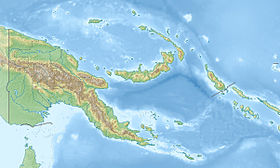
Murray ( Eng. Lake Murray ) - the largest lake in Papua New Guinea and all of Australasia . [1] Located in the western province of the country in the lowlands (maximum depth - 7 m), located north of the confluence of the Strickland and Fly . The total area of the lake is 647 km², but in the rainy season it can increase significantly. [2] Murray waters flow into the Strickland River through the Herbert River. However, during heavy rains, it happens that the waters of the Strickland River flow into the lake, and not vice versa. [2]
| Lake | |
| Marry | |
|---|---|
| English Lake murray | |
 Space image of the lake | |
| Morphometry | |
| Absolute height | 20 m |
| Dimensions | 63 × 18 km |
| Square | 647 km² |
| Coastline | 2038 km |
| Deepest | 10 m |
| Location | |
| A country |
|


In the dry season, which lasts from April to November, silt is exposed on the lake, and during droughts, Murray can completely dry out. [1] The lake is located in the tropical monsoon climate zone. The rainy season usually lasts from December to March or April. The average annual rainfall in the region is about 2300 mm. [1] Murray plays an important role in the life of the local Papuan tribes, as it provides them with fresh water and food.
The lake was discovered in 1913 by an expedition led by Massey Baker, who named it after Lieutenant Governor of the Australian Territory Papua Hubert Murray . [3] [4]
See also
- Koutoubu
Notes
- ↑ 1 2 3 Osborne, Patrick L. Papua New Guinea (inaccessible link) . RAMSAR Date of treatment April 3, 2010. Archived April 21, 2012.
- ↑ 1 2 Papua New Guinea. Dept. of Environment and Conservation, International Union for Conservation of Nature and Natural Resources, IUCN Environmental Assessment Service. The Fly River catchment, Papua New Guinea: a regional enviromental assessment. - IUCN, 1995 .-- P. 10 .-- 86 p. - ISBN 2831702364 .
- ↑ Ok-Fly Social Monitoring Project - Baseline Documentation . Date of treatment April 3, 2010. Archived April 21, 2012.
- ↑ Pacific linguistics, Issues 23-29. - Dept. of Linguistics, Research School of Pacific Studies, Australian National University, 1970. - P. 3.