Letas ( Lake Letas ) is the largest freshwater lake in Vanuatu and the islands of Oceania (excluding New Guinea ) [1] , located in the center of the volcanic island of Gaua as part of the Banks islands . In 2004, it was included in the preliminary list of UNESCO World Heritage Sites . [2]
| Lake | |
| Letas | |
|---|---|
| English Lake letas | |
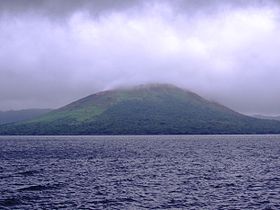 Letas Lake with Mount Gharat | |
| Morphometry | |
| Absolute height | 418 m |
| Dimensions | 6.3 × 3.6 km |
| Square | 19 km² |
| Deepest | 350 m |
| Average depth | 42 m |
| Location | |
| A country |
|
| Region | Torba |

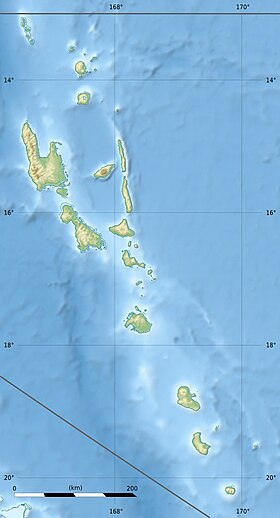

The lake has a U-shape and surrounds Mount Gharat on all sides (except southwest). The length of Letas from north to south is about 9 km, width - about 6 km, and area - 19 km². The lake is located in the center of the island with a diameter of 20 km at an altitude of about 418 m above sea level. The maximum depth is about 350 m. [2] Letas is a freshwater crater lake with a water temperature of 32 ° C (therefore, only eels and shrimps can survive in it). [3] The water in the lake is not transparent, but a slightly greenish hue. It regularly flows from the lake on the east side and reaches after about 3 km of Siri waterfall, and then flows into the Namang and Mbe-Solomul rivers, eventually reaching the waters of the Pacific Ocean .
At the lake there is a large nesting site for waterfowl. Due to the fact that the lake is surrounded by marshland , it grows a large number of marsh vegetation, among which the Warburg metroxylons ( lat. Metroxylon warburgii ) and swamp palms stand out. Among other plants, lipid-shaped hibiscus ( lat. Hibiscus tiliaceus ), various types of heliconia ( lat. Heliconia sp. ) And lunate cyate ( Lat. Cyathea lunulata ) are found. In addition, nineteen endemic plant species, 39 bird species, two thirds of which are endemic, two endemic lizard species, are recorded in the Letas area. [2]
Notes
- ↑ Lake Letas (inaccessible link) . Date of treatment April 3, 2010. Archived April 21, 2012.
- ↑ 1 2 3 Lake Letas . UNESCO World Heritage Center. Date of treatment April 3, 2010. Archived April 21, 2012.
- ↑ Republic of Vanuatu environmental profile (inaccessible link) . Date of treatment April 3, 2010. Archived April 21, 2012.