New Zealand fertile pigeon [1] ( lat. Hemiphaga novaeseelandiae ) is a bird of the pigeon family .
| New zealand pigeon |
 |
| Scientific classification |
|---|
| No rank : | Bilateral symmetrical |
| Gender: | New Zealand fertile pigeons |
|
| International scientific name |
|---|
Hemiphaga novaeseelandiae ( Gmelin , 1789 ) |
| Security status |
|---|
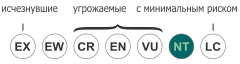
Close to vulnerableIUCN 3.1 Near Threatened : 22727557 |
|
Content
The body length of the bird is 46-50 cm. Weight 650-800 g. The head, neck and chest are green, with a golden sheen. The lower neck, upper back and wing coverts are painted dark purple-red. Primary flywheels are bluish-black. The tail is slate black with brown tips of feathers. The lower body is completely white. Coloring of the beak with a reddish base and a yellowish tip. The color of the legs is purple-red. A female with a less intense purplish-red color.
Distributed in New Zealand and the nearby islands.
Sedentary bird. It inhabits forests and anthropogenic landscape - parks, plantations, gardens. The diet consists of fruits, berries, green shoots, buds and flowers. Particular preference is given to the fruits of the Eriobotrya japonica tree. It is an important part of the local ecosystem, spreading the seeds of the trees Corynocarpus laevigatuskaraka , Beilschmiedia tarairi , Beilschmiedia tawatawa , Prumnopitys ferrugineamiro .
Nesting lasts from November to April. Nests in trees or shrubs in the thicket. The nest is a rough construction of branches. In clutch 1 egg. The color of the shell is clean, matte. Egg incubation lasts 28 days. Chicks leave the nest at the age of about 40 days.
By autumn and winter, these pigeons gain weight and become very greasy and are the targets of mass shooting.
Often kept in captivity, like a decorative bird. In captivity, they feel comfortable. Chicks taken from a nest and raised by humans become tame.
- H. n. novaeseelandiae (Gmelin, 1789)
- † H. n. spadicea (Latham, 1802)
A subspecies from Chatham Island ( H. n. Chathamensis ( Rothschild , 1891)) is now considered as an independent species, Hemiphaga chathamensis [2] . He is currently on the verge of extinction, its number does not exceed 50 individuals.
- ↑ Boehme R. L. , Flint V. E. The Bilingual Dictionary of Animal Names. Birds. Latin, Russian, English, German, French / Ed. ed. Acad. V. E. Sokolova . - M .: Rus. lang., "RUSSO", 1994. - S. 102. - 2030 copies. - ISBN 5-200-00643-0 .
- ↑ Taxonomy browser (Hemiphaga) .