Ferdinand Stolichka ( German: Ferdinand Stoliczka , Czech. Stolička June 7, 1838 , Bilani, today part of Kromeriz , Moravia - June 19, 1874 , India ) - Czech and Austrian researcher, botanist , zoologist, geologist, surveyor and paleontologist.
| Ferdinand Stolichka | |
|---|---|
| him. Ferdinand stoliczka | |
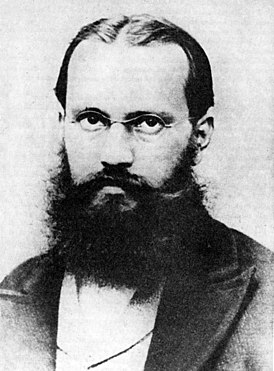 | |
| Date of Birth | June 7, 1838 |
| Place of Birth | Kromeriz , Moravia , Austrian Empire |
| Date of death | June 19, 1874 (36 years old) |
| Place of death | Ladakh , India |
| A country | Austrian Empire |
| Scientific field | zoology , botany |
| Alma mater | |
| Taxonomy of wildlife | |
|---|---|
The author of the names of a number of botanical taxa . In the botanical ( binary ) nomenclature, these names are supplemented by the abbreviation " Stoliczka " . Personal page on IPNI website The researcher who described a number of zoological taxa . The names of these taxa (to indicate authorship) are accompanied by the designation " Stoliczka " . |

Biography
Ferdinand Stolichka was born in a forest, not far from the Moravian city of Kromeriz , in a hunting lodge, which had its own name Zámeček. His father belonged to the Ganak ethnic group and served as a forester on the estates of the Archbishop of Olomouc .
Ferdinand studied at a German second-level school in Kromeriz, then at the universities of Vienna [1] and Tübingen . In 1859 he traveled to the Northeast Alps. On October 14, 1861, he defended his doctoral dissertation at the University of Tübingen .
After graduation, he worked for several years at the Imperial Geological Institute in Vienna, until he transferred to the Geological Survey of the Indian Empire in 1862 (that is, British India). He visited Burma , Malaya , Singapore , the Andaman and Nicobar archipelagos, explored the geological structure of the Great Cach Rann . From 1864 to 1866, he initiated several research expeditions to the Himalayas and Tibet , where he carried out petrographic studies, meteorological observations and collected rocks, fossils, plants and mammals. He proved that the frame of the Himalayas consists of gneiss . He was the secretary of the Asiatic Society of Bengal. In 1872 he visited Darjeeling , in 1873 - the Nicobar and Andaman Islands .
Last Expedition
In 1873, he made his last trip to the Himalayas as a member of the 2nd Yarkand mission of Thomas Douglas Forsyth (1827–1886). The expedition set off from Rawalpindi through Kashmir to Kashgar. One of her tasks was to shoot the Pamirs , which the British saw as a very important part of the "Northwest Theater of War" against Russia, in which they saw the "potential threat" of British India. The expedition included Stolichka and four pandits (including Abdul-Sabhan); they were led by topographical officer Henry Trotter. From Yangigisar (at 76 ° E), the detachment headed southwest and reached the Tashkurgan River at the end of March. Trotter and pandits photographed a number of snow peaks in the Muztagat massif, including the highest (7546 m [2] ). Then they climbed the pass in the open watershed ridge (Sarykolsky), which has a meridian direction here. Before them opened the valley of the Oksu River (the upper reaches of the Bartanga-Murgaba). In deep snow in early April, tenants walked to this river and described a high ridge of snow peaks - the southern border of the Pamirs, the watershed of the upper Oksu and the Tashkurgan River. Accompanied by a strong wind, they arrived at Lake Chakmaktinkul, the source of Oksu, and then headed further west and split at the confluence of the Vakhandarya and Pamir rivers. Abdul-Sabhan traced the Panj course for 300 km to the confluence of the Yazgulema River and found that on the meridional section Pyanj quickly flows in a narrow gorge, on the left it receives only two tributaries, on the right - many small and a number of large ones, including clean Gunt and dirty red Bartang. After the accession of Abdul-Sabhan to the head unit, everyone returned to the Sarykol ridge and returned to Yangigisar. According to D. Baker, the first serious contribution of the British to the scientific study of the Pamirs was made. The book of one of the expedition members, Forsyth, Lieutenant Thomas Gordon, "Journey to the Pamirs" was soon translated into Russian (St. Petersburg, 1877). And Ferdinand Stolichka died of the disease on his way back to India, at the southern foot of the Karakoram ridge, in the town of Murghi, state of Ladakh (Ladakh), on the banks of the Shayok river. The expeditionary doctor, Dr. Henry Walter Bellew, wrote an obituary, where he also indicated his diagnosis: "meningitis." Modern doctors believe that it was a high-altitude disease, characteristic of many visiting the Himalayas.
The scientific report of Stolichki was published by Allan Octavian Hume (1829-1912).
The Ladakh administration established an obelisk in the city of Leh in honor of the researcher in 1876, which has since become a pilgrimage site for Himalayan scholars.
Nationality Capitals
Many biographers are surprised by the fact that Stolichka did not write anything in Czech. Even for his surname, he used the transcription Stoliczka - and not Stolička , as is customary to write in the modern Czech Republic ... In Kolkata, he visited mainly German-speaking clubs. In this connection, the hypothesis appeared that the Stolicek family was also German-speaking. However, another option is possible. The Central Moravian Ganack dialect (common in its native Kromeriz) is very different from the literary Czech language; Ferdinand Stolichka was indeed educated in German.
Moravans , for the most part (including the Hanaks , to which Stolichka belonged), never considered themselves Czechs. The aforementioned granite obelisk stands on the “Moravian Cemetery” of the city of Lech , and on the bronze plate is inscribed: “Born in Moravia”.
Honors
Some of the animal species are named after him:
- Agama Stolichki
- The genus of snakes Stoliczkaia ;
- Butterflies Parnassius stoliczkanus and Colias stoliczkana ;
- Spider crab Thomisus stoliczka ;
- Fish Puntius stoliczkanus and Nemacheilus stoliczkai ;
- South Asian trident ( Aselliscus stoliczkanus );
- Central Asian vole ( Alticola stoliczkanus )
See also
- Stolichka (island)
Literature
- Stolichka, Ferdinand // Brockhaus and Efron Encyclopedic Dictionary : in 86 volumes (82 volumes and 4 additional). - SPb. , 1890-1907.
- Wilhelm von Gümbel: Stoliczka, Ferdinand. In: Allgemeine Deutsche Biographie (ADB). Band 36, Duncker & Humblot, Leipzig 1893, S. 399-401.
Notes
- ↑ Where I listened to lectures by professors Eduard Suess and Rudolf Hoernes.
- ↑ Overstated his "growth".