Capture of Hormuz in 1622 - the combined Anglo-Persian forces destroyed the garrison of the Portuguese fortress on the island of Hormuz , thus opening trade between Persia and England. [1] The Portuguese held the fortress since the annexation of Hormuz in 1507 (then its construction was initiated by Afonso d'Albuquerque ). The possession of Hormuz gave the Portuguese complete control over trade between India and Europe through the Persian Gulf. [2] "The capture of Hormuz by the Anglo-Persian forces completely changed the balance of power." [3]
| Capture of Hormuz | |||
|---|---|---|---|
| Main Conflict: Portuguese-Persian War | |||
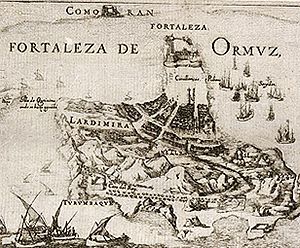 The city and fortress of Hormuz, XVII century. | |||
| date | February - April 22, 1622 | ||
| A place | Hormuz Island | ||
| Total | The victory of the Persians and the British | ||
| Opponents | |||
| |||
| Commanders | |||
| |||
| Forces of the parties | |||
| |||
| Losses | |||
| |||


The English forces provided by the English East India Company [1] consisted of 5 ships and 4 pins . [4] The Persians recently started a war with Portugal and the Persian army besieged the Portuguese fort in Qeshma, but they needed English help to capture Hormuz. [4] Abbas I wanted English support against Portugal, [5] and commander Imam Kuli Khan , son Allahverdi Khan, negotiated with the British to get their help, promising the development of silk trade in their favor. [6] The agreement was signed, ensuring the separation of income and customs duties in Hormuz, the repatriation of those captured in accordance with their faith and the payment by the Persians of half the cost of maintaining the fleet. [7]

The English fleet first went to Qeshmu , 15 miles, to bombard Portuguese positions. [7] The Portuguese quickly surrendered; English casualties were small, but they included the famous explorer William Baffin . [7]
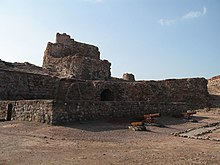
Then the Anglo-Persian fleet went to Hormuz; the Persians landed to take possession of the city. [2] The British bombed the fortress and sank the Portuguese fleet, after which Hormuz was finally captured [2] on April 22, 1622. [5] Another explorer, Robert Bylot, was killed. The Portuguese were forced to retreat to Muscat . [2]
Since England and Portugal were not at war, the Duke of Buckingham threatened to court the Company, but withdrew his application after receiving an amount of 10,000 pounds. [1] Jacob I received the same amount after a complaint: "Have I not saved you from the claims of the Spaniards, and you have not paid me for this in any way." [one]
The capture of Hormuz gave the Company the opportunity to develop trade with Persia, which intended to exchange English fabrics and other artifacts for silk. [1] The English adventurer Robert Shirley also benefited from the development of this trade. [one]
See also
- Portuguese-Persian War
- The fall of Aden
Notes
- ↑ 1 2 3 4 5 6 Chaudhuri, p.64
- ↑ 1 2 3 4 Sykes, p. 279
- ↑ A History of Christianity in India by Stephen Neill p. 549
- ↑ 1 2 Sykes, p. 277
- ↑ 1 2 Biography Charles Knight, p. 7
- ↑ Sykes, p.277-278
- ↑ 1 2 3 Sykes, p. 278
Links
- KN Chaudhuri The English East India Company: the study of an early joint-stock company 1600-1640 Taylor & Francis, 1999 ISBN 0-415-19076-2
- Percy Molesworth Sykes A History of Persia READ BOOKS, 2006 ISBN 1-4067-2692-3