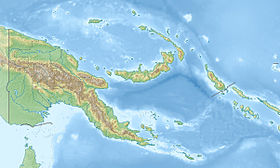
Kutubu ( eng. Lake Kutubu ) - a lake in Papua New Guinea , located in the province of Northern Highlands . It is located east of the Kikori River, into which it subsequently dumps its water. About 50 km north-east of the lake is the city of Mendi , which is the provincial capital. Koutoubu is one of the few lakes in the country located in the lowlands among the highlands. [1] It is the second largest lake in Papua New Guinea, second only to Lake Murry , [2] and the largest mountain lake in the country [3] (altitude is 800 m [2] above sea level). The water surface area of Koutoubu is 49.24 km² [2] , and the catchment area is 250 km². [3] Together with Lake Sentani, Koutoubu is allocated by the World Wildlife Fund as an independent ecoregion . [four]
| Lake | |
| Koutoubu | |
|---|---|
| English Lake kutubu | |
 | |
| Morphometry | |
| Absolute height | 808 m |
| Dimensions | 19 × 4.5 km |
| Square | 49.24 km² |
| Deepest | 70 m |
| Pool | |
| Pool area | 250 km² |
| Flowing river | Soro |
| Location | |
| A country |
|


There are several small islands in the lake, the largest of which is Vasemi Island in the northern part of Koutoubu. The water of the lake is transparent, and the maximum depth reaches 70 m. Nutrition occurs mainly due to underground sources, although several small streams also flow into Kutubu. [4] Two main ethnic groups live near the lake - the Foe people in the south and the Faso in the north, settled in 33 villages with a total population of 10,885 people. [3]
The lake gave its name to the oil project of the same name, which was the first commercial oil field in Papua New Guinea, the development of which began in 1992 by Oil Search Limited . [5] The appearance of oil rigs in the region had a positive effect on the local economy, which, in turn, led to an influx of population. Environmental problems, caused by a sharp population growth, resulted in environmental pollution, destruction of forests and excessive fishing. The alleged construction of a gas pipeline and road in the event of improper management is expected to aggravate the current situation. [3]
12 endemic fish species have been recorded in Koutoubu, making the lake the most unusual lake habitat for fish in the New Guinean-Australian region. [3] Endemics include: [6]
- Oloplotosus torobo
- Melanotaenia lacustris
- Craterocephalus lacustris
- Hephaestus adamsoni
- Mogurnda kutubuensis
- Mogurnda spilota
- Mogurnda variegata
- Chilatherina sentaniensis .
Due to its biological diversity and environmental importance, the lake region, according to the Ramsar Convention , has the status of a “ wetland of international importance ”. [2] The designated area coincides with the Kutuba Conservation Area [2] (its area is about 240.57 km²) [7] , the study of which is carried out by the World Wildlife Fund. Kutubu Lake is also included in the preliminary list of World Heritage Sites along with the Kikori River Basin. [7]
Notes
- ↑ Brian Essai. Papua and New Guinea: A Contemporary Survey. - Oxford University Press, 1961. - S. 21.
- ↑ 1 2 3 4 5 Lake Kutubu Ramsar. Date of treatment April 2, 2010.
- ↑ 1 2 3 4 5 Pilot and Demonstration Activities: Integrated Catchment Management in Lake Kutubu, Papua New Guinea . Asian Development Bank. Date of treatment April 2, 2010.
- ↑ 1 2 Lakes Kutubu and Sentani (inaccessible link) . WWF Date of treatment April 2, 2010. Archived April 21, 2012.
- ↑ Kutubu (English) (inaccessible link) . Oil Search Limited website. Date of treatment April 2, 2010. Archived April 21, 2004.
- ↑ The list is based on data from the Lakes Kutubu and Sentani Wildlife Fund website - A Global Ecoregion unopened (link not available) . Date of treatment April 2, 2010. Archived on August 9, 2007. .
- ↑ 1 2 Kikori River Basin - Great Papuan Plateau (English) . World Heritage Sites tentative lists. Date of treatment April 2, 2010. Archived April 21, 2012.
Links
- Lake Kutubu Catchment Management Plan: Project Inception Report (link unavailable) . Archived June 24, 2007. , also includes topographic map on Page 12
- Map of Lake Kutubu catchment unopened (inaccessible link) . Archived June 24, 2007. produced by WWF
- Lake Kutubu - newest Ramsar site in Papua New Guinea
- Wetlands documentation page (inaccessible link) . Archived on May 27, 2011.