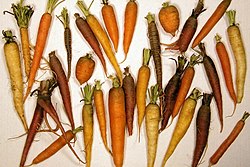
Carotene (from the Latin carota “ carrot ”) is a yellow-orange pigment , an unsaturated hydrocarbon from the carotenoid group.
The empirical formula is C 40 H 56 . Insoluble in water, but soluble in organic solvents. It is found in the leaves of all plants, as well as in the root of carrots, rose hips , etc. It is a vitamin A provitamin . Registered as a food additive E160a .
Two Carotene


Two carotene isomers are distinguished: α-carotene and β-carotene. β-carotene is found in the yellow, orange, and green leaves of fruits and vegetables. For example, in spinach , lettuce, tomatoes , sweet potato and others.
Nomenclature
The two terminal fragments ( β-rings ) of the β-carotene molecule are structurally identical. The α-carotene molecule contains two terminal cyclic fragments, characterized by the location of the double bond in the ring. One of the terminal fragments is called the β-ring , identical to the β-ring of β-carotene, the other is called the ε-ring .
The following options for the spatial arrangement of parts of the molecule that determine the structure of the isomer are possible :
- α-Carotene β, ε-Carotene ;
- β-Carotene β, β-Carotene ;
- γ-Carotene (with one β ring and one non-cyclized end, which is indicated by the letter psi ) - β, ψ-Carotene ;
- δ-Carotene (with one ε-ring and one non-cyclized end) - ε, ψ-Carotene ;
- ε-Carotene ε, ε-Carotene
Sources of Carotene
Despite the fact that carotene can be obtained using chemical synthesis, it is produced mainly from natural raw materials.
Plants (for example, pumpkin , carrots ), bacteria (some strains of staphylococci ), algae and fungi with a high content of the target substance are used as sources of carotene.
Carotenoids are obtained by chemical synthesis [1] [2] and by isolation from natural sources - plants and microorganisms [3] [4] [5] . The use of plants as a source of carotenoids also has several disadvantages: it is seasonal in nature; depends on the ecological state of soils and plant yields, significantly reduced due to the accumulation of sources of diseases of plant materials; there is a need for large sown areas for growing plants. In addition, the bioavailability of the source of carotenoids from vegetable juice is low due to the presence of carotenoids in protein complexes, which greatly complicates their release. The digestibility of carotene from vegetables with a diet without fats is very low.
Microbiological synthesis of beta-carotene is the most justified industrial method of its production from both technological and economic points of view [6] . “Microbiological” carotenoids, including beta-carotene, are obtained from the cells of mycelial fungi, yeast, bacteria, actinomycetes and algae [7] [8] [9] . Mushrooms are of great importance as producers of various biologically active substances for the food industry, medicine, agriculture and other industries. The microscopic mucinous mushroom Blakeslea trispora is no exception. The strains of Blakeslea trispora are superproducers of β-carotene and lycopene [10] [11] [12] [13] and, in addition, the biosynthesis of other valuable compounds of a terpenoid nature is possible - ubiquinones, ergosterol [14] [15] [16] . During carotene biosynthesis by microorganisms, it accumulates in producer cells. Blakeslea trispora's own fats comprise up to 60% of the total biomass, which contributes to the dissolution of carotene during fermentation. This accordingly increases its availability for assimilation. The technology for producing microbiological carotenoids is environmentally friendly due to the absence of harmful emissions and the use of non-aggressive chemicals. The raw materials in the production of carotenoids are by-products, intermediate products and wastes of starch and syrup production, flour milling, canning, oil and meat and dairy industries.
Beta Carotene
Description
Beta-carotene is a yellow-orange plant pigment , one of 600 natural carotenoids . Beta-carotene is a precursor to vitamin A ( retinol ) and is a powerful antioxidant . Also, this substance has an immunostimulating and adaptogenic effect [17] .
Sources
Pumpkin, carrot, green onion, sorrel, spinach, lettuce, lettuce, romano salad, cabbage cale , tomatoes, red pepper, broccoli, grapefruit, plums, peaches, melons, apricots, persimmons, gooseberries, blueberries, black currants.
Beta-carotene is found in a unique salt deposit in the Crimea on Lake Sasyk . The natural component gets into salt pools thanks to the flowering of the algae Dunaliella sallina, which was able to adapt to the harsh conditions of ultra-salted water and solar radiation, having learned how to produce beta-carotene. Thus, beta-carotene accompanies the main components of natural sea salt.
Daily requirement
According to the guidelines for rational nutrition, “Norms of physiological requirements for energy and nutrients for various groups of the population of the Russian Federation” dated December 18, 2008 (MP 2.3.1.2432 −08) [18] , 6 mg of beta-carotene are equivalent to 1 mg of vitamin A. The average consumption in different countries is 1.8-5.0 mg / day. There is no upper allowable consumption level. The physiological need for adults is 5 mg / day (administered for the first time).
Long-term use of beta-carotene is not accompanied by any side effects.
Subsequent studies have shown that, in reality, the vitamin activity of carotenoids is two times lower than what was previously thought. Therefore, in 2001, the US Institute of Medicine proposed another new unit - the equivalent of retinol activity (RAE). 1 RAE corresponds to 1 μg of retinol, 2 μg of β-carotene dissolved in fat (in the form of a pharmaceutical preparation), 12 μg of “food” β-carotene, or 24 μg of other provitamins A.
Mechanism of Action
The unsaturated structure of beta-carotene allows its molecules to absorb light and prevent the accumulation of free radicals and reactive oxygen species. Beta-carotene inhibits the production of free radicals. It is believed that thereby it protects the cells of the immune system from damage by free radicals and can improve the state of immunity [17] . Beta-carotene is a natural immunostimulant that increases the body's immune potential regardless of the type of antigens , that is, it acts non-specifically.
Some studies have shown its weakly expressed immunostimulating effect [19] .
There are many publications regarding the effect of beta-carotene on the increase in the number of T-helpers . Moreover, in some experiments, an increase in the number of all T-lymphocytes, and in some only T-helpers, is recorded [20] .
The greatest effect is shown in individuals (people and animals) experiencing peroxide stress (improper diet, diseases, old age). In completely healthy organisms, the effect is often minimal or absent [21] .
The effect itself is associated with an increase in the proliferative ability of T-lymphocytes , including T (0,1,2) -helpers. The proliferation of T-lymphocytes is inhibited by the peroxide radical. The elimination of peroxide radicals increases the ability of T cells to blastogenesis. Beta-carotene also stimulates the growth of thymus glands, the sources of T-lymphocytes, in animals [22] .
This is a non-specific effect of most lipophilic antioxidants (lutein, cryptoxanthin, retinol, tocopherol, alpha-carotene, astaxanthin) [23] .
The episodic accumulation of T-helpers, and not other lymphocytes, is apparently associated with a specific cytokine situation in the body [24] .
An increase in the proliferative ability of T-lymphocytes under the influence of beta-carotene is also shown in model experiments with cultures of lymphocytes (and not only T-lymphocytes). The use of specific mitogens (CON A) leads to proliferation of lymphocytes. This is an imitation of the cytokine environment in the immune response. Beta-carotene T-lymphocytes proliferate more than control ones. Studies have concluded that with infection, beta-carotene will accelerate the immune response [25] . The growth and differentiation of T-helpers also depends on the presence of interleukins 1,2,4. These cytokines are formed in the T-lymphocytes and macrophages themselves. Beta-carotene significantly increases the activity of macrophages , since they undergo specific peroxidation processes that require a large amount of antioxidants. In addition to phagocytosis, macrophages present antigen and stimulate the corresponding T-helpers. This leads to an increase in the number of T-helpers. But only in the presence of antigen [26] .
Some domestic scientists attribute the immunomodulatory activity of beta-carotene to the effect on arachidonic acid and its metabolites [27] .
In particular, it is believed that beta-carotene inhibits the production of arachidonic acid products (refers to omega fatty acids), thereby inhibiting the production of prostaglandin E2 (a lipid physiologically active substance) [28] . Prostaglandin E 2 is a suppressor of NK cells, reducing its content, beta-carotene enhances the activity of NK cells producing gamma- interferon . Thus, beta-carotene carries out its immunostimulating effect [29] .
Beta Carotene Preparations
- Vetoron (allowed from 3 years)
- Betaviton (allowed from 14 years old)
- Triovit (allowed from 12 years old)
Carotenemia
Carotinemia or hypercarotinemia is an excess of carotene in the body (unlike excess vitamin A, carotene is low toxic). Usually carotinemia is not considered a dangerous condition, although it leads to yellowing of the skin ( carotenoderma ). It is often observed if there is a lot of carrots in food, but can also be a symptom of more dangerous conditions.
Carotene and Cancer
Previous studies have shown that beta-carotene, being an antioxidant, reduces the likelihood of getting cancer with people who consume a lot of beta-carotene-rich foods. But recent major studies have shown that the use of beta-carotene leads to an increase in the likelihood of lung cancer and prostate cancer in smokers, as well as people working in asbestos production [30] .
The first study, published in 1994 in The New England Journal of Medicine [31], showed that taking beta-carotene increased the likelihood of cancer in smokers by 18%.
A second study, published in the Journal of the National Cancer Institute [32] , showed a 28% increase in cancer among smokers.
Recently summarized recent scientific evidence supports the hypothesis that in smokers, consuming high doses of beta-carotene may increase the risk of lung cancer [33] .
However, this action of carotene applies only to smokers and people in contact with harmful substances. The specific mechanism of this effect of carotene is unknown.
Carotene as a source of odor
Many plants, in the aroma of which ionon plays a significant role, owe their smell to a significant concentration of carotene, the structural precursor of the ionon molecule.
See also
- Nutritional supplements
Notes
- ↑ Pat. 2074177 RU, MKI C07C403 / 24. A method for producing beta-carotene / E.P. Kovsman, K.A. Solop, V.D. Batelman, G.I. Samokhvalov, V.L. Khristoforov, L.A. Vakulova, T.A. Zhidkova. - No. 93035263/04; Claim 07/07/1993; Publ. 02/27/1997
- ↑ Pat. 2152929 RU, MKI C07C403 / 24. The method of purification of technical β-carotene / V. M. Belova; T. I. Ozorova; V.P. Belovodsky; S. N. Anakin; I.P. Serpukhovitin; G. B. Gvozdev; D.V. Davydovich; A.T. Kirsanov. - No. 99115385/04; Claim 07/12/1999; Publ. 07/20/2000
- ↑ Pat. 2177505 RU, MKI C12P23 / 00, C12N1 / 14, C12N1 / 14, C12R1: 645. A pair of strains of the heterotallic fungus Blakeslea trispora КР 74+ and КР 86−, producing beta-carotene / I. S. Kunshchikova (UA); R.V. Ghazaryan (RU); S.P. Kudinova (RU). - No. 2000103831/13; Claim 02/15/2000; Publ. 12/27/2001
- ↑ Petrova Zhanna Oleksandrіvna. ROSROBKA PROCESSES IN ACCESSION OF CAROTIN GOODS PRODUCTS: Dis ... cand. tech. Sciences: 05.18.12 / І Institute of technology teplofiziki NAS of Ukraine. - K., 2004 .-- 218 p.
- ↑ Constantly Olena Mikhailovna. Ecological characteristics of cultivated and wild caroteniferous rosins - accumulation of virus and xenobiotics and method of carotene removal from them: Dis ... cand. b_ol. Sciences: 03.00.16 / Kiev National University of Ukraine. Taras Shevchenko. - K., 2003 .-- 120 p.
- ↑ Saakov V.S. Alternative pathways of carotenoid biosynthesis in Procaryota and Eucaryota // Dokl. AN of Russia. - 2003. - T.392. - No. 6. - S. 825-831.
- ↑ Kamіnska M. Karotinsynthesis of other Phaffia rhodozyma / M. Kamіnska, L. Sologub // News of Lviv. Un-tu. Ser. Biol., 2004. - VIP. 37. - S. 3-12.
- ↑ Kamіnska Marta Volodimirіvna. Carotenogenesis in штам штам штам штам др др Ph Ph Ph Ph Phaffia rhodozyma and застх х х ку жив жив жив жив жив жив:::: diss ... S.-g. Sciences: 03.00.04 / UAAN; Institute of Biology Tvarin. - L., 2005 .-- 144 p.
- ↑ Primova L.O. Special features of the nitrogenous storage of biomassi of the mushroom mushroom Blakeslea trispora / L.O. Primova, Visotsky I. Y. // News of SumU. Seriya Medicine, 2008. - T. 1. - No. 2. - P. 27—34.
- ↑ Avchiev M.I., Butorova I.A., Avchieva P. B. Study of the peculiarities of growth and accumulation of lycopene by a pair of heterotallic fungus Blakeslea trispora VSB-130 (+) and VSB-129 (-) // Biotechnology. - 2003. - No. 3. - S. 12-19.
- ↑ Tereshina V.M., Memorskaya A.S., Feofilova E.P. Express method for determining the content of lycopene and b-carotene // Microbiology. - 1994. - T.63. - No. 6. - S. 1111-1116.
- ↑ Tereshina V.M., Memorskaya A.S., Feofilova E.P. Lipid composition of the mushroom Blakeslea trispora fungus under conditions of lycopene formation stimulation // Microbiology. - 2010 .-- T.79. - No. 1. - S. 39-44.
- ↑ Mantzouridoua F., Tsimidou MZ On the monitoring of carotenogenesis by Blakeslea trispora using HPLC // Food Chemistry. - 2007 .-- Vol.104. - No. 1. - P. 439–444.
- ↑ Deev S.V., Butorskaya I.A., Avchieva P. B. Isolation of ubiquinones from the biomass of the fungus Blakeslea trispora // Biotechnology. - 2000. - No. 5. - P. 36—46.
- ↑ Deev S.V., Butorskaya I.A., Avchieva P. B. Synthesis and isolation of ergosterol when using Blakeslea trispora as a producer // Biotechnology. - 2000. - No. 4. - S. 22-31.
- ↑ Tereshina V.M. Lipid composition of the mushroom Blakeslea trispora mushroom under conditions of lycopene formation stimulation / V.M. Tereshina, A.S. Memorskaya, E.P. Feofilova // Microbiology. - 2010. - T. 79. - No. 1. - S. 39-44.
- ↑ 1 2 SANTOS MS; LEKA LS; RIBAYA-MERCADO JD; RUSSELL RM; MEYDANI M .; HENNEKENS CH; GAZIANO JM; MEYDANI SN; Short- and long-term β-carotene supplementation do not influence T cell-mediated immunity in healthy elderly persons.
- ↑ “Norms of physiological requirements for energy and nutrients for various groups of the population of the Russian Federation” MP 2.3.1.2432-08 Archived on February 19, 2016.
- ↑ van Poppel G, Spanhaak S, Ockhuizen T. Effect of beta-carotene on immunological indexes in healthy male smokers. Am. J. Clin. Nutr. 1993 Mar; 57 (3): 402-407.
- ↑ Sampliner, Richard E., Watson, Ronald R., Garewal, Harinder S., Prabhala, Rao H., Hicks, Mary J. The effects of 13-cis-retinoic acid and beta-carotene on cellular immunity in humans. 1991.
- ↑ Boon P. Chew2 and Jean Soon Park. Proceedings of Symposium to Honor the Memory of James Allen Olson. Carotenoid Action on the Immune Response. Department of Animal Sciences, Washington State University, Pullman, WA 99164-6351
- ↑ Boon P. Chew. Antioxidant Vitamins Affect Food Animal Immunity and Health. Department of Animal Sciences, Washington State University, Pullman, WA 99164-6320
- ↑ Chung-Yung Jetty Lee and Jennifer Man-Fan Wan Immunoregulatory and antioxidant performance of O ± -tocopherol and selenium on human lymphocytes. Department of Zoology, University of Hong Kong, Pokfulam Road, Hong Kong, SAR, China.
- ↑ Satoru Moriguchi Ph.D., Naoko Okishima BS, Satoshi Sumida Ph.D., Koji Okamura MS, Tatsuya Doi MSand Yasuo Kishino MD β-carotene supplementation enhancing lymphocyte proliferation with mitogens in human peripheral blood lymphocytes. Nutrition Research Volume 16, Issue 2, February 1996, Pages 211-218.
- ↑ Boon P. Chew2, Jean Soon Park, Teri S. Wong, Hong Wook Kim, Brian BC Weng, Katherine M. Byrne, Michael G. Hayek * and Gregory A. Reinhart. Dietary ß-Carotene Stimulates Cell-Mediated and Humoral Immune Response in Dogs. Journal of Nutrition. 2000; 130: 1910-1913.
- ↑ B-Carotene and the immune response. BY ADRIANNE BENDICH. Proceedings of the Nutrition Society (1991) 50, 263-274.
- ↑ Santos MS, Gaziano JM, Leka LS, Beta-carotene-induced enhancement of natural killer cell activity in elderly men: an investigation of the role of cytokines. Am J Clin Nutr. 1998 Jul; 68 (1): 164-70.
- ↑ Rhodes J. Human interferon action: reciprocal regulation by retinoic acid and beta-carotene. J Natl Cancer Inst. 1983 May; 70 (5): 833-7.
- ↑ Biochim Biophys Acta. 1987 Apr 24; 918 (3): 304-7. Inhibition of arachidonic acid oxidation by beta-carotene, retinol and alpha-tocopherol. Halevy O, Sklan D.
- ↑ Beta-carotene and cancer
- ↑ The Effect of Vitamin E and Beta Carotene on the Incidence of Lung Cancer and Other Cancers in Male Smokers
- ↑ Risk Factors for Lung Cancer and for Intervention Effects in CARET, the Beta-Carotene and Retinol Efficacy Trial
- ↑ Goralczyk R. Beta-carotene and lung cancer in smokers: review of hypotheses and status of research. Nutr Cancer 2009 Nov; 61 (6): 767-74.