The Ganja Khanate ( Persian خانات گنجه - Khānāt-e Ganjeh , azerb. Gəncə xanlığı ) is a feudal estate that existed in 1747-1804 in the territory of modern Azerbaijan , in the Kura river valley, with its center in the fortress city of Ganja .
| Historical state | |||
| Ganja Khanate | |||
|---|---|---|---|
| azerb. Gəncə xanlığı | |||
| |||
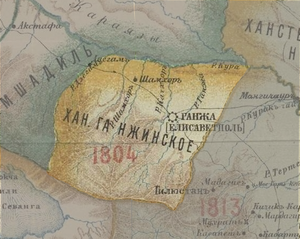 Ganja (Ganja) Khanate on the map of the Caucasus region with the designation of the borders of 1806 Tiflis 1901 | |||
←   → →1747 - 1804 | |||
| Capital | Ganja | ||
| Languages) | Persian (official) [1] , Azerbaijani | ||
| Religion | Islam Christianity ( Armenian Apostolic Church ) | ||
| Form of government | Absolute monarchy | ||
| Dynasty | Ziyad-oglu | ||

History
Early History

The history of the khanate is connected with the surname Ziyad-oglu from the kajar tribe, whose representatives were first runaway runners , and then - khans of Ganja. At one time, Tamerlan resettled 50,000 Khajar families in Transcaucasia, settling them in Erivan , Ganja and Karabakh [3] . In the 16th century, the Persian Shah Tahmasp I appointed the emir Shahverdi-Sultan Ziyad-oglu, who came from the aimak of the ziyyadly of the Kyzylbash tribe of the Ghajar, the runaway of Karabakh and the head of the tribe and aimag of the Ghajar [4] .
In the XVIII century, Lezgins and other highlanders of Dagestan constantly raided the Khanate [5] .
Representatives of this tribe since then hereditarily ruled Ganja . In 1747 , after the death of Nadir Shah and the beginning of internal unrest in Persia, the runaway runner Ziyadoglu Shahverdi Khan adopted the Khan's title [6] .
Ganja turned into a khanate, which enjoyed, like the neighboring khanates , de facto independence with nominal recognition of the power of the weak Zend dynasty [7] ; for some time the khanate was dependent on Georgia [8] . For a long time, the khanate fought for influence in Azerbaijan with neighboring khanates. In particular, for the inclusion in its composition of the Dizak and Dzheraberdsky melikov. In the very first years of his reign, Panah Ali Khan of Karabakh managed to subjugate both meliks, however, after a while the Gerard Melik Atam, having entered into an alliance with Melik Hovsep, who came to power in Talysh (Gulistan), began the fight against Panah Ali Khan, ultimately as a result, having been defeated, they hid from the Ganja Khan and lived in Shamkir for seven years. Later, returning to the newly built Panah by Ali Khan Shusha , they took vassal dependence on the Khan of Karabakh [9] .
In the 1750s, the influence of the Sheki Khan increased. Concerned about this, the khans of Nakhichevan , Karabakh , Ganja, Karadag and Erivani , as well as the Georgian king decided to unite in the fight against the Khan Sheki Haji-Celebi . In 1752, the Georgian king Teimuraz II and his son Irakli with an army moved to Ganja. Some khans of Azerbaijan arrived here to negotiate with Heraclius. However, Heraclius unexpectedly declared the khans his captives. Soon, the Sheki Khan Haji-Celebi attacked the troops of the Georgian king, and defeated him at the battle of Shamkir. Then the Sheki Khan occupied Ganja, Kazakh , Borchaly and some other territories. The captured khans were freed, and for some time were dependent on the Sheki khan [10] .
After the death of Muhammadhasan Khan (1760-1780), during which the khanate remained independent, the Ganja Khanate was attacked by the Karabakh khan and the Georgian king. Their governors were in Ganja and ruled the khanate. In 1783, an uprising began in Ganja, led by Haji Bey from the Ziyad-oglu clan. The Georgian tsar, together with the Russian military detachment, tried to suppress the performance of the townspeople, but Hadji-bei called for help from the Dagestan feudal lords. With the help of Dagestan detachments, the Ganja Khanate regained independence. Rahim Khan (1785-1786) became its head [11] .
The fall of Ganja and the annexation of the Khanate to Russia
The khanate gained the greatest influence during the reign of Javad Khan . He started his own mint and for a long time successfully maneuvered between the forces existing in the region: the shahs, Georgia, Turkey and Russia [6] .
At odds with the neighboring Karabakh khanate and the Georgian kingdom , Javad Khan supported his relative Aga Mohammed Khan Kajar , who seized the Shah’s throne at the end of the 18th century, and participated in his invasion of Transcaucasia, especially Georgia in 1795 [12] .
In 1796, the Karabakh khan and the Georgian king began a return campaign to Ganja. In this they were assisted by Russian military units. However, after the death of Empress Catherine II in 1796, the Russian army left the South Caucasus.
Javad Khan began to prepare for a return campaign to Georgia. However, in 1802, the Russian army launched an attack on the Azerbaijani khanates and in 1803 went to Ganja. Given the strategically important location of the khanate, the command of the Russian army considered Ganja "the key to the northern provinces of Iran." General Prince Tsitsianov wrote that Ganja occupied an important place in Azerbaijan due to its favorable geographical location [13] . Since December 1803, Ganja was besieged by Russian troops under the command of Tsitsianov. Residents of the city, led by Javad Khan, successfully resisted the attackers for several months.
However, in January 1804 the city fell. On January 3, 1804, at 5.30 a.m., Tsitsianov’s troops began storming the city in two columns. In addition to the Russians, the assault involved up to 700 Azerbaijani militias [14] and volunteers from other khanates - opponents of Javad Khan. Ganja was a very powerful fortress. It was surrounded by double walls (external - mud and internal - stone), the height of which reached 8 meters. The walls were reinforced with 6 towers. On the third attempt, the Russians managed to overcome the walls and break into the fortress; Javad Khan and his eldest son died in battle on the fortress wall [15] . By noon, Ganja was taken.
The Ganja Khanate was liquidated and annexed to Russia, and Ganja itself was renamed Elizavetpol (in honor of Empress Elizabeth Alekseevna - wife of Alexander I.
Economics and Culture
In connection with the geographical features of the region, the basis of the economy, in addition to trade, was carpet weaving and silk production. Also, in connection with the presence of large forest lands and pastures, cattle breeding developed [16] .
An important indicator of the economic development of the Khanate was the coinage organized at the Khan's court. The Ganja Khanate, the most economically developed and successfully located in the center of trade and transport communications connecting the Azerbaijani lands, was the first of the North Azerbaijani khanates to issue its coins. The Ganja Mint worked intensively during the Ottoman occupation, and the silver onluks (dozens) minted by it constituted one of the most important components of the monetary circulation of Azerbaijan in the 20-30s of the 18th century. The minting of coins at this mint continued under the afshars ( Nadir , Adil Shah and Ibrahim) [17] . About trade in the khanate is written in the message “Ajaib ad-dunya (Interesting world)” by an unknown Arab author:
... this densely populated large metropolitan city of Arran was surrounded by powerful fortified ramparts. Ganja is all ... in the green. There was a wide variety of fruits. Atlas, brocade, cotton, silk and other goods were exported to other cities. The population here is courageous, shoots well from a bow ... [13]
Rulers and khans
(Until 1747 - beglarbeks)
| one. | Shahverdi-Sultan Ziyad-oglu Qajar | OK. 1554-1570 |
| 2. | Sultan Ali Mirza, son of Shah Tahmasp | 1570-1577 |
| ottoman conquest | 1588-1606 | |
| 3. | Muhammad Khan Ibn Khalil Ziyad-oglu | OK. 1606-1615 |
| four. | Murshid Kuli Khan, son of 3 | OK. 1615-1620 |
| five. | Muhammad Quli Khan, son of 4 | OK. 1620-1626 |
| 6. | Daud Khan, tribes. five | OK. 1626-1640 |
| Muhammad Quli Khan (repeatedly) | OK. 1640-1650 | |
| 7. | Murtaza Kuli Khan | OK. 1650-1660 |
| eight. | Ugurlu Khan I | OK. 1663 |
| 9. | unknown khan | |
| ten. | unknown khan | |
| eleven. | unknown khan | |
| ottoman conquest | 1724-1734 | |
| 12. | Ugurlu Khan II (killed) | 1735-1738 |
| 13. | Haji Khan Chemishkezek (killed) | 1743-1747 |
| 14. | Shahverdi Khan | 1747-1760 |
| 15. | Muhammad Hassan Khan | 1760-1782 |
| sixteen. | Ibrahim Khalil Khan, Khan of Karabakh | 1782-1784 |
| Muhammad Hassan Khan (re) | 1784 | |
| 17. | Rahim khan | 1785-1786 |
| 18. | Javad Khan (slain) | 1787-1804 |
Gallery
Khan's Garden in Ganja
Mosque built during the Khanate
Mausoleum of Javad Khan
Helmet related to the Ganja Khanate. Museum of Art of Azerbaijan
Notes
- ↑ Swietochowski, Tadeusz. Russian Azerbaijan, 1905-1920: The Shaping of a National Identity in a Muslim Community. - Cambridge: Cambridge University Press, 2004. - P. 12. - "(...) and Persian continued to be the official language of the judiciary and the local administration [even after the abolishment of the khanates].". - ISBN 978-0521522458 .
- ↑ “In Safavi times, Azerbaijan was applied to all the Muslim-ruled khanates of the eastern Caucasian as well as to the area south of the Araz River as fas as the Qezel Uzan River, the latter region being approximately the same as the modern Iranian ostans of East and West Azerbaijan. ” Muriel Atkin, Russia and Iran, 1780-1828. 2nd. ed. Minneapolis: University of Minnesota Press Press, 2008, ISBN 0-521-58336-5
- ↑ Abbas-Quli-Aga Bakikhanov . Gulistan-i Iram ("History of the eastern part of the Caucasus"). - Baku, 1991. - P.172. Some of the kajars once moved to Anatolia and Syria. Emir Teymur (Tamerlan) resettled 50 thousand kajar families in the Caucasus region and settled them in Erivan, Ganja and Karabagh, where they multiplied over time. Many of these kajars under the Safavid shahs were statesmen and ruled Armenia and Shirvan. It was from them that the Erivan and Ganja khans came, of which the latter, by the name of Ziyad oglu, used to be lords of the lands from the Khudaferin bridge to the village of Shulaver, which is higher than the Red Bridge in Georgia.
- ↑ I.P. Petrushevsky. Essays on the history of feudal relations in Azerbaijan and Armenia in the XVI - early XIX centuries // Oriental Research Institute . - Leningrad: Leningrad State University named after Zhdanova, 1949 .-- S. 122 .
- ↑ http://www.history.gov.az/kitablar/Gence.pdf
- ↑ 1 2 Ganja
- ↑ In 1747 Nadir Shah, the strong ruler who had established his hold over Persia eleven years earlier, was assassinated in a palace coup, and his empire fell into chaos and anarchy. These circumstances effectively terminated the suzerainty of Persia over Azerbaijan, where local centers of power emerged in the form of indigenous principalities, independent or virtually so, inasmuch as some maintained tenuous links to Persia's weak Zand dynasty. Thus began a half-century-long period of Azerbaijani independence, albeit in a condition of deep political fragmentation and internal warfare. Most of the principalities were organized as khanates, small replicas of the Persian monarchy, including Karabagh, Sheki, Ganja, Baku, Derbent, Kuba, Nakhichevan, Talysh, and Erivan in northern Azerbaijan and Tabriz, Urmi, Ardabil, Khoi, Maku, Maragin , and Karadagh in its southern part. - Tadeusz Swietochowski. Russian Azerbaijan, 1905-1920: The Shaping of National Identity in a Muslim Community. - Cambridge, UK, Cambridge University Press, 2004. - P.2.
- ↑ Elizabethpol // Brockhaus and Efron Encyclopedic Dictionary : in 86 volumes (82 volumes and 4 additional). - SPb. , 1890-1907.
- ↑ Mirza Jamal Garabagi, “History of Karabakh”. Baku, AS ASSR Publishing House, 1959, p. 37-39
- ↑ History of Azerbaijan, Volume 1, pp. 336—337, Institute of History of the Academy of Sciences of the Azerbaijan SSR, Baku, 1958
- ↑ R. A. Huseynov, X Yu. Verdiev. History of Azerbaijan, Baku, Ozan, 2000, paragraph 47
- ↑ V.V. Bartold. Ganja // Works, t. III, M., 1965, p. 406
- ↑ 1 2 History II
- ↑ Haji Murat Ibrahimbeyli. Russia and Azerbaijan in the first third of the 19th century (From military-political history). Publishing house "Science", The main edition of oriental literature. - Moscow, 1969, p. 37–38
- ↑ Potto V.A. Caucasian wars. Book 1
- ↑ Charles King, The ghost of freedom: a history of the Caucasus, Oxford University Press US, 2008, ISBN 0-19-517775-4 , p. 35
- ↑ Ali Rajabli, Numismatics of Azerbaijan, Essays on the History of Monetary Affairs and Money Circulation of Azerbaijan, Elm ve Hayat Publishing House, Baku, 1997
Literature
- Ganja Khanate / D. Yu. Arapov // Grigoriev - Dynamics. - M .: Great Russian Encyclopedia, 2007. - P. 208. - ( Great Russian Encyclopedia : [in 35 vols.] / Ch. Ed. Yu. S. Osipov ; 2004—2017, vol. 8). - ISBN 978-5-85270-338-5 .
- Rulers of the world. Chronological and genealogical tables on world history in 4 vols. Compiled by V.V. Erlikhman. M., 2002.
- Ryzhov K.V. All the monarchs of the world: Muslim East. XV — XX centuries (Directory). - M .: Veche, 2004 .-- 544 p. (unavailable link from 06/14/2016 [1181 days])