
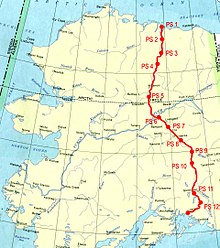

The Trans-Alaska Oil Pipeline (TAN; English Trans-Alaska Pipeline System, TAPS ) is an oil pipeline in the United States . Designed for pumping oil from the Pradkho Bay field in northern Alaska to the port of Valdez in its south.
Crosses the state of Alaska from north to south, the length of the pipeline is 1288 km. It consists of a crude oil pipeline, 12 pumping stations, several hundred miles of supply pipelines, and a terminal in the city of Valdez. The oil pipeline is one of the largest such structures. Belongs to Alyeska Pipeline Service Company.
Content
History
The construction of the pipeline began after the energy crisis of 1973 . The laying was started on March 26, 1975 , the pipeline itself was built by 1977. It was launched on June 20, 1977 . The rise in price of oil has made it economically viable to produce it in Pradho Bay . Following the discovery of the field, environmental, legislative, and political debates followed regarding construction issues. The oil pipeline was built after the crisis helped solve these problems.
Construction faced many problems, mainly very low temperatures and rugged, isolated terrain. The oil pipeline was one of the first projects faced with permafrost problems; it was necessary to develop new construction technologies in frozen soil. The pipeline under construction attracted several tens of thousands of workers, which provoked the rapid growth of cities such as Valdez , Fairbanks and Anchorage .
The first barrel of oil was pumped through the pipeline in 1977. The oil pipeline was fully loaded by the end of the year. Since then, several serious oil spill incidents have occurred. Among them are sabotage of construction, maintenance errors, intentional damage.
As of 2010, almost 16 billion barrels of oil were pumped through the pipeline.
Pipeline Features
During the construction, 48-inch (122 cm) pipes were used. The maximum throughput is 2.13 million barrels per day (339 600 m³ / day).
It is one of the most protected pipelines in the world. The Trans-Alaskan oil pipeline was designed by engineer Yegor Popov to withstand an earthquake of up to 8.5 points. It was laid above the ground on special supports with compensators, allowing the pipe to slide along special metal rails in the horizontal direction by almost 6 m, using a special gravel cushion, and by 1.5 meters vertically. In addition, the pipeline route was laid in a zigzag broken line to compensate for stresses caused by displacement of the soil during very strong longitudinal seismic vibrations, as well as during thermal expansion of the metal.
In November 2002, an earthquake struck in Denali, magnitude 7.9, but the pipeline remained intact.
For the pipeline to function, it is necessary that a certain volume of oil is pumped through it, although it, unlike the maximum, is not exactly known. Smaller flows increase the life of pipes and equipment. [1] In 2012, the volume decreased to 600 thousand barrels per day, which is significantly lower than design standards. Small volumes of oil require slower pumping through pipelines, which is why oil temperature decreases more than when pumping large volumes. During supercooling, precipitation of solid precipitates (paraffins) occurs and congestion may occur, which will require stopping the pipeline and repair [1] . In 2011, the Alyeska report proposed that the pumping stations be equipped with heaters to avoid overcooling, while flows of around 350 thousand b / d would be possible. [one]
In the movie
In the documentary series Life after People , 200 years later, some elements of the pipeline will collapse from corrosion, and the oil left there will leak out, but due to the cold climate, the pipeline will remain recognizable.
Notes
- ↑ 1 2 3 Alan Bailey . A TAPS bottom line , Petroleum News (January 15, 2012). Date of treatment October 27, 2012.
Links
- Trans- Alaskan oil pipeline at justice.gov
- The 2002 Denali Fault earthquake Magnitude 7.9 near Denali National Park, AK