Spirula [1] , or coil [2] ( lat. Spirula spirula ) - a species of cephalopods , a representative of the same genus Spirula , from the group of ten-armed ( Decapodiformes ), allocated in a special family Spirulidae .
| Spirula | ||||||||||||||||||||
|---|---|---|---|---|---|---|---|---|---|---|---|---|---|---|---|---|---|---|---|---|
 View of the dorsal side of a living mollusk | ||||||||||||||||||||
| Scientific classification | ||||||||||||||||||||
| ||||||||||||||||||||
| Latin name | ||||||||||||||||||||
| Spirula spirula Linnaeus , 1758 | ||||||||||||||||||||
| Synonyms | ||||||||||||||||||||
Nautilus spirula (Linnaeus, 1758) |
Content
Description
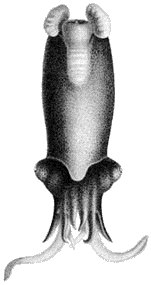
Body length with arms 7-8 cm. Males are somewhat larger than females. Both sexes have an inner shell ( fragmentation window ). The diameter of the shell itself is 20-22 mm. The shell is spirally wrapped with a few characteristic non-touching turns, divided by partitions into a series of chambers and with a siphon close to the abdominal side of the shell. With its help, buoyancy of the mollusk is regulated. The sink is divided by partitions into chambers connected by a siphon. The shell is strong enough to withstand hydrostatic pressure at depths of 1300–2300 m, an average of 1700–1750 m. The siphon mechanism creates superosmotic concentrations sufficient for pumping monovalent cations from the chamber fluid against the hydrostatic pressure gradient at the depth of the spirula, which ensures neutral buoyancy .
The body is elongated with 8 short tentacles equipped with 6 rows of small stalked suckers. The grasping tentacles are very long. The hands of the 4th pair in males are hectocotylized (modified for sexual purposes) and lack suction cups. There is no rainbow .
The mantle is dense, at the back ends with blades covering most of the shell. Only the mantle blade protrudes into the last chamber of the shell. Two elongated protrusions of the mantle at the end of the body are fins, between which is located the luminescence organ. The fins are tiny, petal-shaped, located at the very end of the body at a certain angle to the longitudinal axis.
At the rear end of the body between the fins, there is a rather large photophore with constant non-bacterial luminescence, which differs sharply in structure from photophores of cuttlefish with bacterial, and from photophores of squids with their own glow .
Habitat and habitat
The area is torn. The western and eastern parts of the Atlantic Ocean , the Caribbean Sea , the southwestern and eastern parts of the Indian Ocean , the seas of the Malay Archipelago, the southwestern Pacific Ocean . Live animals are extremely rare, regularly caught at great depths near New Zealand and the Antilles .
Bottom spawning and the inability to significant horizontal migrations lead to the fact that it lives only in areas with closed circulation of intermediate waters, providing the possibility of passive return of males and females to the slope.
Spends most of his life at depths of 100-1000 meters. It performs daily vertical migrations - mainly at daytime it keeps at depths of 600-700 meters, at night at a depth of 100-300 meters.
Biology
Spirula swims mainly with her head down, in a vertical position, and is well adapted to vertical, but not horizontal movements. With potential danger, it draws the head and most of the limbs into the mantle.
Spirula is a flock of animals - the day of the flock is denser than at night. Feeds at night. It feeds on zooplankton .
It breeds at the bottom at depths from 500 to 1500-1750 m. Adult individuals descend into the bathipelagial shortly before the start of spawning . Both abdominal arms are hectocotilized, spermatophores are transferred to the female’s oral membrane. The eggs are rather small, about 1.7 mm long, bottom. The incubation is long and lasts for several months. The development is direct. Young spirules soon after hatching emerge in the mesopelagial . Grow slowly. Maturity occurs at the age of 1-1.5 years. The maximum life expectancy, apparently, does not exceed 18-20 months.
Notes
- ↑ Ershov V.E. , Kantor Yu. I. Sea shells. Brief identifier. - M .: Italic, 2008 .-- 288 p. - 3,000 copies. - ISBN 978-5-89592-059-6 .
- ↑ Vitushka // Brockhaus and Efron Encyclopedic Dictionary : in 86 volumes (82 volumes and 4 additional). - SPb. , 1890-1907.