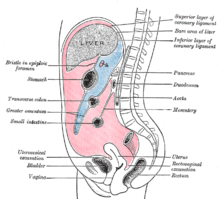
Peritoneum ( lat.peritoneum ) - a thin translucent serous membrane covering the inner walls of the abdominal cavity and the surface of internal organs. The peritoneum has a smooth, shiny surface, formed by two sheets - visceral (covering organs) and parietal (parietal), passing into each other with the formation of a closed sac - the cavity of the peritoneum ( lat. Cavitas peritonei ).
The peritoneal cavity is a system of slit-like spaces filled with serous contents, formed both between separate sections of the visceral leaf and between the visceral and parietal leaf. The peritoneum sheets form folds protruding into the interior, forming the mesentery of the hollow organs, a large and small omentum .
Distinguish organs covered by the peritoneum from all sides (intraperitoneally), from three sides (mesoperitoneal) and from one side (extraperitoneally). At the same time, vessels and nerves heading to the organs of the abdominal cavity from the retroperitoneal space do not perforate the peritoneum, but lie in the slit-like spaces between the mesentery sheets - the duplicate of the peritoneum connecting the visceral peritoneum of the organ with the parietal.
Links
Literature
- Knipovich N.M. Bryushina // Brockhaus and Efron Encyclopedic Dictionary : in 86 volumes (82 volumes and 4 additional). - SPb. , 1890-1907.