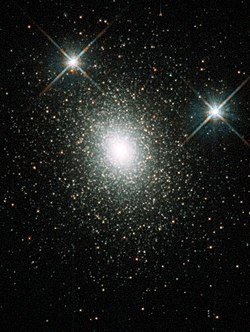
Mayall II ( Mayall II , M31 G1 ), also known as the Andromeda Cluster , is a globular cluster in the Andromeda galaxy .
| Mayall II | |
|---|---|
| Star cluster | |
 | |
| Research history | |
| Discoverer | and |
| opening date | |
| Designations | NGC-224-G1 , SKHB 1 , GSC 2788: 2139 , HBK 0-1 , M31GC J003247 + 393440 |
| Observational data ( Age J2000.0 ) | |
| Right ascension | |
| Declination | |
| Distance | 2.52 ± 0.14 million, St. years (770 ± 40 K pc ) |
| Visible magnitude (V) | 13.8 |
| Visible Dimensions (V) | 0.6 ' |
| Constellation | Andromeda |
It is located 130 thousand light years (40 kpc) from the galactic center of Andromeda , and is the brightest ( absolute magnitude ) globular cluster in the Local Group , with a visible brightness of 13.8. G1 is twice as massive as Omega Centauri and possibly contains in its center a black hole of intermediate mass (~ 2⋅10 4 M ⊙ ).
It was first identified as a possible globular cluster by Mayall and Eggen in 1953 using 48-inch Palomar plates captured in 1948.
Due to the wide distribution of metals, indicating several generations of stars and a large period of star formation, many believe that Mayall II is not a classic globular cluster, but represents the galactic center of a dwarf galaxy absorbed by the Andromeda galaxy .