Clever Geek Handbook
šŸ“œ ā¬†ļø ā¬‡ļø

Poynting Theorem

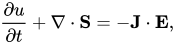
Poynting 's theorem is a theorem that describes the law of conservation of electromagnetic field energy . The theorem was proved in 1884 by John Henry Pointing . It all comes down to the following formula:

āˆ‚uāˆ‚t+āˆ‡ā‹…S=-Jā‹…E,{\ displaystyle {\ frac {\ partial u} {\ partial t}} + \ nabla \ cdot \ mathbf {S} = - \ mathbf {J} \ cdot \ mathbf {E},} {\ displaystyle {\ frac {\ partial u} {\ partial t}} + \ nabla \ cdot \ mathbf {S} = - \ mathbf {J} \ cdot \ mathbf {E},}

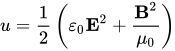
Whereu {\ displaystyle u} u - energy density :u=one2(ε0E2+B2μ0) {\ displaystyle u = {\ frac {1} {2}} \ left (\ varepsilon _ {0} \ mathbf {E} ^ {2} + {\ frac {\ mathbf {B} ^ {2}} {\ mu _ {0}}} \ right)} {\ displaystyle u = {\ frac {1} {2}} \ left (\ varepsilon _ {0} \ mathbf {E} ^ {2} + {\ frac {\ mathbf {B} ^ {2}} {\ mu _ {0}}} \ right)} ;

ε0{\ displaystyle \ varepsilon _ {0}} \ varepsilon _ {0} - electric constantμ0 {\ displaystyle \ mu _ {0}} \ mu _ {0} - magnetic constant ;
āˆ‡{\ displaystyle \ nabla} \ nabla - operator nabla ; S is the Poynting vector ;
J is the current density and E is the electric field strength .

Poynting's theorem in integral form:

āˆ‚āˆ‚t∫VudV+āˆ®āˆ‚V⁔SdA=-∫VJā‹…EdV{\ displaystyle {\ frac {\ partial} {\ partial t}} \ int _ {V} u \ dV + \ oint _ {\ partial V} \ mathbf {S} \ d \ mathbf {A} = - \ int _ {V} \ mathbf {J} \ cdot \ mathbf {E} \ dV} {\ frac {\ partial} {\ partial t}} \ int _ {V} u \ dV + \ oint _ {{\ partial V}} {\ mathbf {S}} \ d {\ mathbf {A}} = - \ int _ {V} {\ mathbf {J}} \ cdot {\ mathbf {E}} \ dV ,

Whereāˆ‚V {\ displaystyle \ partial V} \ partial V - surface limiting volumeV {\ displaystyle V} V .

In the technical literature, the theorem is usually written as follows (u {\ displaystyle u} u - energy density):

āˆ‡ā‹…S+ε0Eā‹…āˆ‚Eāˆ‚t+Bμ0ā‹…āˆ‚Bāˆ‚t+Jā‹…E=0{\ displaystyle \ nabla \ cdot \ mathbf {S} + \ varepsilon _ {0} \ mathbf {E} \ cdot {\ frac {\ partial \ mathbf {E}} {\ partial t}} + {\ frac {\ mathbf {B}} {\ mu _ {0}}} \ cdot {\ frac {\ partial \ mathbf {B}} {\ partial t}} + \ mathbf {J} \ cdot \ mathbf {E} = 0} \ nabla \ cdot {\ mathbf {S}} + \ varepsilon _ {0} {\ mathbf {E}} \ cdot {\ frac {\ partial {\ mathbf {E}}} {\ partial t}} + {\ frac {{\ mathbf {B}}} {\ mu _ {0}}} \ cdot {\ frac {\ partial {\ mathbf {B}}} {\ partial t}} + {\ mathbf {J}} \ cdot {\ mathbf {E}} = 0 ,

Whereε0Eā‹…āˆ‚Eāˆ‚t {\ displaystyle \ varepsilon _ {0} \ mathbf {E} \ cdot {\ frac {\ partial \ mathbf {E}} {\ partial t}}} \ varepsilon _ {0} {\ mathbf {E}} \ cdot {\ frac {\ partial {\ mathbf {E}}} {\ partial t}} Is the energy density of the electric field,Bμ0ā‹…āˆ‚Bāˆ‚t {\ displaystyle {\ frac {\ mathbf {B}} {\ mu _ {0}}} \ cdot {\ frac {\ partial \ mathbf {B}} {\ partial t}}} {\ frac {{\ mathbf {B}}} {\ mu _ {0}}} \ cdot {\ frac {\ partial {\ mathbf {B}}} {\ partial t}} Is the energy density of the magnetic field andJā‹…E {\ displaystyle \ mathbf {J} \ cdot \ mathbf {E}} {\ mathbf {J}} \ cdot {\ mathbf {E}} - power of joule losses per unit volume.

Conclusion

The theorem can be deduced using two Maxwell equations (for simplicity, we assume that the medium is a vacuum (μ = 1, ε = 1); for the general case with an arbitrary medium, we need to assign ε and μ to the formulas for each ε 0 and μ 0 ) :

āˆ‡Ć—E=-āˆ‚Bāˆ‚t.{\ displaystyle \ nabla \ times \ mathbf {E} = - {\ frac {\ partial \ mathbf {B}} {\ partial t}}.}  

Multiplying both sides of the equation byB {\ displaystyle \ mathbf {B}}   we get:

Bā‹…(āˆ‡Ć—E)=-Bā‹…āˆ‚Bāˆ‚t.{\ displaystyle \ mathbf {B} \ cdot (\ nabla \ times \ mathbf {E}) = - \ mathbf {B} \ cdot {\ frac {\ partial \ mathbf {B}} {\ partial t}}.}  

We first consider the Maxwell-AmpĆØre equation:

āˆ‡Ć—B=μ0J+ε0μ0āˆ‚Eāˆ‚t.{\ displaystyle \ nabla \ times \ mathbf {B} = \ mu _ {0} \ mathbf {J} + \ varepsilon _ {0} \ mu _ {0} {\ frac {\ partial \ mathbf {E}} { \ partial t}}.}  

Multiplying both sides of the equation byE {\ displaystyle \ mathbf {E}}   we get:

Eā‹…(āˆ‡Ć—B)=E⋅μ0J+E⋅ε0μ0āˆ‚Eāˆ‚t.{\ displaystyle \ mathbf {E} \ cdot (\ nabla \ times \ mathbf {B}) = \ mathbf {E} \ cdot \ mu _ {0} \ mathbf {J} + \ mathbf {E} \ cdot \ varepsilon _ {0} \ mu _ {0} {\ frac {\ partial \ mathbf {E}} {\ partial t}}.}  

Subtracting the first from the second, we get:

Eā‹…(āˆ‡Ć—B)-Bā‹…(āˆ‡Ć—E)=μ0Eā‹…J+ε0μ0Eā‹…āˆ‚Eāˆ‚t+Bā‹…āˆ‚Bāˆ‚t.{\ displaystyle \ mathbf {E} \ cdot (\ nabla \ times \ mathbf {B}) - \ mathbf {B} \ cdot (\ nabla \ times \ mathbf {E}) = \ mu _ {0} \ mathbf { E} \ cdot \ mathbf {J} + \ varepsilon _ {0} \ mu _ {0} \ mathbf {E} \ cdot {\ frac {\ partial \ mathbf {E}} {\ partial t}} + \ mathbf {B} \ cdot {\ frac {\ partial \ mathbf {B}} {\ partial t}}.}  

Finally:

-āˆ‡ā‹…(EƗB)=μ0Eā‹…J+ε0μ0Eā‹…āˆ‚Eāˆ‚t+Bā‹…āˆ‚Bāˆ‚t.{\ displaystyle - \ nabla \ cdot \ (\ mathbf {E} \ times \ mathbf {B}) = \ mu _ {0} \ mathbf {E} \ cdot \ mathbf {J} + \ varepsilon _ {0} \ mu _ {0} \ mathbf {E} \ cdot {\ frac {\ partial \ mathbf {E}} {\ partial t}} + \ mathbf {B} \ cdot {\ frac {\ partial \ mathbf {B}} {\ partial t}}.}  

Since the Poynting vectorS {\ displaystyle \ mathbf {S}}   defined as:

S=oneμ0EƗB{\ displaystyle \ mathbf {S} = {\ frac {1} {\ mu _ {0}}} \ mathbf {E} \ times \ mathbf {B}}  

this is equivalent to:

āˆ‡ā‹…S+ε0Eā‹…āˆ‚Eāˆ‚t+Bμ0ā‹…āˆ‚Bāˆ‚t+Jā‹…E=0.{\ displaystyle \ nabla \ cdot \ mathbf {S} + \ varepsilon _ {0} \ mathbf {E} \ cdot {\ frac {\ partial \ mathbf {E}} {\ partial t}} + {\ frac {\ mathbf {B}} {\ mu _ {0}}} \ cdot {\ frac {\ partial \ mathbf {B}} {\ partial t}} + \ mathbf {J} \ cdot \ mathbf {E} = 0. }  

Summary

The mechanical energy of the theorem described above

āˆ‚āˆ‚tum(r,t)+āˆ‡ā‹…Sm(r,t)=J(r,t)ā‹…E(r,t),{\ displaystyle {\ frac {\ partial} {\ partial t}} u_ {m} (\ mathbf {r}, t) + \ nabla \ cdot \ mathbf {S} _ {m} (\ mathbf {r}, t) = \ mathbf {J} (\ mathbf {r}, t) \ cdot \ mathbf {E} (\ mathbf {r}, t),}  

where u_m is the kinetic energy of density in the system. It can be described as the sum of the kinetic energy of particles α

um(r,t)=āˆ‘Ī±mα2r˙α2Ī“(r-rα(t)),{\ displaystyle u_ {m} (\ mathbf {r}, t) = \ sum _ {\ alpha} {\ frac {m _ {\ alpha}} {2}} {\ dot {r}} _ {\ alpha} ^ {2} \ delta (\ mathbf {r} - \ mathbf {r} _ {\ alpha} (t)),}  

Sm{\ displaystyle \ mathbf {S_ {m}}}   - energy flow, or ā€œmechanical Poynting vectorā€:

Sm(r,t)=āˆ‘Ī±mα2r˙α2r˙αΓ(r-rα(t)).{\ displaystyle \ mathbf {S} _ {m} (\ mathbf {r}, t) = \ sum _ {\ alpha} {\ frac {m _ {\ alpha}} {2}} {\ dot {r}} _ {\ alpha} ^ {2} {\ dot {\ mathbf {r}}} _ {\ alpha} \ delta (\ mathbf {r} - \ mathbf {r} _ {\ alpha} (t)).}  

Energy continuity equation or energy conservation law

āˆ‚āˆ‚t(ue+um)+āˆ‡ā‹…(Se+Sm)=0,{\ displaystyle {\ frac {\ partial} {\ partial t}} \ left (u_ {e} + u_ {m} \ right) + \ nabla \ cdot \ left (\ mathbf {S} _ {e} + \ mathbf {S} _ {m} \ right) = 0,}  

Alternative Forms

Other forms of Poynting's theorem can be obtained. Instead of using a stream vectorSāˆEƗB {\ displaystyle \ mathbf {S} \ propto \ mathbf {E} \ times \ mathbf {B}}   can choose the shape of AbrahamEƗH {\ displaystyle \ mathbf {E} \ times \ mathbf {H}}   Minkowski formDƗB {\ displaystyle \ mathbf {D} \ times \ mathbf {B}}   , or some other.
Source - https://ru.wikipedia.org/w/index.php?title= Pointing Theorem&oldid = 91680034


More articles:

  • Christian Charlie
  • Rycroft, Carter
  • Marcin, Tatyana Filippovna
  • Kirzhach
  • MacCormick, Cyrus
  • Diocese of the Holy Trinity (Alma-Ata)
  • Marzun, Maria Antonovna
  • Flags of the Saratov Region
  • Virtual PBX
  • Institute for the Investigation of Communist Crimes in Romania

All articles

Clever Geek | 2019