The Journal des Débats Politiques et Littéraires ( Journal of Political and Literary Debates ) is an influential French conservative newspaper of the 19th and 20th centuries. Came out in Paris from 1789 to 1944 .
| Journal des Débats Politiques et Littéraires | |
|---|---|
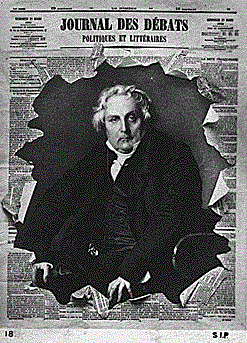 “Journal des Débats” - a collage of the portrait of the editor of the newspaper Bertin by Ingres | |
| Abbreviation ( ISO 4 ) | Journal des Débats |
| Specialization | politics and literature |
| Periodicity | daily newspaper |
| Tongue | French |
| A country |  France France |
| Publisher | Louis Francois Bertin |
| Edition History | 1789 - 1944 |
| Established | |
| Circulation | 13,000 copies ( 1830 year ) |
Content
History
The Magazine de Deba, a well-known Parisian newspaper in the 19th century, appeared in the spring of 1789 at the very beginning of the French Revolution under the name Journal des débats et des décrets (Journal de Deba et de Decreux), founder - Gaultier de Beaulieu ( Jean- François Gaultier de Biauzat ; 1739-1815). The newspaper appeared shortly after the convocation of the General States and reprinted parliamentary reports and government orders, hence its name.
The publication came out as official materials accumulated, first weekly, subsequently daily and no different from the numerous Parisian newspapers of the Revolutionary era. Since 1791, it has become a platform for speeches by Jacobin journalists. In 1799, the newspaper was acquired by Louis-Francois Bertin Sr. and his brother , stood up to the royalist opposition to Napoleon’s politics and gradually gained the position of one of the most influential central newspapers. With the establishment of the era of the Empire , Napoleon ordered the newspaper to be called the Journal de l'Empire (“Journal de l'Ampire,” Empire Newspaper). In 1814 , during the Restoration era, the newspaper changed its “imperial” name to Journal des Débats Politiques et Littéraires and retained it until 1864 , when only “Journal des Débats” remained on the front page of the newspaper.
From now on, the publication for many years becomes the most famous morning newspaper of the conservative trend. She was generally loyal to the rule of the Bourbons , occasionally criticizing the government. The newspaper gained popularity due to its skillful leadership, the ability of editors to react sensitively to changes in public opinion, to combine the demands of political urgency and acuteness with analyticity and balanced evaluations.
Under Charles X, the newspaper changed its conservative principles and supported the liberal opposition of the monarchy ( Guizot , Roye-Collard , etc.). Therefore, the subsequent July monarchy received tangible support from the Journal des Débats, the newspaper became the mouthpiece of Louis Philippe's policy. Alfons de Lamartine called the Journal des Débats "a daily extract from the minutes of the meeting of the Tuileries Cabinet."
The preferences of the newspaper in the field of literature were as conservative as its political views: the newspaper disapproved of romanticism. Literary critic of the newspaper E.-J. Delecluse condemned romanticism as an art "wild, uncultured, erroneous", alien to the French spirit, artificially transferred from Germany and Great Britain . In his opinion, romanticism is just a variant of the Baroque , which did not create masterpieces.
Nevertheless, the Journal des Débats would not have been an outstanding newspaper, had the editors not enlisted the participation of such significant literary names of romanticism as Victor Hugo , Charles Nodier , Alexander Dumas father , Jules Jeanen . A special surge of popularity occurred in 1842 and 1843, when Eugene Sue published his felton novel “ Paris Secrets ” in the newspaper.
Until the last days of the July monarchy and the heyday of the newspaper Emile de Girardin 's La Presse, and later the Le Petit Journal, the Journal des Débats remained the most read and influential of the French bourgeois newspapers. Her reputation was maintained thanks to the cooperation of the best literary forces in France.
Until the early 1840s, the newspaper was headed by the Bertin brothers, in 1841 the long-time editor of the newspaper, Bertin Sr., died, the next year his brother dies, and Louis-Francois, Bertin Jr. The leadership of the newspaper passes to the youngest son of Bertin Sr. - Arman, and after the death of the latter in 1854 to his elder brother - Eduard Bertin. Edward runs the newspaper until his death in 1871 . With the death of the Bertin clan, the newspaper is headed by Leon Ce (1871–1885), Georges Patino (1885–1895). The last editor of the famous publication was Etienne Bundy de Nales (1895-1942).
At the turn of the eighteenth and nineteenth centuries, the newspaper became the founder of the appearance of the feuilleton as an independent literary newspaper genre. At the same time, the style of literary criticism “Journal des Débats” was formed by Julien Geoffrey , later developed in the works of Emile Fage , Vogue , etc.
The newspaper was collaborated by prominent French thinkers and writers Maurice Blanchot , Chateaubriand , poet J. M. Heredia , German critic August Schlegel , composer and music critic Hector Berlioz , philosopher Ernest Renan , physicist Foucault and many others.
For many decades, the newspaper adhered to conservative ideological principles, and in 1944 it was closed immediately after the liberation of France from Nazi occupation for the collaborative orientation of its materials.
See also
- Feuilleton romance
- Feuilleton
Literature
- Histoire générale de la presse française / Sous le dir. C. Bellanger. P .: PUF, 1972. T. 2;
- Lenin V.I., Complete Works, 5th ed., Vol. 16.
- Trykov V.P. Foreign Journalism of the 19th Century. M., 2004.S. 13-14, 80-81.
- Bertin, family // Brockhaus and Efron Encyclopedic Dictionary : in 86 volumes (82 volumes and 4 additional). - SPb. , 1890-1907.
Links
- Le Journal des débats digital archives from 1800 to 1805 , from 1805 to 1814 and from 1814 to 1944