Cereal moth miners ( lat.Elachistidae ) - a family of mole-shaped butterflies . Includes over 3,300 species .
| Cereal Moth Miners | ||||||||||||
|---|---|---|---|---|---|---|---|---|---|---|---|---|
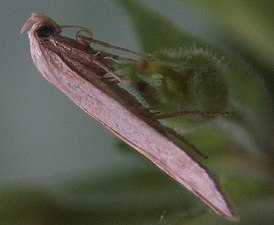 Elachista rufocinerea | ||||||||||||
| Scientific classification | ||||||||||||
| ||||||||||||
| Latin name | ||||||||||||
| Elachistidae Bruand , 1851 |
Description
Butterflies are small and very small. Wingspan 5-13 mm. They sit at rest, clinging tightly to the substrate and folding their wings with a house. The fringe of the front wings forms a characteristic vertical tooth. The head is smooth, covered with bundles of scales on the back of the head. Antenna from 1/2 to 3/4 of the length of the front wing. Labial palps moderately long, slightly saber-like, curved, diverging to the sides, less often very short, hanging down. Proboscis shorter than labial palps. Fore wings lanceolate, with distinctly pointed apex. Their pattern (if expressed) is formed by a white band and spots on a dark background, or dark dots and strokes on a light background. The venation is quite complete.
The way of life of butterflies is mostly nocturnal, but some species fly during the day and almost all are active before sunset and at dawn. Caterpillars of most species are leaf miners on grassy monocotyledonous plants - cereals , sedges , less often chytnos , and only the most archaic genera) are associated with dicotyledonous - honeysuckle , rosaceae , labioecious and others. Mining leaves throughout the development; many winter in mines and continue to feed in the spring. Pupation in species associated with monocotyledons occurs openly on the leaves of fodder plants (moreover, the pupa is attached to the substrate only with a silk girdle and cremaster). Other species make cocoons coated with substrate particles.
Economic Significance
The significance of family members as pests in Russia was not noted, although a number of species are found in high numbers. In tropical regions, certain species harm sugarcane and crops.
Systematics
Most species are known from the northern hemisphere. The species composition is poorly studied (except for northern and partly Western Europe ). There are 10 genera in the Palearctic , up to 150 species.
Subfamilies
- Stenomatinae
- Ethmiinae
- Depressariinae
- Elachistinae
- Agonoxeninae
- Hypertrophinae
- Deuterogoniinae
- Aeolanthinae
Childbirth
- Annettenia
- Aphelosetia
- Aphigalia
- Araucarivora
- Aristoptila
- Atachia
- Atmozostis
- Atrinia
- Austriana
- Biselachista
- Bradleyana
- Calamograptis
- Canariana
- Cleroptila
- Cosmiotes
- Cryphioxena
- Dibrachia
- Dicasteris
- Dicranoctetes
- Donacivola
- Elachista
- Elachistites
- Elachistoides
- Eretmograptis
- Eupneusta
- Euproteodes
- Gibraltarensis
- Habeleria
- Hecista
- Hemiprosopa
- Holstia
- Illantis
- Ireicodes
- Kumia
- Kuznetzoviana
- Mendesia
- Microperittia
- Microplitica
- Mylocrita
- Myrrhinitis
- Ogmograptis
- Onceroptila
- Palaeoelachista
- Paraperittia
- Perittia
- Perittoides
- Petrochroa
- Phaneroctena
- Phthinostoma
- Platyphyllis
- Polymetis
- Praemendesia
- Pretoriana
- Proterochyta
- Ptilodoxa
- Sineviana
- Sruogania
- Stephensia
- Swezeyula
- Symphoristis
- Triboloneura
- Whitebreadia
Literature
- Thomas Kaltenbach, Peter Victor Küppers: Kleinschmetterlinge . 1. Auflage. J. Neudamm-Neudamm, Melsungen 1987, ISBN 3-7888-0510-2 .