The Stirling engine is a heat engine in which the working fluid, in the form of a gas or liquid, moves in a closed volume, a kind of external combustion engine . Based on the periodic heating and cooling of the working fluid, with the extraction of energy from the resulting pressure changes. It can work not only from burning fuel , but also from any heat source.
History

The Stirling engine was first patented by the Scottish priest Robert Stirling on September 27, 1816 (English patent number 4081 1819). However, the first elementary "hot air engines" were known at the end of the 17th century , long before Stirling. Stirling's achievement is the addition of a node, which he called "economy."
In modern scientific literature, this site is called the " regenerator ". It increases engine performance by keeping heat in the warm part of the engine, while the working fluid is cooled. This process greatly improves system efficiency. Most often, the regenerator is a chamber filled with wire, granules, corrugated foil (corrugations go along the direction of gas flow). The gas, passing through the filler in one direction, gives off heat to the regenerator, and when moving in the other direction, takes it away. The regenerator can be external to the cylinders, and can be placed on the piston propellant in the β- and γ-configurations. In the latter case, the dimensions and weight of the machine are smaller. Partially, the role of the regenerator is performed by the gap between the displacer and the walls of the cylinder (with a long cylinder, the need for such a device disappears altogether, but significant losses appear due to the viscosity of the gas). In α-stirling, the regenerator can only be external. It is installed in series with a heat exchanger in which the working fluid is heated from the side of the cold piston.
In 1843, the inventor's brother, James Stirling, used this engine in a factory where he was an engineer at the time. In 1938, Philips invested in a Stirling engine with a power of more than two hundred horsepower and a return of more than 30%. The Stirling engine has many advantages and was widespread in the era of steam engines.
Description
| Thermodynamic cycles |
|---|
| The article is part of the Thermodynamics series. |
| Edwards Reference Cycle |
| Atkinson cycle |
| Brighton / Joule Cycle |
| Girna cycle |
| Diesel Cycle |
| Kalina Cycle |
| Cycle Carnot |
| Lenoir Cycle |
| Miller's cycle |
| Otto cycle |
| Rankine cycle |
| Stirling cycle |
| Trinkler Cycle |
| Humphrey Cycle |
| Eriksson Cycle |
| Sections of thermodynamics |
| The beginnings of thermodynamics |
| Equation of state |
| Thermodynamic values |
| Thermodynamic potentials |
| Thermodynamic cycles |
| Phase transitions |
| See also “Physical portal” |
In the 19th century, engineers wanted to create a safe replacement for steam engines of the time, whose boilers often exploded due to high steam pressures and inappropriate materials for their construction. A good option appeared with the creation of the Stirling engine, which could convert into operation any temperature difference. The main principle of operation of the Stirling engine is to continuously alternate the heating and cooling of the working fluid in a closed cylinder. Typically, air acts as the working fluid , but hydrogen and helium are also used. Freons, nitrogen dioxide, liquefied propane-butane and water were tested in a number of prototypes. In the latter case, the water remains in a liquid state at all sites of the thermodynamic cycle. Features of the "Stirling" with a liquid working fluid are small in size, high power density and high working pressure. There is also a “stirling” with a two-phase working fluid. It is also characterized by high power density, high working pressure.
It is known from thermodynamics that the pressure , temperature and volume of an ideal gas are interconnected and follow the law where:
- p is the gas pressure;
- V is the gas volume;
- v is the number of moles of gas;
- R is the universal gas constant;
- T is the gas temperature in kelvins.
This means that when the gas is heated, its volume increases, and when cooled, it decreases. When heated, the gas does the job (for example, pushes the piston) and cools. It is simpler to compress cooled gas than to keep expanding hot (less gas is “consumed” to compress cold gas than work is released when it is heated and the gas expands). This property of gases and underlies the operation of the Stirling engine.
The Stirling engine uses the Stirling cycle , which is not inferior to the Carnot cycle in thermodynamic efficiency, and even has an advantage. The fact is that the Carnot cycle consists of slightly different isotherms and adiabats. The practical embodiment of this cycle is unpromising. The Stirling cycle allowed to get a working in practice engine in acceptable sizes.
The Stirling cycle consists of four phases and is separated by two transition phases: heating, expansion, transition to the source of cold, cooling, compression and transition to the source of heat. Thus, during the transition from a warm source to a cold source, the gas in the cylinder expands and compresses. In this case, the pressure changes, due to which you can get useful work.
Heating and cooling of the working fluid (sections 4 and 2) is made by the displacer. Ideally, the amount of heat given and taken away by the displacer is the same. Useful work is done only due to isotherms, that is, it depends on the temperature difference between the heater and the cooler, as in the Carnot cycle.
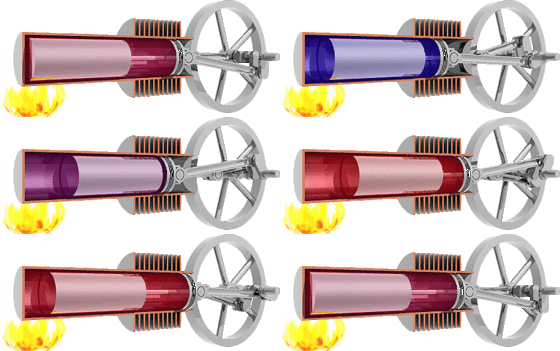
Duty cycle β-type Stirling engine:
one
2
3
four
where: a - displacement piston; b - working piston; c - flywheel; d - fire (heating area); e - cooling fins (cooling area).
- An external heat source heats the gas at the bottom of the heat exchange cylinder. The created pressure pushes the working piston upwards (the displacing piston is not tight against the walls).
- The flywheel pushes the displacement piston down, thereby moving the heated air from the bottom to the cooling chamber.
- The air cools and shrinks, the working piston goes down.
- The displacement piston rises, thereby moving the cooled air to the bottom. And the cycle repeats.
In the Stirling machine, the movement of the working piston is shifted by 90 ° relative to the movement of the piston propellant. Depending on the sign of this shift, the machine may be an engine or a heat pump. With a shift of 0 °, the machine does not do any useful work.
Other Stirling Engines
The Stirling cycle is considered an indispensable accessory of the Stirling engine. At the same time, a detailed study of the principles of operation of the set of constructions created to date shows that a significant part of them has a working cycle different from the Stirling cycle. For example, α-Stirling with pistons of different diameters has a cycle that is more similar to the Ericsson cycle . The β- and γ-configurations, which have a sufficiently large rod diameter at the piston-displacer, also occupy a certain intermediate position between the Stirling and Eriksson cycles.
When the displacer moves in the β-configuration, the change in the state of the working medium occurs not along the isochore, but along an inclined line intermediate between the isochore and the isobar . With a certain ratio of the diameter of the rod to the total diameter of the displacer, it is possible to obtain an isobar (this ratio depends on the operating temperatures). In this case, the piston, which was previously a worker, plays only an auxiliary role, and the displacer rod becomes a real worker. The specific power of such an engine is about 2 times greater than in the usual "Stirling", lower than the friction loss, since the pressure on the piston is more even. A similar picture in α-Stirling with a different diameter of the pistons.
A motor with an intermediate diagram may have a load evenly distributed between the pistons, that is, between the working piston and the displacer rod.
An important advantage of the operation of the engine according to the Eriksson cycle or close to it is that the isochore is replaced by an isobar or a process close to it. With the expansion of the working fluid through the isobar, there are no changes in pressure, no heat exchange, except for the transfer of heat from the cleaner to the working fluid. And this heating immediately does a useful job. With isobaric compression, heat is released to the cleaner.
In the Stirling cycle, when the working medium is heated or cooled, heat loss occurs due to isothermal processes in the heater and cooler.
Configuration
Engineers subdivide Stirling engines into three different types:
α-stirling
β-Stirling with a rhombic mechanism and a regenerator
γ-Stirling without regenerator
- α-Stirling - contains two separate power pistons in separate cylinders, one is hot, the other is cold. The cylinder with the hot piston is in a heat exchanger with a higher temperature, with a cold one in a cooler one. In this type of engine, the ratio of power to volume is quite large, but, unfortunately, the high temperature of the “hot” piston creates certain technical difficulties. The regenerator is located between the hot part of the connecting tube and the cold one.
- β-Stirling is only one cylinder, hot from one end and cold from the other. Inside the cylinder, a piston (from which power is removed) and a displacer separating the hot and cold cavities move. Gas is pumped from the cold part of the cylinder to the hot through a regenerator. The regenerator can be external, as part of a heat exchanger, or it can be combined with a piston propellant.
- γ-Stirling - there is also a piston and a displacer, but there are two cylinders - one is cold (the piston moves from there, from which power is removed), and the second is hot from one end and cold from the other (the displacer is moving there). The regenerator can be external, in this case it connects the hot part of the second cylinder with the cold one and at the same time with the first (cold) cylinder. The internal regenerator is part of the displacer.
There are also varieties of the Stirling engine that do not fall under the above three classic types:
- Rotary Stirling engine - problems of tightness were solved (Mukhina's patent for hermetic rotation inlet (GVV), silver medal at the international exhibition in Brussels "Eureka-96") and bulkiness (no crank mechanism, because the motor is rotary) [1] .
- Thermo-acoustic Stirling engine - instead of using a piston-displacer, the working fluid moves between the hot and cold cavity due to the phenomena of acoustic resonance . This scheme allows to reduce the number of moving parts, but there are difficulties with maintaining acoustic resonance, as well as with the removal of power.
Disadvantages
- Bulkiness and consumption of materials - the main disadvantage of piston engine options. In external combustion engines in general, and the Stirling engine in particular, the working fluid must be cooled, and this leads to a significant increase in mass and dimensions of the power plant due to the increased radiators.
- To obtain characteristics comparable with the characteristics of ICE, it is necessary to apply high pressures (over 100 atm) and special types of working fluid - hydrogen, helium.
- Heat is not supplied directly to the working fluid , but only through the walls of the heat exchangers. The walls have limited thermal conductivity, which is why the efficiency is lower than might be expected. A hot heat exchanger operates under very intense heat transfer conditions and at very high pressures, which requires the use of high-quality and expensive materials. Creating a heat exchanger that would satisfy conflicting requirements is a very non-trivial task. The larger the heat exchange area, the greater the heat loss. At the same time, the size of the heat exchanger and the volume of the working fluid that does not participate in the work increase. Since the heat source is located outside, the engine responds slowly to changes in the heat flux supplied to the cylinder, and may not immediately provide the necessary power at start-up.
- For a quick change in engine power, methods other than those used in internal combustion engines are used: buffer capacity of a variable volume, change in the average pressure of the working fluid in the chambers, change in the phase angle between the working piston and the displacer. In the latter case, the response of the engine to the control action of the driver is almost instantaneous.
Benefits
However, the Stirling engine has advantages that force its development.
- The “omnivorous nature of the engine” - like all external combustion engines (or rather, external heat supply), a Stirling engine can operate from almost any temperature difference: for example, between different layers of water in the ocean, from the sun, from a nuclear or isotopic heater, a coal or wood-burning furnace etc.
- Simplicity of design - the design of the engine is very simple, it does not require additional systems, such as a gas distribution mechanism. It starts independently and does not need a starter. Its characteristics allow you to get rid of the gearbox.
- The increased resource - simplicity of design, the absence of many “delicate” nodes allows “stirling” to provide an unprecedented for other engines operating capacity of tens and hundreds of thousands of hours of continuous operation.
- Profitability - for the utilization of certain types of thermal energy, especially with a small temperature difference, "stirling" is often the most effective types of engines. For example, in the case of conversion of solar energy into electricity, "stirlings" sometimes give greater efficiency (up to 31.25%) than steam heat engines. [2]
- Environmental friendliness - "Stirling" has no exhaust from the cylinders, which means that its noise level is much less than that of piston internal combustion engines. The β-Stirling with a rhombic mechanism is a perfectly balanced device and, with a sufficiently high quality of manufacture, has an extremely low level of vibrations (the amplitude of vibration is less than 0.0038 mm). By itself, "stirling" does not have any parts or processes that may contribute to environmental pollution. He does not spend working body. That is, the environmental friendliness of the engine is primarily due to the environmental friendliness of the heat source. And for him it can be noted that to ensure complete combustion of fuel in an external combustion engine is easier than in an internal combustion engine. [However, in ICE, the completeness of fuel combustion depends on the compliance of the chemical composition of the fuel with the physical parameters of the ICE. For example, gasoline or diesel fuel is always burned in the cylinders (or in the chamber of the rotary internal combustion engine) is not fully, while alcohol or liquefied gas burns completely in the internal combustion engine.]
Application
The Stirling engine is applicable in cases when a small heat energy converter is required, simple in design, or when the efficiency of other heat engines is lower: for example, if the temperature difference is not sufficient for the operation of a steam or gas turbine.
Universal Power Sources
Stirling engines can be used to convert any heat into electricity. They have hopes for the creation of solar electrical installations. They are used as autonomous generators for tourists. Some enterprises produce generators that operate on a gas stove burner. NASA is considering variants of generators based on "Stirling", working from nuclear and radioisotope heat sources [3] . A specially designed “stirling” generator with a radioisotope power source ( Advanced Stirling Radioisotope Generator (ASRG)) will be used in the space expedition planned by NASA - Titan Saturn System Mission [4]
Pumps
The efficiency of heating or cooling systems increases if a forced-coolant pump is installed in the circuit. Установка электрического насоса снижает живучесть системы, а в неавтономных бытовых энергосистемах неприятна тем, что электросчётчик «накручивает» ощутимую сумму. Насос, использующий принцип двигателя Стирлинга, решает эту задачу.
«Стирлинг» для перекачки жидкостей может быть гораздо проще привычной схемы «двигатель-насос». В двигателе Стирлинга вместо рабочего поршня может использоваться перекачиваемая жидкость, которая одновременно служит для охлаждения рабочего тела.
Насос на основе двигателя «стирлинга» может служить для накачки воды в ирригационные каналы посредством солнечного тепла, для подачи горячей воды от солнечного коллектора в дом (в системах отопления теплоаккумулятор стараются установить как можно ниже, чтобы вода шла в радиаторы самотёком).
Стирлинг-насос может использоваться для перекачки химических реагентов, поскольку герметичен.
Стирлинг-насос с жидким поршнем использует цикл, отличный от цикла Стирлинга. Его идеализированная диаграмма PV имеет вид прямоугольника и состоит из двух изохор и двух изобар. КПД примерно в 2 раза хуже, чем у цикла Карно (и цикла Эрикссона) для такого же перепада температур.
Тепловые насосы
Тепловые насосы позволяют сэкономить на отоплении [5] . Принцип действия тот же, что у кондиционера (кондиционер — это тот же тепловой насос), только кондиционер обычно охлаждает помещение, нагревая окружающее пространство, а тепловой насос, как правило, обогревает помещение, охлаждая наружный воздух, воду из скважины или другой источник низкопотенциального тепла. Обычно используются теплонасосы, приводимые в движение электричеством. Но электричество в ряде стран производится на теплоэлектростанциях, сжигающих газ, уголь, мазут, и в итоге калория, полученная на таком теплонасосе, оказывается не дешевле, чем полученная от сжигания газа. Устройство, в котором совмещены двигатель Стирлинга и тепловой насос Стирлинга, делает ситуацию более благоприятной. Двигатель Стирлинга отдаёт в систему отопления бросовое тепло от «холодного» цилиндра, а полученная механическая энергия используется для подкачки дополнительного тепла, которое забирается из окружающей среды. Гибридный теплонасос «стирлинг-стирлинг» оказывается проще, чем композиция из двух стирлинг-машин. В устройстве совершенно отсутствуют рабочие поршни. Перепады давления, возникающие в двигателе, непосредственно используются для перекачки тепла тепловым насосом. Внутреннее пространство устройства герметично и позволяет использовать рабочее тело под очень высоким давлением.
Холодильная техника
Почти все холодильники используют те же тепловые насосы. Применительно к системам охлаждения их судьба оказалась более счастливой. Ряд производителей бытовых холодильников собирается установить на свои модели «стирлинги». Они будут обладать большей сберегательностью, а в качестве рабочего тела будут использовать обычный воздух.
Сверхнизкие температуры
Двигатель Стирлинга может работать и в режиме холодильной машины (обратный цикл Стирлинга ). Для этого его приводят в движение любым другим внешним двигателем (в том числе с помощью другого «Стирлинга»). Такие машины оказались эффективны для сжижения газов. Если не требуется больших объёмов (например в условиях лаборатории), то «стирлинги» выгоднее, чем турбинные установки .
Маленькие «Стирлинги» выгодно применять для охлаждения датчиков в сверхточных приборах.
Подводные лодки
Преимущества «стирлинга» привели к тому, что ещё в первой половине 1960-х годов военно-морские справочники указывали на возможность установки на подводных лодках типа « Шёурмен » производства Швеции воздухонезависимых двигателей Стирлинга. Однако ни «Шёурмены», ни последовавшие за ними « Наккены » и « Вестеръётланды » указанные силовые установки так и не получили. И только в 1988 году головная субмарина типа «Наккен» была переоборудована под двигатели Стирлинга. С ними она прошла под водой более 10 000 часов. Другими словами, именно шведы открыли в подводном кораблестроении эру вспомогательных анаэробных двигательных установок. И если «Наккен» — первый опытный корабль этого подкласса, то субмарины типа « Готланд » стали первыми серийными лодками с двигателями Стирлинга, которые позволяют им находиться под водой непрерывно до 20 суток. В настоящее время все подводные лодки ВМС Швеции оснащены двигателями Стирлинга, а шведские кораблестроители уже хорошо отработали технологию оснащения этими двигателями подводных лодок, путём врезания дополнительного отсека, в котором и размещается новая двигательная установка. Двигатели работают на жидком кислороде, который используется в дальнейшем для дыхания, имеют очень низкий уровень шума, а упомянутые выше недостатки (размер и охлаждение) на подводной лодке несущественны.
На новейших японских подводных лодках типа «Сорю» установлено по 4 двигателя Стирлинга Kawasaki Kockums V4-275R, 8 000 л.с,
На текущее время двигатель Стирлинга рассматривается как многообещающий единый всережимный двигатель НАПЛ 5-го поколения.
Аккумуляторы энергии
Можно запасать с его помощью энергию, используя в качестве источника тепла теплоаккумуляторы на расплавах солей. Такие аккумуляторы превосходят по запасу энергии химические аккумуляторы и дешевле их. Используя для регулировки мощности изменение фазного угла между поршнями, можно аккумулировать механическую энергию, тормозя двигателем. В этом случае двигатель превращается в тепловой насос.
Солнечные электростанции
Двигатель Стирлинга может использоваться для преобразования солнечной энергии в электрическую. Для этого двигатель Стирлинга устанавливается в фокус параболического зеркала, (похожего по форме на спутниковую антенну) таким образом, чтобы область нагрева была постоянно освещена. Параболический отражатель управляется по двум координатам при слежении за солнцем. Энергия солнца фокусируется на небольшой площади. Зеркала отражают около 92 % падающего на них солнечного излучения. В качестве рабочего тела двигателя Стирлинга используется, как правило, водород , или гелий .
В феврале 2008 года Национальная лаборатория Sandia достигла эффективности 31,25 % в установке, состоящей из параболического отражателя и двигателя Стирлинга [6] .
Компания Stirling Energy Systems разрабатывала солнечные коллекторы большой мощности — до 150 кВт на одно зеркало. Компания строила в южной Калифорнии крупнейшую в мире солнечную электростанцию, но не выдержала конкуренции в связи со снижением цен на субсидируемые фотоэлектрические солнечные элементы.
Notes
- ↑ Схема роторного двигателя Стирлинга
- ↑ Принцип работы двигателя Стирлинга
- ↑ * membrana. Лунная АЭС взяла низкий старт в тестах на Земле (неопр.) . Membrana (17 августа 2009). — О разработке лунной АЭС с применением двигателей Стирлинга. Дата обращения 24 сентября 2009. Архивировано 23 августа 2011 года.
- ↑ NASA's Planetary Science Division Update (June 23, 2008).
- ↑ Васильев Г. П., Хрустачев Л. В., Розин А. Г., Абуев И. М. и др. Руководство по применению тепловых насосов с использованием вторичных энергетических ресурсов и нетрадиционных возобновляемых источников энергии // Правительство Москвы Москомархитектура, ГУП «НИАЦ», 2001. — 66 с.
- ↑ « Установлен новый рекорд эффективности Архивная копия от 23 ноября 2008 на Wayback Machine »
Links
- Двигатель Стирлинга (простейший вариант) — видео (рус.)
- Двигатель Стирлинга — своими руками (рус.)
- Г. Уокер ДВИГАТЕЛИ СТИРЛИНГА Сокращённый перевод с английского Б. В. СУТУГИНА и Н. В. СУТУГИНА (рус.)
- Значительная часть сайта посвящена моему личному увлечению, двигателям Стирлинга, а именно, изготовлению рабочих моделей этого замечательного устройства (рус.)
- ДВИГАТЕЛИ СТИРЛИНГА И МНОГОЕ ДРУГОЕ (рус.)
- Двигатель Стирлинга В книге: В.М. Бродянский . От твердой воды до жидкого гелия (история холода). — М.: Энергоатомиздат, 1995.