The King Philip's War is a war between part of the Indian tribes of northeastern North America on the one hand and the English colonists of New England , as well as their Indian allies on the other in 1675-1676 . It was the most bloody of the Indian wars that took place in the territory of modern USA ; accompanied by exceptional mutual cruelties. The war of King Philip became a turning point in the history of the British development of North America, after which the predominance of Europeans and the dominance of their culture became irreversible.
| King Philip War | |||
|---|---|---|---|
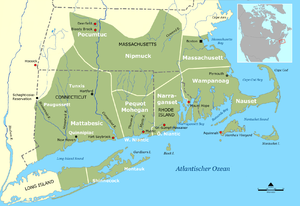 Theater of War King Philip | |||
| date | June 1675 - August 1676 | ||
| A place | New england | ||
| Total | The victory of the colonists | ||
| Opponents | |||
| |||
| Commanders | |||
| |||
| Forces of the parties | |||
| |||
| Losses | |||
| |||

Content
Prerequisites
The speed of resettlement of the British in the territory of modern New England caused discontent and opposition from the Indians and their leaders, who saw the aliens as a direct threat to their land holdings, freedom and traditional culture. Particular displeasure was caused by the attempts of immigrants - Puritans to conduct missionary activity among the Indian tribes. This activity of the Puritans led to the fact that the Indians who were baptized left their native tribes and the pastors settled them in special settlements, cities of prayer .
Under the leadership of the leader ( sachem ) of the Metacomet vampanoag tribe, who received the nickname King Philip from the British, an armed uprising of the Indians was secretly prepared for several years, the purpose of which was to destroy or permanently expel the British from the territories of the New England colonies. Since the strength of the vampanoag warriors alone was clearly insufficient - there were only about 1,000 men in the tribe, while the English population of southern New England was about 35 thousand people [1] , King Philip made an alliance with the Nipnuk , Pokumnuk and, later , narragansett . The maneuvers of the Indian leader did not go unnoticed for the British, moreover, the British had a network of informants among the Indians. In 1671, King Philip was called to the English settlement of Taunton , where he was charged with hostile acts. Metacomet was forced to sign a peace treaty with the British and promised to hand over the firearms available to his tribe (which he did not actually do, and preparations for the uprising continued).
The beginning of the war
In January 1675, the British found one of the baptized Indians who served them John Sassamon killed . In this case, three vampanoag warriors were captured, convicted and hanged. After the incident, King Philip convened a military council at his Mount Hope camp, at which most of the vampanoagas supported his call to attack the White settlements. Over time, the Pokamtuk, Massachusetts , Nipmuk, Narragansett tribes, Western and Eastern Abenaki , individual Mohicans and Mohawks joined the vampanoagam. The English colonies, as early as 1643, united into the Confederation of New England , which had a common military command and armed forces. In addition, the colonists received military assistance from England. Their allies were baptized Indians and the Mohegan tribe, led by the leader ( sachem ) Oneko, the son of the great leader .
First Period
The war began in late June 1675 after the assassination of one of the vampanoag warriors near the English settlement of Swansea . The Indians attacked the settlements of Swansea, Taunton, Tiverton and Dartmouth in southern Massachusetts . Each of the allied tribes sent thousands of soldiers to the Metacomet army; the tribes, formally observing neutrality, provided assistance to the rebel food and various supplies. Indians could acquire firearms in Canada from the French . Another source of replenishment of the army of rebels was deserters and defectors from among the baptized Indians.
In July 1675, an English detachment left Plymouth in the direction of Mount Hope (near present-day Bristol on Rhode Island ), ruining the vampanoag villages along the road. Warriors of King Philip and their families, fleeing from the British, were surrounded in the swamps. However, the Indians managed to smuggle their women and children, who were sheltered by the Narragansett Indians, under the nose of the enemy to the land. Then the soldiers themselves secretly for the enemy managed to get out of the encirclement and leave for central Massachusetts.
After these events, the war took on even more fierce character. Nipmuk tribes attacked Brookfield and Worcester , after which they teamed up with the Pokamtuk Indians and went on a campaign against the English settlements on the Connecticut River. After the Indians attacked the town of Northfield , to the south of it, the English detachment of Captain Baer was ambushed and defeated; at least half of the soldiers died. Since September 1675, the Indians have raided Deerfield and Hadley , forcing the colonists, abandoning all their property, to flee. In connection with the upcoming winter, a detachment of 80 soldiers was sent to Hadley under the command of Captain Thomas Lotrop, who was instructed to take out the grain harvested in the town. On the way back, at the Fornication Brooks (Blood Stream), an English unit was unexpectedly attacked by more than 700 Pokamtuk Indians. Another detachment of 60 soldiers and a group of allies, the Mohegans, was urgently thrown to help Lotropot, but he was late and found only seven miraculously survived. After the ravages of settlements in northern Connecticut, King Philip's detachments rushed south and attacked the towns of Hatfield, Springfield, Westfield, and Northampton . Despite the help of the Mohegans , the settlers were forced to retreat and take refuge in several fortified forts.
By this time, Metacomet assessed his position so strong that he moved his family from Rhode Island to a new winter apartment in Husik , on the border of Massachusetts and New York . Detachments of the tribes of the Western Abenaki and even some Mohicans and Mohawks joined the army of the Indians. The number of residents of Husik was constantly growing, and in the winter of 1675/76 amounted to more than 2 thousand people. The crowding of the population led to prolonged hunger and disease among the rebels.
In December 1675, the Narragansett tribe also entered the war on the side of King Philip, who had previously proclaimed neutrality, but secretly assisted the rebels and sheltered the women and children of the vampanaog people in their fortified settlement on the marshes of Rhode Island. Governor Winslow of Plymouth sent a detachment of 1,000 soldiers and 150 allied Mohegans against this Indian fort in the swamps. After the leader of the Narragansett Kanonchet refused to give out the rebels hiding from him, the British attacked the fort. As a result, the main settlement of narragansett was taken and burned. In this battle, 600 Indians and 20 leaders of the Narragansett Indians were killed. Part of the besieged, along with the Canonchet, nevertheless managed to escape in the swamps and join the forces of King Philip in Husik.
One of the goals of the Metacomet was to attract the Mohawk tribes to its side. However, in this he was resolutely opposed by the Governor of New York, Edmund Andros , who saw the catastrophe in the possible entry of the Iroquois tribes into the war. After several Mohawks died near mysterious rebel camp, the latter themselves forced King Philip to leave his headquarters in Husik. The Indian army moved to the Connecticut River Valley , to the border between Massachusetts and Vermont . In February 1676, she ravaged and burned many settlements in southern New England. Twice large English troops were again ambushed, and the Narragansett warriors, led by the leader Kanonchet, killed more than 130 enemy soldiers. Having learned about these victories, many Indians of various tribes went to Squaquit , where King Philip was then - however, he could not dispose of so many soldiers. First of all, there was not enough food, and in the spring the narragansetta again attacked the English settlements of Deerfield and Northfield, hoping to capture the stocks of maize cultivated by the colonists in them, but were repelled with heavy losses among the attackers. Then leader Kanchet went to his homeland, in Rhode Island, where he had significant food supplies. On the way back he was captured by the Mohegans, betrayed to the British and executed.
End of War
The death of Canonchet was a turning point in this war. King Philip with his army retreated to Mount Vachuset , where he organized a military camp. The British seized the initiative in hostilities, began to more successfully use the baptized Indians devoted to them. In May 1676, Captain William Turner captured the enemy camp at Turner Fall , destroying more than 400 Pokamtuk Indians along with their leader Sankumachu. In this camp, the British destroyed the weapons workshops and forges there, which supplied the rebels with weapons. Turner detachment lost 43 people as a result of the Indian attack. However, the losses among the Indians themselves as a result of both this and other operations of the British troops were so great that the union of Indian tribes formed by King Philip began to gradually disintegrate. Each tribe now cared primarily about its own survival. So, part of the Nipmuk and Pokamtuk Indians accepted the offer of the Mohicans of New York and came under their protection. Other rebels scattered north (among the Kovasuiks ) and further among the Missiko and Odanak tribes in Quebec . King Philip and his vampanoagi went to their homelands, to the southeast of Massachusetts. Throughout the summer, the remnants of Philip's troops pursued the English and allied Indian units under the command of Captain Benjamin Church. Metacomet was retreating to his old Mount Hope camp. On August 1, 1676, the British attacked the hometown of Metacomet, his wife and son were captured, but the leader himself managed to slip away. On August 5, the British occupied the village of the Pokasset Indians, in which the widow of the brother of Metacometh was hiding. When trying to escape from the enemies, she drowned, and the British chopped off the head of a corpse, then putting it in Taunton. On August 12, King Philip was surrounded by soldiers at Mount Hope and shot dead. The severed head of the leader stood on a pole for 25 years in Plymouth , and his body was quartered. According to some reports, the wife and son of King Philip were sold into slavery in the West Indies , according to others - they managed to escape from captivity.
Summary
The final peace between the colonists and the tribes was concluded only 2 years after the death of King Philip, but hostilities ceased almost immediately after it. During the war, both sides suffered huge losses. The vampanoag tribe was almost exterminated, only about 400 Indians from this people survived. Similar losses were suffered by the Narragansetta and Nipmuk tribes. The people of Pokamtuk actually ceased to exist. The British lost more than 600 colonists; every fifth male settler who was fit for military service perished. 90 English settlements during the war were attacked, 13 were completely destroyed. If before the war the number of Indians in southern New England was 15 thousand people, then by 1680 this number was reduced to 4 thousand. At the same time, most British soldiers sent from England to help the settlers did not want to return from the colonies to the homeland after the war. The war of King Philip as a whole strengthened the position of the colonists in New England.
See also
- Pecot war
- Mary Rowlandson - author of memoirs about her abduction by the Indians during this war
- Whitamu - the wife of King Philip's brother and one of the active participants in the conflict
Links
Notes
- ↑ Forgotten predecessors of Little Bighorn // Ketsalk-western.ru