The Battle of Nefels is the battle of the first Swiss-Austrian war, which occurred on April 9, 1388, near the town of Nefels of the canton of Glarus , during which the Swiss militia inflicted a heavy defeat on the Austrian knightly army.
| Battle of Nefels | |||
|---|---|---|---|
| Main conflict: the wars of independence of Switzerland | |||
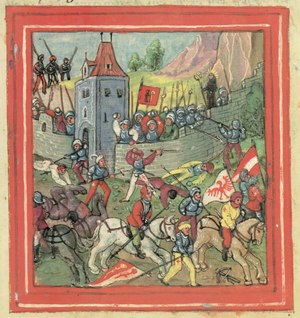 Miniature "The Battle of the Nefels", " Lucerne Chronicle » Dibolda Schilling the Younger , 1513 | |||
| date | April 9, 1388 | ||
| A place | Nefels , Switzerland | ||
| Total | Swiss victory | ||
| Opponents | |||
| |||
| Commanders | |||
| |||
| Forces of the parties | |||
| |||
| Losses | |||
| |||


Prerequisites
Against the growing power of Austria in 1385, a peace treaty was concluded between some of the Allied lands of Switzerland ( Bern , Zurich , Lucerne , Zug ) and the cities of Swabia ( Basel , Solothurn ) at the Sejm in Constance . However, when Austria went on the offensive, the Swiss were left without help.
In 1386, the battle of Sempach took place , in which the militia of the Swiss Confederation defeated the knightly army of Leopold III of Hapsburg . The defeat at Sempach was another step towards the recognition by Habsburg of the de facto independence of the Swiss Confederation [1] </ ref>.
A few weeks after the battle of Sempach, confederation forces attacked and besieged the village of Habsburg Wesen , on Lake Valenstadt [2] . The following year, the troops of Glarus destroyed the fortress of Windegg ( German Windegg ). Then, on March 11, 1387 , the city council declared Glarus independent of the control of the Hapsburgs.
In response to this, on the night of February 21-22, 1388 , the Austrian army attacked Weesen and knocked out confederation forces from there. In early April, two units of the Austrian army moved to Glarus, cut off from the main forces of the confederation. At the head of the first, numbering about 5,000 soldiers, were Count Donat von Toggenburg ( him. Donat von Toggenburg ) and knight Peter von Torberg ( him. Peter von Thorberg ). The second compound (about 1500 people) under the command of Count Hans von Werdenberg-Sargans ( German: Hans von Werdenberg-Sargans ) moved through the Alpine Pass .
Battle Course
On April 9, 1388, the army of Toggenburg and Torberg attacked and captured the fortifications around Nephels , whose garrison successfully defended for some time, but was forced to retreat before the superior forces of the enemy. On the side of the Swiss were only the local garrison of Glarus (about 400 people) and detachments of several dozen soldiers from the German areas of Uri and Schwyz [3] . The Swiss retreated to the nearby hills (height Rauchberg). Rolling up large stones, they upset the Austrian marches [3] . Seeing the resistance, the Austrian soldiers for the most part began to plunder and destroy the nearby villages and farms, from which the army dispersed.
By evening, the snowfall began and the fog fell. Taking advantage of the weather, the Swiss attacked the marauding Austrians. After a short battle, the scattered Austrians fled towards Vezen. An unorganized retreat led to the collapse of the Maag Bridge ( Maag or Lint) , with the result that a large part of the Austrians found themselves in the water, where many were drowned.
Seeing the flight of the main forces, the Werdenberg-Zargans compound retreated to the village of Beglingen ( English Beglingen , now belongs to the Mollis municipality).
As a result of the battle in the army of Glarus and the confederation, there were about 54 dead, who were buried in the parish church of Mollis . The losses of the Habsburg army are not so well known, and vary from a few hundred [4] to 1700 [5] dead (sometimes even 80 knights and 2,200 soldiers [3] ).
It is known that Brother Bilgeri von Wagenberg ( Bilgeri von Wagenberg ), Ryu , was killed in the Battle of Nephels, as a result of which he petitioned the city council of Glarus with a request to bury the dead on Austrian soil. He achieved his goal only 20 months after the battle, and on November 29, 1389, 20 (or 180) bodies of the Austrians who were killed at Nefels were reburied in the choir of the in Ryuty [6] .
Implications
The battle of Nefels is considered the last battle of the Swiss-Austrian conflict, which lasted for most of the fourteenth century . In 1394, a peace agreement was signed, according to which the Austrian duke Albrecht III recognized the de facto independence of the Swiss cantons from Austria [7] .
Memorial Day
Every year, on the first Thursday of April, residents of the canton of Glarus celebrate their victory in the Battle of Néfels, this day is the official holiday of the canton. In memory of this event, residents go to the battlefield with a solemn procession consisting of musicians, drummers, soldiers, representatives of the Catholic and Protestant churches. The procession stops several times in order to perform various ceremonies, one of which solemnly reads the names of the soldiers who died in this battle [8] .
See also
- Battle of Sempach
- Battle of Fegelinzek
Notes
- ↑ Harbottl, 1993 , Sempach The war for the independence of Switzerland.
- ↑ Collenberg A. The History of Vezen (Fr.) . Lexicon Istoric Retic .. Circulation date 15 March 2010. Archived April 20, 2012.
- ↑ 1 2 3 Harbottle, 1993 , Naefels I The Swiss-Austrian War.
- ↑ Historisches Lexikon .
- ↑ McCracken W. The Swiss of the Swiss republic: a history (English) . - Geneva: Georg & Cie Libraires, 1901. - P. 179 .
- ↑ 3. Bericht (German) // Zürcher Denkmalpflege. - 1962. - H. 3 . - S. 76 .
- ↑ Holy Roman Empire in the second half of the XIV century . World history . The appeal date is May 5, 2019. Archived April 20, 2012.
- ↑ Memorial Day Battle of Nephels, Canton Glarus (Inaccessible link) . swissworld.org. The appeal date is March 15, 2010. Archived April 20, 2012.
Literature
- Harbotl T. Battle of World History = Dictionary of battles, Thomas Harbottle (rus.) / Revised and updated by D. Bruce; translation, editing, changes and additions - under the direction. Medvedeva N. .. - M .: Vneshigma, 1993. - 575 p. - ISBN 5-86290-195-7 .
Links
- Battle of Näfels (Näfels, Schlacht bei) (him) . Historisches Lexikon der Schweiz (06/22/2009). - also French and Italian . The appeal date is May 5, 2019. Archived April 20, 2012.